
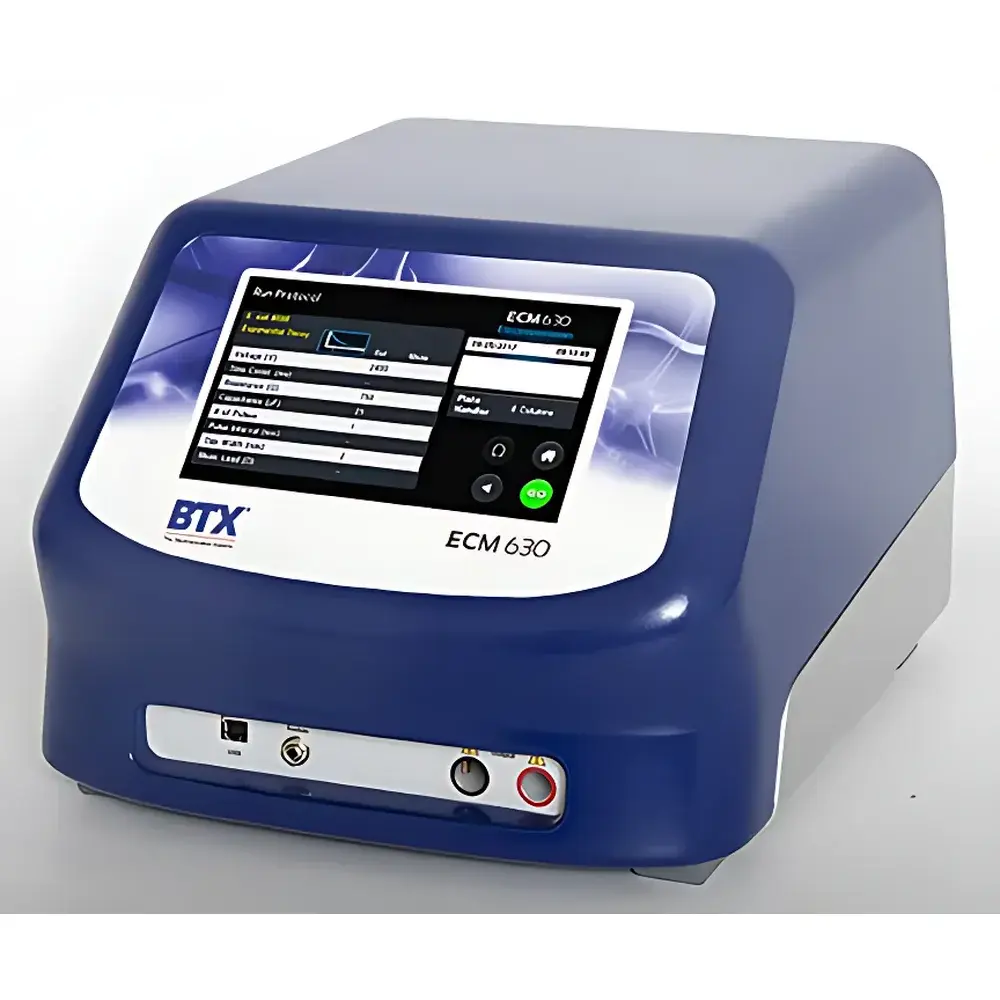
BTX ECM630 Electroporator
| Brand | BTX |
|---|---|
| Origin | USA |
| Model | ECM 630 |
| High-Voltage Range | 505–3000 V |
| Low-Voltage Range | 5–500 V |
| Capacitance Range | 25–3275 µF |
| Resistance Range | 25–1575 Ω |
| Pulse Form | Exponential Decay |
| Pulse Duration | 133 ms–5 s |
| Voltage Resolution (LV) | 1 V |
| Voltage Resolution (HV) | 5 V |
| Capacitance Resolution (LV) | 25 µF |
| Resistance Resolution | 25 Ω |
| Max Time Constant | 5 s @ 500 V or 133 ms @ 3000 V |
| Programmable Protocols | >1,000 stored |
| Display | 7-inch color touchscreen |
| Charging Time (LV) | <7 s |
| Charging Time (HV) | <4 s |
| Arc Suppression | Yes |
| Short-Circuit Protection | Yes |
| Pre-Pulse Resistance Measurement | Yes |
| Current-Limiting Pulse Termination | Yes |
Overview
The BTX ECM630 Electroporator is a precision-engineered exponential decay waveform electroporation system designed for reproducible and scalable nucleic acid delivery, cell fusion, and in vivo gene transfer. Developed by BTX (a Harvard Bioscience company), the ECM630 operates on the fundamental principle of transient membrane permeabilization via controlled electric field application—enabling efficient uptake of plasmid DNA, siRNA, CRISPR ribonucleoproteins, and other macromolecules into prokaryotic and eukaryotic cells. Its dual-range architecture supports both low-voltage (LV) and high-voltage (HV) protocols, accommodating diverse biological systems—from bacterial transformation and yeast electroporation to primary mammalian cell transfection and ex vivo tissue electroporation. The system’s RC-based pulse generation ensures precise control over field strength (V/cm) and pulse duration (τ = R × C), critical parameters governing electroporation efficiency and cell viability.
Key Features
- Dual-mode operation with independent LV (5–500 V) and HV (505–3000 V) ranges, each optimized for distinct biological targets and electrode configurations.
- High-resolution parameter control: 1 V voltage resolution in LV mode; 5 V in HV mode; 25 µF capacitance steps; 25 Ω resistance increments—enabling fine-tuned optimization of time constant (τ) across applications.
- 7-inch full-color capacitive touchscreen interface with intuitive navigation, real-time waveform preview, and on-screen display of peak voltage, measured resistance, and calculated τ.
- Robust safety architecture including pre-pulse impedance measurement, arc suppression circuitry, short-circuit detection, and current-limiting pulse termination to protect both sample integrity and instrument longevity.
- Integrated programmability supporting storage of >1,000 user-defined protocols—including voltage, resistance, capacitance, pulse count, and inter-pulse delay—with password-protected access and timestamped audit logging.
- Fast charging performance: <7 seconds in LV mode and <4 seconds in HV mode—minimizing workflow interruption during high-throughput experiments.
Sample Compatibility & Compliance
The ECM630 is validated for use with standard electroporation cuvettes (0.1–4 mm gap), Petri dish electrodes (35 mm), sandwich-style flat electrodes, and high-throughput MOS platforms (25- and 96-well formats). It supports Gram-negative and Gram-positive bacteria (e.g., E. coli, Bacillus), yeast (S. cerevisiae, P. pastoris), plant protoplasts, insect cells (Sf9, S2), and adherent and suspension mammalian lines (HEK293, CHO, Jurkat, primary T cells). The system complies with IEC 61010-1:2012 for laboratory electrical equipment safety and meets electromagnetic compatibility (EMC) requirements per EN 61326-1. While not FDA-cleared as a medical device, its design supports GLP-compliant documentation workflows and aligns with ISO/IEC 17025 traceability principles for method validation in regulated research environments.
Software & Data Management
The ECM630 operates as a standalone instrument with no external PC dependency. All protocol data—including operator ID, date/time stamp, applied parameters, measured resistance, and pulse confirmation—are retained in non-volatile memory. Audit trails are exportable via USB to CSV format for integration into LIMS or electronic lab notebooks (ELN). Optional connectivity to the BTX Enhance3000 monitoring system enables real-time impedance tracking and post-pulse conductivity analysis—supporting USP & ASTM-recommended process analytical technology (PAT) approaches for transfection process characterization. Firmware updates are performed locally via USB, ensuring version control and compliance with internal IT security policies.
Applications
- Bacterial and yeast transformation using chemically competent or electrocompetent cells.
- Transient and stable transfection of difficult-to-transfect mammalian cells—including primary neurons, dendritic cells, and hematopoietic stem cells.
- In vivo electroporation for preclinical gene therapy studies (e.g., muscle, skin, tumor, and ocular delivery).
- Electrofusion of somatic cells for hybridoma generation and synthetic biology chassis development.
- CRISPR-Cas9 RNP delivery for high-fidelity genome editing with reduced off-target effects.
- High-throughput screening using MOS-compatible multiwell plates under standardized field conditions.
FAQ
What types of waveforms does the ECM630 generate?
The ECM630 exclusively generates exponential decay pulses—optimized for consistent energy delivery and minimal thermal stress across diverse cell types.
Can the ECM630 be used with custom electrodes or third-party cuvettes?
Yes—provided the electrode geometry and impedance fall within the specified resistance range (25–1575 Ω) and the cuvette gap width is compatible with the selected voltage and capacitance settings.
Is the ECM630 compliant with 21 CFR Part 11 for electronic records?
While the device itself does not include built-in electronic signature functionality, its audit trail export capability supports manual implementation of Part 11 controls when integrated into validated laboratory information management systems.
How is pulse consistency verified during routine operation?
The system performs automatic pre-pulse resistance measurement and displays real-time peak voltage and calculated τ—allowing users to confirm parameter fidelity before initiating electroporation.
Does the ECM630 support multiple pulse protocols per experiment?
Yes—users may define up to two sequential pulse programs (e.g., priming + delivery) within a single run, with configurable inter-pulse delays.





