
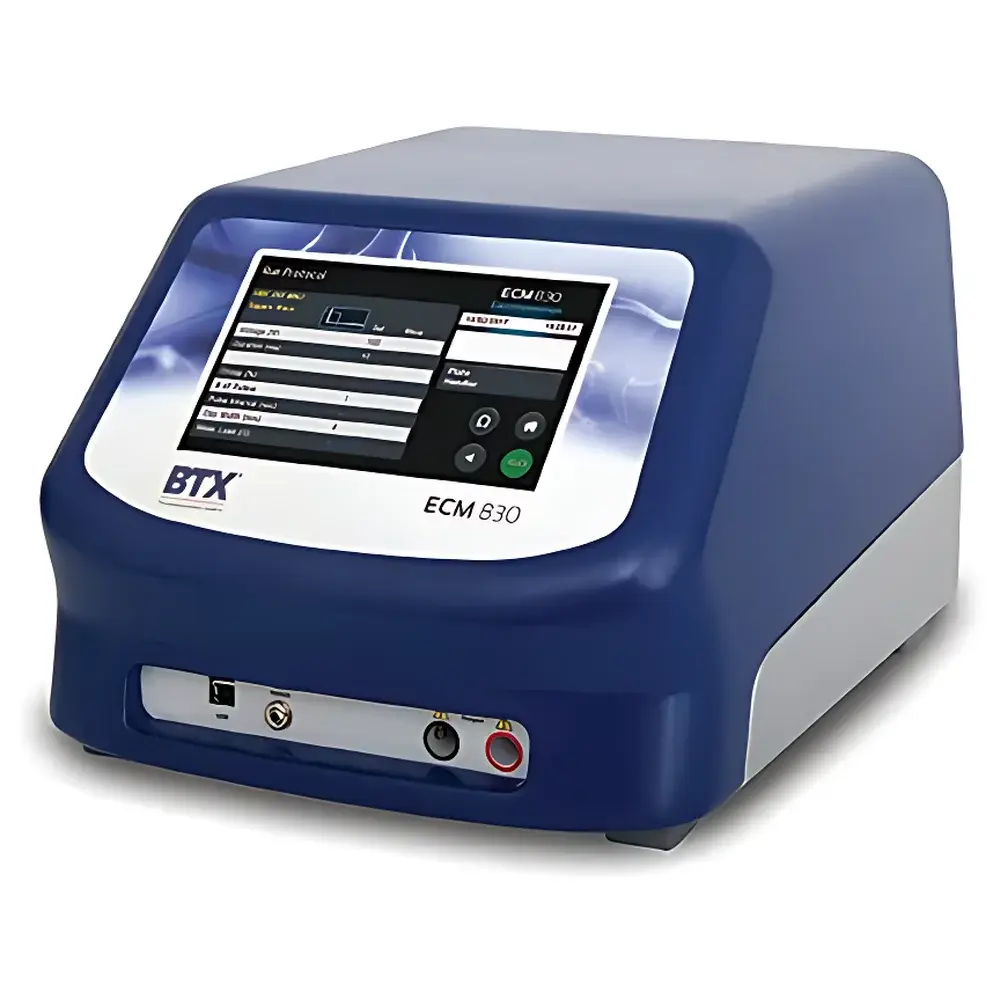
BTX ECM830 Square-Wave Electroporator
| Brand | BTX |
|---|---|
| Origin | USA |
| Model | ECM 830 |
| High-Voltage Range | 505–3000 V |
| Low-Voltage Range | 5–500 V |
| Pulse Form | Square Wave |
| Capacitance | 3,775 µF (LV), 85 µF (HV) |
| Number of Pulses | 1–99 (or up to 120 in high-throughput mode) |
| Pulse Duration | 10 µs–10 s (LV: 10 µs–999 ms |
| HV | 10–600 µs) |
| Discharge Time | LV <7 s, HV <4 s |
| Resistance Check | Yes |
| Arc Suppression | Yes |
| Short-Circuit Protection | Yes |
| Display | 7-inch color touchscreen |
| Programmable Protocols | >1,000 stored methods |
| Compliance | Designed for GLP/GMP-aligned workflows |
Overview
The BTX ECM 830 Square-Wave Electroporator is a precision-engineered, dual-range electroporation system developed by BTX, a pioneer in electroporation technology since 1983 and a division of Harvard Bioscience. Designed for both in vitro and in vivo applications, the ECM 830 delivers controlled, reproducible square-wave pulses optimized for high-efficiency nucleic acid, protein, or small-molecule delivery into diverse cell types—including mammalian cells, primary isolates, plant protoplasts, bacteria, yeast, oocytes, embryos, and tissue explants. Its core architecture leverages constant-voltage square-wave delivery, which minimizes thermal stress and electrochemical damage compared to exponential decay waveforms—thereby significantly improving post-pulse cell viability without compromising transfection or transformation efficiency. The system operates across two independent voltage domains (low-voltage: 5–500 V; high-voltage: 505–3000 V), each with dedicated capacitance banks (3,775 µF for LV; 85 µF for HV), enabling precise adaptation to cell membrane capacitance, size, and resistivity.
Key Features
- Dual-Range Square-Wave Architecture: Independent LV and HV circuits allow optimal pulse configuration for fragile primary cells (e.g., neurons, hematopoietic stem cells) and robust targets (e.g., bacterial cells, plant protoplasts).
- High-Resolution Parameter Control: Voltage resolution of 1 V (LV) and 5 V (HV); pulse duration resolution down to 1 µs (LV/HV); programmable pulse intervals from 100 ms to 10 s.
- Real-Time Monitoring & Feedback: 7-inch color touchscreen interface displays real-time peak voltage, actual pulse duration, number of delivered pulses, inter-pulse interval, and measured sample resistance prior to discharge.
- Integrated Safety Protocols: Automatic pre-pulse resistance verification prevents arcing; arc suppression circuitry limits energy dissipation during dielectric breakdown; over-current detection terminates pulse trains upon short-circuit detection.
- Protocol Scalability: Supports single-pulse, multi-pulse (1–99 per sample), and high-throughput modes (up to 120 pulses via 10-pulse bursts across 12 samples using compatible multi-well electrodes).
- Robust Electrical Design: Solid-state switching, low-inductance bus architecture, and temperature-stabilized capacitor banks ensure pulse fidelity and long-term repeatability across thousands of cycles.
Sample Compatibility & Compliance
The ECM 830 is validated for use with BTX’s full ecosystem of electroporation accessories—including cuvette-based electrodes (0.1–4 mm gap), needle-type in vivo applicators (e.g., BTX Tweezers, Caliper Electrodes), multi-well plate systems (MOS series), and embryo-handling tools. It accommodates suspension cultures, adherent monolayers (via lift-and-electroporate protocols), ex vivo tissue slices, and intramuscular or intratumoral in vivo delivery. All operational parameters—including voltage, capacitance, pulse count, and timing—are fully traceable and timestamped, supporting documentation requirements under ISO/IEC 17025, FDA 21 CFR Part 11 (when used with validated software and electronic signature controls), and GLP-compliant laboratory practices. Resistance auditing at startup ensures consistent electrical coupling—critical for reproducibility in regulated QC/QA environments.
Software & Data Management
While the ECM 830 operates as a standalone instrument with embedded firmware, it integrates seamlessly with BTX’s optional VIP 3000 Monitoring System for waveform capture, impedance profiling, and comparative pulse analysis. Protocol libraries (>1,000 user-defined methods) are stored internally with metadata (date/time, operator ID, electrode type). Exportable logs (CSV format) include pre-pulse resistance, delivered voltage, measured pulse width, and system status flags—enabling retrospective analysis and audit trail generation. When deployed in GxP-regulated labs, the system supports integration with LIMS platforms via RS-232 or USB-serial emulation for automated data ingestion and electronic record retention.
Applications
- Transient and stable transfection of hard-to-transfect mammalian cell lines (e.g., CHO, HEK293, iPSCs)
- In vivo gene delivery for preclinical oncology (intratumoral plasmid DNA or siRNA), dermatology (skin electroporation), and neurobiology (intracranial or intraspinal injection + electroporation)
- Bacterial and yeast transformation (including electrocompetent preparation and recovery optimization)
- Plant protoplast transfection and somatic hybridization
- Nuclear transfer and embryonic manipulation (e.g., CRISPR-Cas9 RNP delivery into zygotes)
- Protein and antibody electrophoretic delivery for functional studies or intracellular targeting
FAQ
What distinguishes square-wave electroporation from exponential decay systems?
Square-wave delivery maintains constant voltage throughout the pulse duration, enabling precise control over electric field strength and exposure time—critical for minimizing Joule heating and maximizing membrane resealing kinetics.
Can the ECM 830 be used for in vivo applications?
Yes. It is routinely employed with BTX’s sterile needle electrodes for intramuscular, intradermal, intratumoral, and intraorgan delivery in rodent and large-animal models.
Is resistance measurement performed automatically before each pulse?
Yes. The system conducts a non-destructive impedance check immediately prior to pulse initiation and aborts if resistance falls outside user-defined thresholds.
How many protocols can be saved internally?
Over 1,000 protocols may be stored with full parameter sets, including voltage, capacitance, pulse count, duration, and inter-pulse interval.
Does the ECM 830 comply with electromagnetic compatibility (EMC) standards?
It meets IEC 61326-1:2013 for laboratory equipment emissions and immunity, ensuring reliable operation in shared instrumentation environments.
Related Products





