
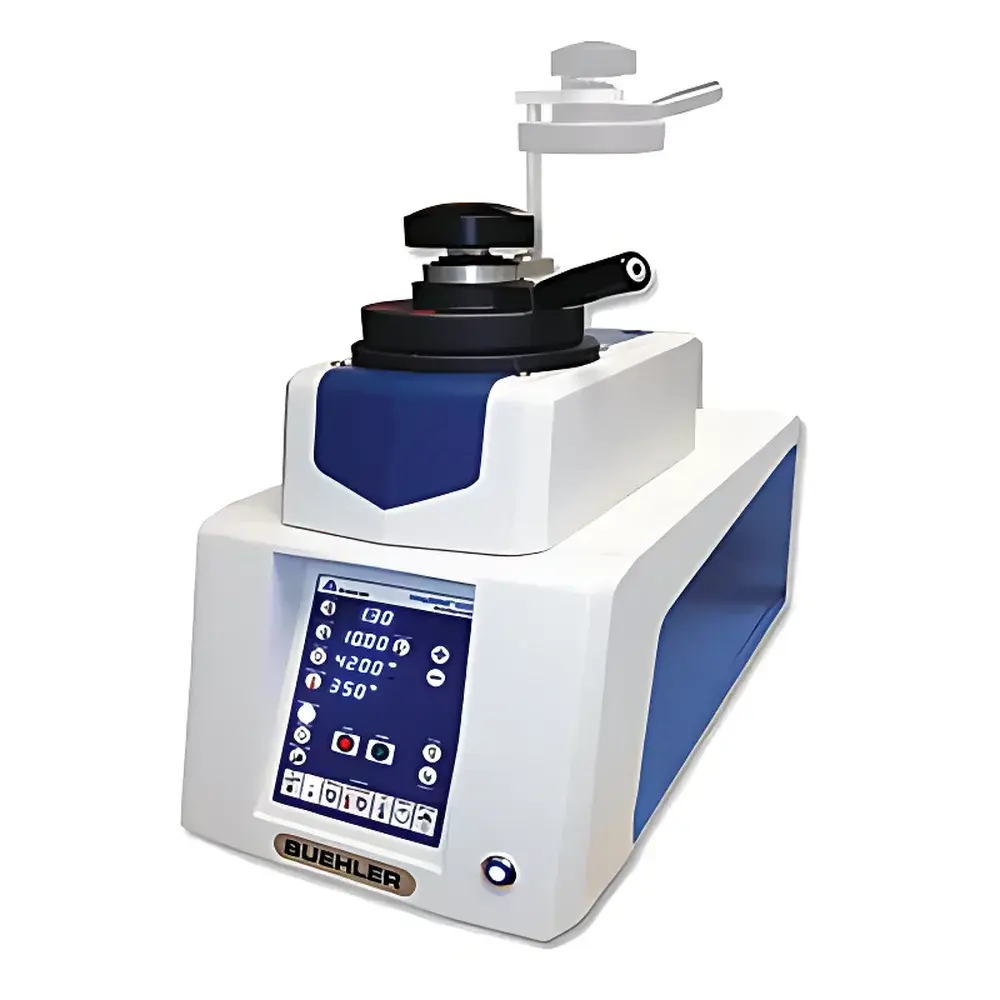
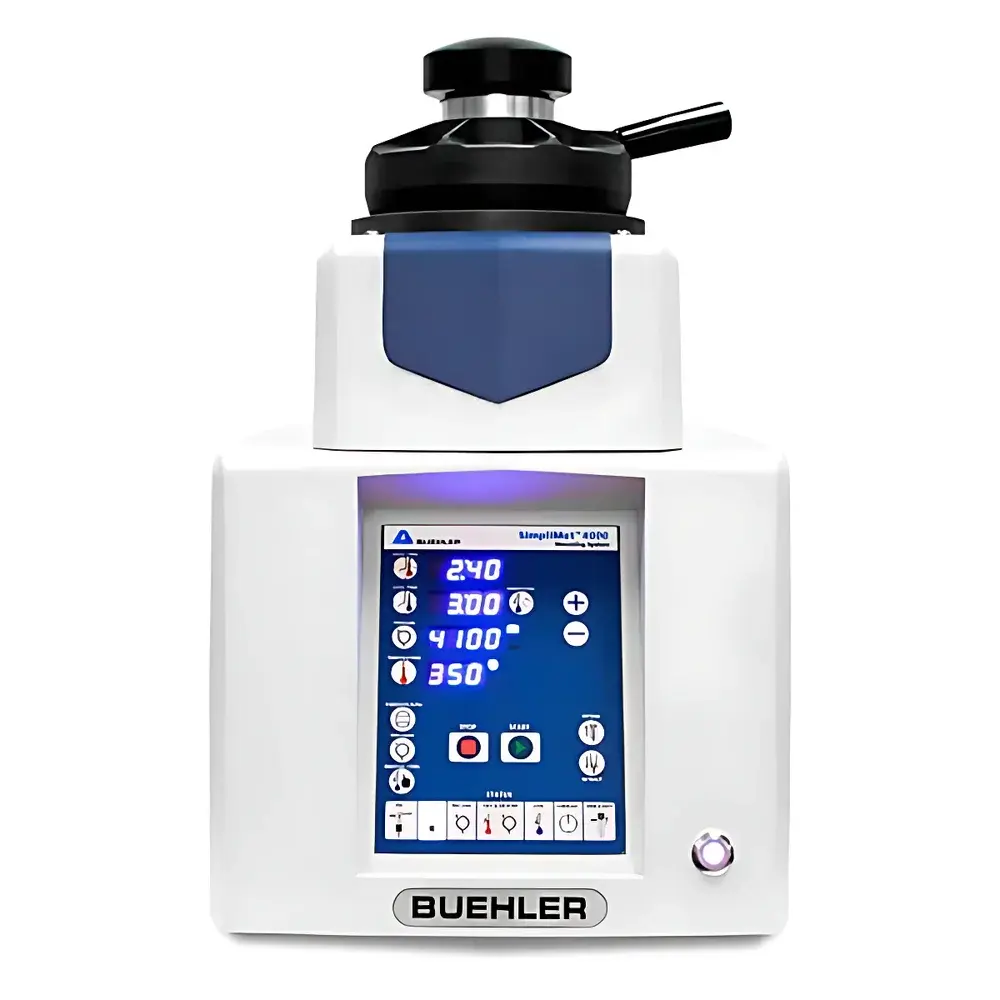
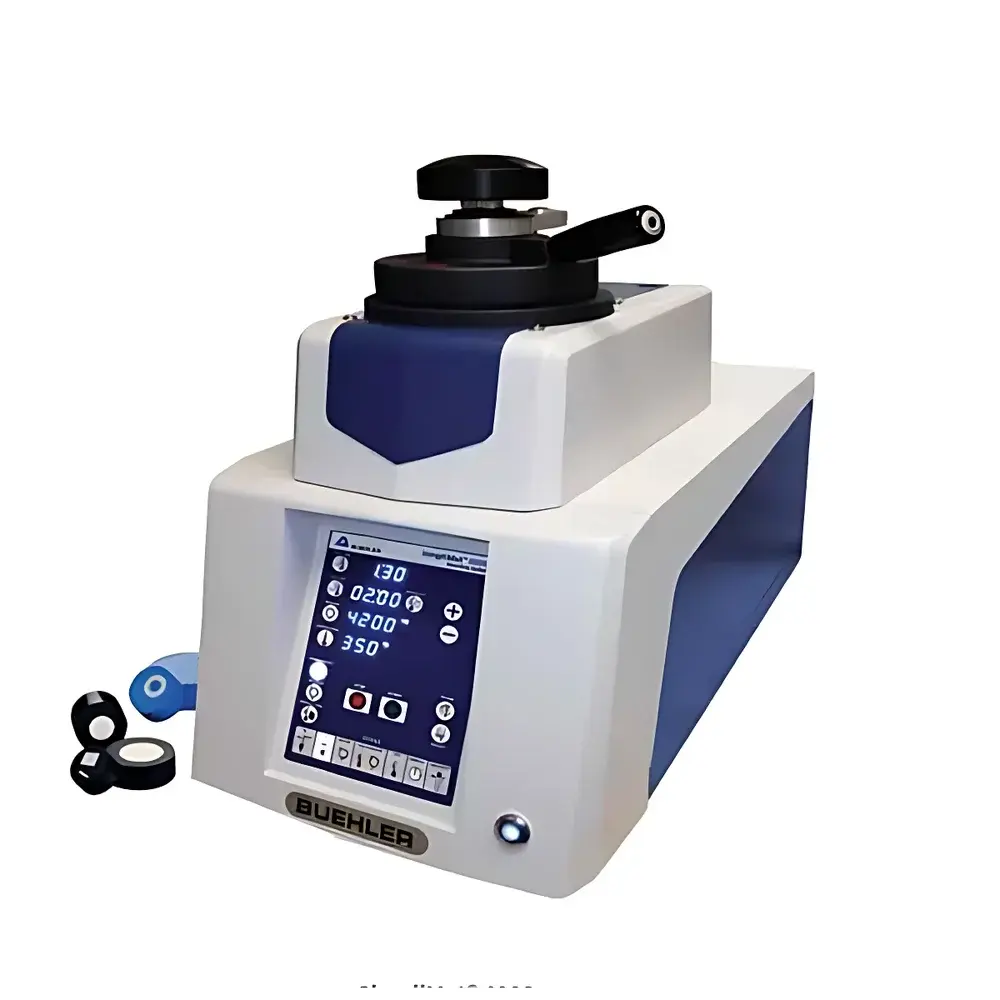
Buehler SimpliMet 4000 Hot Mounting Press
| Brand | Buehler |
|---|---|
| Origin | USA |
| Model | SimpliMet 4000 |
| Type | Hot Mounting Press |
| Dimensions | 12.25" W × 18.5" D × 16.5" H (311 mm × 470 mm × 419 mm) |
| Power Supply | 120 V / 240 V, 50/60 Hz |
| Heating Range | Ambient to 200 °C |
| Pressure Range | 0–12,000 lbf (0–53.4 kN) |
| Cooling Method | Smart Cool™ Intelligent Water-Cooled System |
| Compliance | CE, UL Listed |
| Software Interface | Standalone front-panel control with LED status bar and digital timer |
Overview
The Buehler SimpliMet 4000 Hot Mounting Press is an engineered solution for high-throughput metallographic sample preparation in industrial quality control laboratories, failure analysis centers, and academic research facilities. It operates on the principle of thermosetting resin compression molding—applying controlled heat, pressure, and dwell time to encapsulate metallic, ceramic, or composite specimens within phenolic, epoxy, or acrylic resins. Designed for continuous operation under demanding production schedules, the SimpliMet 4000 replicates the thermal-mechanical conditions of high-volume metallurgical labs worldwide. Its robust cast-aluminum frame, precision-machined platens, and sealed hydraulic actuation system ensure long-term dimensional stability and force repeatability—critical for maintaining consistent mount geometry, edge retention, and void-free encapsulation across thousands of cycles.
Key Features
- Smart Cool™ Intelligent Cooling System: Dynamically terminates water cooling once the mold temperature drops below a user-defined safety threshold (typically ≤60 °C), eliminating overcooling delays and reducing average cycle time by up to 35% compared to fixed-timer systems.
- Low-Thermal-Mass Mold Assembly: Optimized aluminum mold design minimizes heat capacity while maximizing heat transfer efficiency; combined with pre-drain functionality that evacuates residual coolant from internal channels prior to heating, enabling rapid ramp-up to target temperature (e.g., 180 °C in <90 seconds).
- Front-Panel-Only Operation: Fully integrated control interface with tactile push-button inputs, dual-line LED display, real-time digital timer, and color-coded status indicators—no touchscreen, no software navigation, no firmware updates required.
- Compact Footprint: 311 mm width accommodates standard lab bench layouts; allows side-by-side placement with grinders, polishers, or storage cabinets without compromising workflow ergonomics.
- Preventive Maintenance Architecture: Self-diagnostic routines monitor platen parallelism, pressure transducer calibration drift, and thermal sensor response time; generates maintenance alerts before performance degradation occurs.
Sample Compatibility & Compliance
The SimpliMet 4000 accepts standard 25.4 mm, 30 mm, and 35 mm diameter mounting molds—including multi-cavity configurations—and supports both single- and dual-specimen inserts. It is validated for use with all major thermosetting resins (e.g., Buehler EpoxiCure 2, PhenolSet, AcrylSet) and compatible with conductive resins for SEM-compatible mounting. The system meets CE marking requirements per Directive 2006/42/EC (Machinery Directive) and UL 61010-1 (Safety Requirements for Electrical Equipment for Measurement, Control, and Laboratory Use). Its mechanical design facilitates full traceability under GLP and ISO/IEC 17025 environments, supporting audit-ready documentation through external data logging interfaces (RS-232 optional).
Software & Data Management
As a standalone hardware platform, the SimpliMet 4000 does not rely on PC-based software for routine operation. All process parameters—including temperature setpoint, pressure profile, hold time, and cooling termination threshold—are stored in non-volatile memory and recalled via numbered presets. Optional RS-232 connectivity enables integration with laboratory information management systems (LIMS) for automated cycle logging, timestamped parameter archiving, and electronic batch records compliant with FDA 21 CFR Part 11 when paired with validated third-party software. Audit trails capture operator ID (via external badge reader), start/stop timestamps, deviations from nominal settings, and system fault codes.
Applications
This press serves core applications in metallurgical QA/QC workflows—including incoming material verification, weld integrity assessment, coating thickness evaluation, and fatigue fracture surface analysis. It is routinely deployed in aerospace component certification (per AMS 2300, ASTM E3), automotive casting inspection (ISO 4527), and electronics packaging reliability testing (JEDEC JESD22-A108). Its reproducible mounting consistency supports quantitative image analysis (QIA) pipelines requiring sub-5 µm edge definition and minimal resin shrinkage—enabling accurate grain size measurement (ASTM E112), inclusion rating (ASTM E45), and porosity quantification (ISO 9276-2).
FAQ
What resin types are compatible with the SimpliMet 4000?
Phenolic, epoxy, and acrylic thermosetting resins—including fast-cure and low-viscosity formulations—are fully supported. Conductive carbon-loaded epoxies may be used with adjusted cure profiles.
Does the system support programmable multi-step pressure profiles?
No. The SimpliMet 4000 applies a single, user-defined pressure throughout the entire compression cycle—optimized for standard hot-mounting protocols per ASTM E3 and ISO 16012.
Can cooling water temperature be monitored in real time?
The Smart Cool™ system regulates based on mold temperature only; inlet water temperature monitoring requires an external thermocouple and data logger.
Is validation documentation available for GMP environments?
Yes—Buehler provides Installation Qualification (IQ) and Operational Qualification (OQ) templates aligned with ASTM E2500 and EU Annex 15 guidelines, including test protocols for platen parallelism, temperature uniformity mapping, and pressure accuracy verification.
What is the expected service life under continuous operation?
With scheduled maintenance every 6 months (seal replacement, hydraulic fluid exchange, sensor recalibration), the unit demonstrates >10 years of operational readiness at ≥200 cycles/day in certified ISO 13485 manufacturing labs.



