
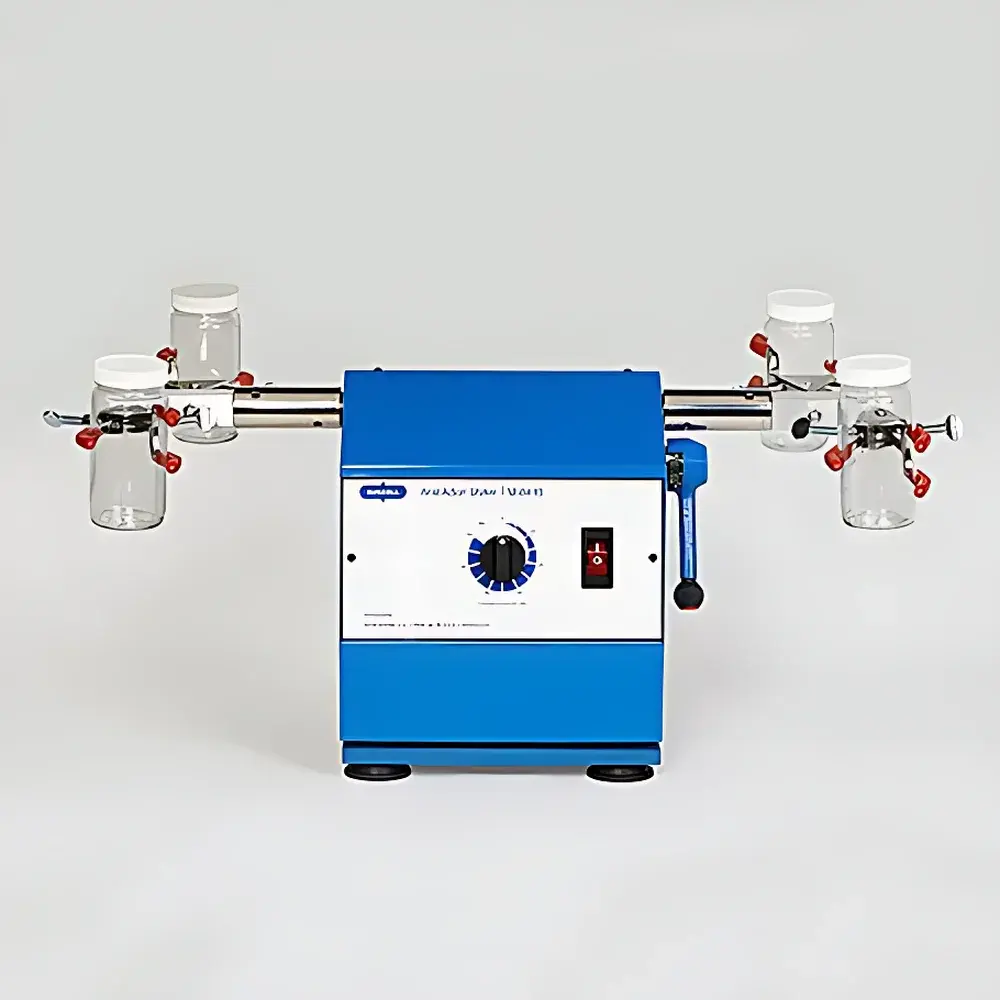
Burrell Wrist-Action Shaker Model 200/250 Series
| Origin | USA |
|---|---|
| Manufacturer Type | Authorized Distributor |
| Origin Category | Imported |
| Model | Burrell Wrist-Action Shaker |
| Pricing | USD 1,400 (FOB) |
| Instrument Type | Ambient-Temperature Orbital Shaker |
| Timer Range | 0–60 min or Continuous Mode |
| Oscillation Frequency | 385 oscillations/min (Fixed-Speed) |
| Oscillation Arc | 1°–15° |
| Temperature Control | Ambient Only |
| Platform Configurations | 4-, 8-, 12-, 16-, 20-, or 24-position arm rack or tray platform |
| Load Capacity | 4.5 kg |
| Power Supply | 220 V, 50 Hz |
| Construction | Anodized aluminum frame, stainless steel bearings |
| Safety | Thermal overload protection with manual reset button |
| Container Compatibility | 10–2000 mL (wide-mouth bottles, Erlenmeyer flasks, distillation flasks, side-arm flasks, test tubes, separatory funnels) |
Overview
The Burrell Wrist-Action Shaker—first engineered in 1940 and continuously refined for over eight decades—is a precision mechanical shaker designed to replicate the natural, low-shear wrist motion of manual mixing. Unlike orbital or reciprocating shakers, it employs a true wrist-action kinematic mechanism: a cam-driven eccentric linkage that produces a smooth, elliptical arc (1°–15°) at controlled frequencies (385 oscillations/min standard; 0–450 oscillations/min variable-speed models). This motion ensures homogeneous suspension of particulates, gentle resuspension of pelleted cells, and consistent gas–liquid interfacial contact without vortexing or foaming—critical for sensitive biological assays and physicochemical analyses. Its ambient-only operation makes it ideal for applications where temperature stability is secondary to mixing fidelity, including enzymatic reactions, platelet aggregation studies, polymer dissolution, and degassing of wine or beer matrices. The shaker’s robust architecture—featuring an anodized aluminum frame and stainless steel bearings—supports long-term reliability under continuous unattended operation, aligning with GLP-compliant laboratory workflows.
Key Features
- True wrist-action kinematics delivering repeatable, low-shear oscillation across full or partial load conditions—validated for >1 hr continuous operation with ≤±2% amplitude deviation.
- Thermal overload protection circuit integrated into motor housing; automatic shutdown upon thermal threshold breach, with front-panel reset button enabling rapid recovery without tool intervention.
- Modular platform system supporting interchangeable arm racks or tray platforms (4-, 8-, 12-, 16-, 20-, and 24-position configurations) to accommodate vessels from 10 mL test tubes to 2 L wide-mouth bottles.
- Fixed-speed (385 osc/min) and variable-speed (0–450 osc/min) models compliant with ASTM D1795 (pulp viscosity), USP (dissolution apparatus qualification), and ISO 8573-1 (compressed air contamination testing protocols requiring consistent agitation).
- Low-part-count mechanical design minimizing maintenance intervals; all wear components—including cam followers and pivot bushings—are field-replaceable using standard hex tools.
Sample Compatibility & Compliance
The shaker accommodates heterogeneous sample formats without adapter modification: conical flasks (50–1000 mL), side-arm flasks, separatory funnels (up to 2 L), culture tubes, and custom reaction vials. Its non-heated, ambient-only platform meets requirements for assays where thermal drift would compromise kinetic integrity—such as coagulation cascade analysis (CLSI H21-A5), red blood cell cryopreservation resuspension, and algal photobioreactor preconditioning. Device construction adheres to IEC 61010-1:2010 safety standards for laboratory equipment. Electrical certification includes CE marking and RoHS compliance. While not equipped with environmental monitoring sensors, its mechanical consistency supports audit-ready documentation per FDA 21 CFR Part 11 when paired with validated external data loggers.
Software & Data Management
As a purely electromechanical instrument, the Burrell Wrist-Action Shaker operates without embedded firmware or digital interfaces. Timing and speed control are implemented via analog potentiometers and electro-mechanical timers—ensuring immunity to electromagnetic interference and eliminating cybersecurity vulnerabilities associated with networked lab devices. For regulated environments, users integrate the shaker into electronic lab notebooks (ELNs) such as LabArchives or Benchling via manual entry or barcode-scanned protocol templates. Audit trails for operational parameters (duration, position count, vessel type) are maintained through SOP-controlled logbooks aligned with ISO/IEC 17025 clause 7.7 (control of records).
Applications
- Biopharmaceutical: Gentle resuspension of thawed PBMCs and platelet concentrates prior to flow cytometry; agitation during solid-phase peptide synthesis on Wang resin.
- Clinical Diagnostics: Standardized mixing of whole-blood samples for coagulation factor assays and hemolysis-free serum separation.
- Food & Beverage: Degassing of wine must prior to fermentation; homogenization of viscous honey or molasses for rheological profiling.
- Environmental Testing: Extraction of organochlorine pesticides from soil matrices using Soxhlet-compatible flasks; algal biomass harvesting in wastewater treatment R&D.
- Materials Science: Deaeration of UV-curable acrylic resins; dispersion of nanocellulose suspensions in coating formulations.
FAQ
Is the Burrell Wrist-Action Shaker suitable for GMP-regulated environments?
Yes—its mechanical simplicity, absence of software dependencies, and documented repeatability support qualification under Annex 15 and WHO TRS 986 Annex 4. IQ/OQ protocols are available upon request.
Can it be used with hazardous solvents?
The unit is rated for use in Class I, Division 2 locations per NEC Article 500; however, solvent compatibility depends on gasket material—standard units include Viton seals; optional PTFE-sealed variants are available for chlorinated or aromatic hydrocarbons.
What maintenance schedule is recommended?
Lubrication of camshaft bearings every 12 months using NLGI #2 lithium complex grease; visual inspection of arm rack mounting bolts prior to each shift.
Does it meet ISO 5725 accuracy criteria for inter-laboratory reproducibility?
When operated within specified load limits (≤4.5 kg, center-of-gravity within ±15 mm of platform center), intra-unit CV for oscillation amplitude remains ≤1.8% over 500 cycles—consistent with ISO 5725-2:2019 intermediate precision thresholds.
Are spare parts stocked internationally?
Yes—critical spares (cam assemblies, timing belts, arm rack inserts) are held in regional distribution centers across EU, APAC, and North America with 48-hr ground shipping.
Related Products




