
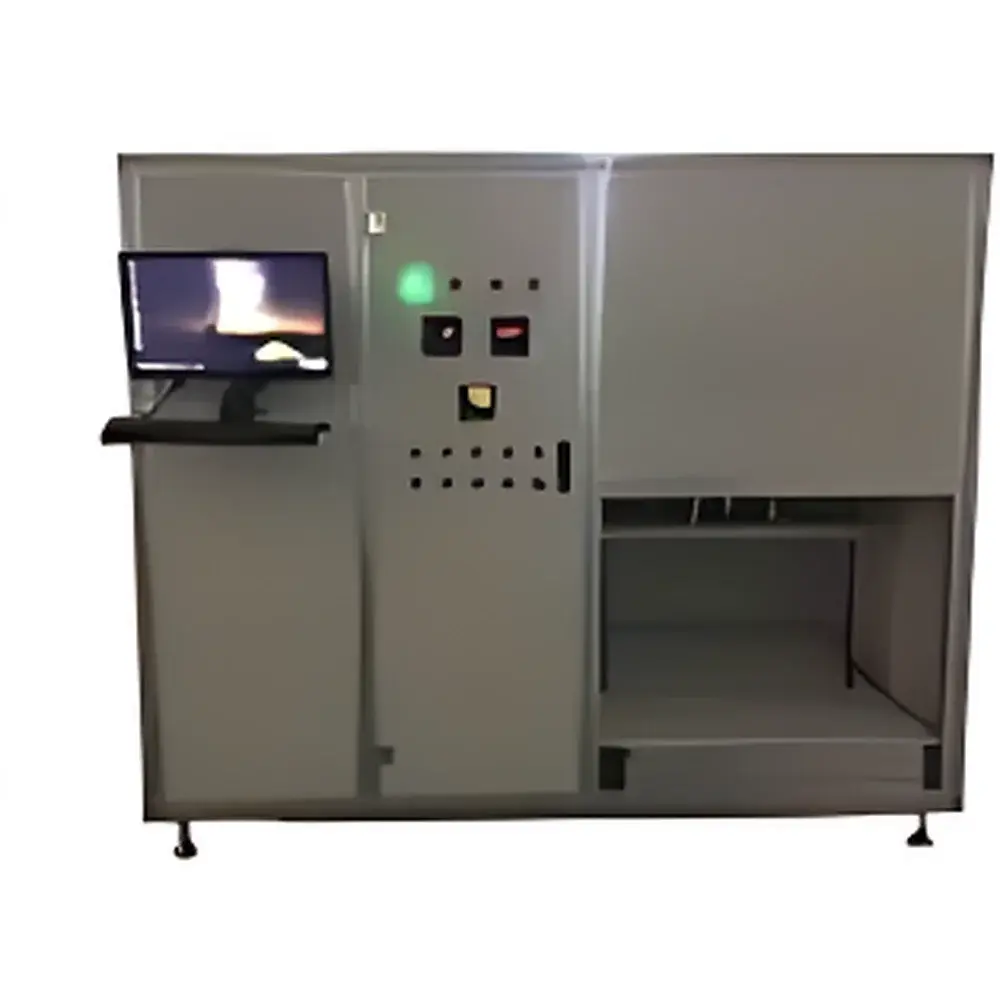
BuzzMac Buzz-1500NV High-Temperature Vacuum Resonant Elastic Modulus Tester
| Origin | USA |
|---|---|
| Manufacturer Type | Authorized Distributor |
| Origin Category | Imported |
| Model | Buzz-1500NV |
| Pricing | Upon Request |
Overview
The BuzzMac Buzz-1500NV is a precision resonant frequency-based elastic modulus tester engineered for non-destructive, high-temperature, and controlled-atmosphere mechanical property characterization. It operates on the fundamental principle of impulse excitation—where a sample is mechanically excited to induce free vibration, and its natural resonance frequencies are measured via non-contact laser Doppler vibrometry. These frequencies, combined with geometric dimensions, mass, and boundary condition data, are used to compute elastic constants—including Young’s modulus (E), shear modulus (G), bulk modulus (K), Poisson’s ratio (ν), and internal friction (damping coefficient Q⁻¹)—using standardized analytical models derived from Euler–Bernoulli beam theory and isotropic elasticity. Designed for operation under vacuum (down to 6.7 × 10⁻⁴ Pa) and programmable inert or reactive gas atmospheres (O₂, N₂, Ar), the system enables in-situ measurement of elastic behavior across temperatures up to 1600 °C, making it indispensable for advanced materials development in aerospace, nuclear, energy, and ceramic engineering.
Key Features
- Resonant frequency measurement accuracy better than ±0.1%—ensuring high reproducibility in modulus calculation
- Integrated high-temperature vacuum furnace with dual-layer air-cooled housing, 1800-grade MoSi₂ heating elements, and independent single-zone PID temperature control (±1.0 °C stability)
- Polytec OFV-5000 series laser Doppler vibrometer for non-contact, high-resolution vibration detection
- Computer-controlled electromagnetic excitation system with adjustable amplitude and pulse duration
- Multi-gas mixing and concentration monitoring module supporting O₂, N₂, Ar, and custom blends at ≤0.02 MPa regulated pressure
- Robust mechanical design accommodating sample geometries including rectangular bars, cylinders, discs, rings, tubes, and plates (max. Ø150 × 120 mm)
- Compliance with ASTM E1876, ASTM C1259, ASTM C1548, ASTM C215, EN 843-2, EN ISO 12680-1, and EN 14146 for dynamic elastic property determination
Sample Compatibility & Compliance
The Buzz-1500NV supports broad material classes: structural metals and superalloys, oxide and non-oxide ceramics, refractory cements, geological specimens (rocks, basalts), optical glasses, and composite matrices. Sample preparation requires only dimensional regularity—not surface polishing or electrode deposition—enabling rapid turnaround for R&D and QA/QC workflows. All measurements adhere to internationally recognized test standards governing dynamic elastic modulus determination by impulse excitation. The system architecture supports full audit trails, user-access logging, and parameter-locking functionality—aligning with GLP and GMP documentation requirements. Optional 21 CFR Part 11-compliant software modules are available for regulated pharmaceutical and biomedical device applications requiring electronic signature and data integrity controls.
Software & Data Management
Buzz-o-Sonic6™ is a proprietary Windows-native (XP through Win10) application developed over 37 years of iterative refinement. Its GUI provides real-time visualization of time-domain vibration decay and FFT-derived resonance spectra. Users may perform X/Y-axis zooming, region-of-interest selection, spectral peak tracking, and automatic multi-mode identification. Raw waveform data, resonance frequencies, temperature profiles, and calculated moduli are stored in structured binary archives with embedded metadata (operator ID, timestamp, calibration status). Export options include CSV, Excel, PDF reports, and image formats (PNG, SVG). The software implements built-in uncertainty propagation per ISO/IEC Guide 98-3 (GUM), calculates confidence intervals for each modulus output, and generates compliance-ready test certificates traceable to NIST-traceable reference standards.
Applications
- High-temperature creep-resistant alloy qualification for turbine blade development
- In-situ modulus evolution mapping during sintering of SiC/Si₃N₄ ceramics
- Thermal shock resistance assessment of refractory linings via modulus vs. temperature hysteresis
- Quality control of nuclear-grade graphite moderators under helium atmosphere
- Phase transition detection in shape-memory alloys via abrupt changes in ν and E
- Non-destructive evaluation of microcrack density in concrete repair materials using damping coefficient trends
- Validation of finite element models with experimentally derived anisotropic stiffness tensors
FAQ
What measurement principle does the Buzz-1500NV use?
It employs impulse excitation thermomechanical analysis (IETMA), measuring resonant frequencies of freely vibrating samples under controlled thermal and atmospheric conditions.
Can the system measure both Young’s modulus and Poisson’s ratio simultaneously?
Yes—by acquiring at least two orthogonal resonance modes (e.g., flexural and torsional), the software computes E, G, K, and ν using coupled eigenvalue solutions consistent with ASTM E1876 Annex A3.
Is vacuum compatibility required for all tests?
No—vacuum is optional; the furnace supports ambient air, inert gas purge, or reactive gas environments depending on material oxidation sensitivity.
Does the system require sample metallization or coupling agents?
No—laser vibrometry eliminates physical contact, enabling direct measurement of as-fired, as-cast, or as-polished specimens without surface modification.
How is temperature uniformity validated across the hot zone?
Calibration includes three-point thermocouple mapping (top/mid/bottom) per ASTM C1040, with axial uniformity maintained within ±2 °C over the 400-mm heated length.
What level of technical support is provided outside North America?
BuzzMac maintains certified service partners in Europe, Japan, South Korea, and China, offering remote diagnostics, on-site maintenance contracts, and ISO/IEC 17025-aligned calibration services.



