
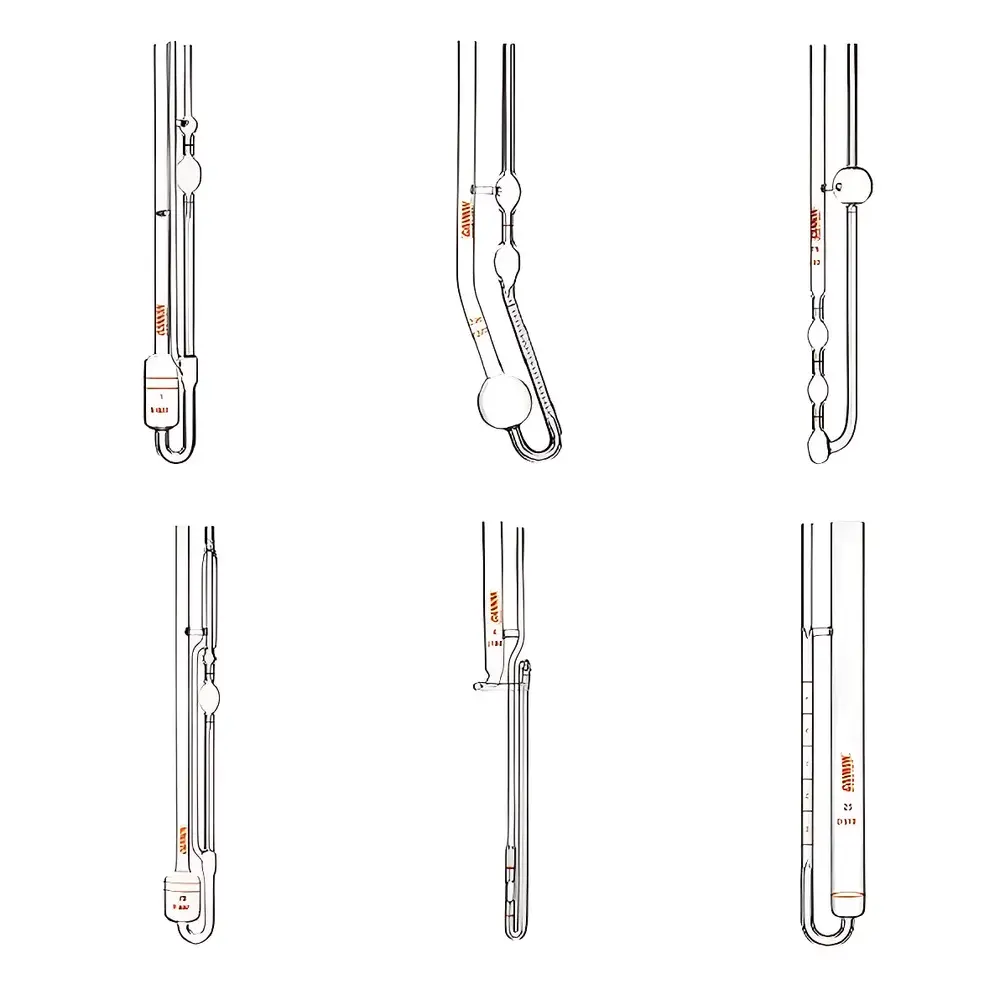
Cannon 9721-N89 Ubbelohde Viscometer (Calibrated, Type 4C)
| Brand | CANNON |
|---|---|
| Origin | USA |
| Model | 9721-N89 |
| Capillary Constant | 30 cSt/s |
| Kinematic Viscosity Range | 600–3000 cSt |
| Compliance | ASTM D445, ASTM D446, ASTM D2170 |
| Temperature Stability Requirement | ±0.02 °C (15–100 °C) |
| Capillary Geometry | Ubbelohde semi-micro, dilution-compatible, suspended-level design |
Overview
The Cannon 9721-N89 is a precision-calibrated Ubbelohde-type capillary viscometer engineered for accurate kinematic viscosity measurement of transparent and opaque liquids in accordance with ASTM D445, ASTM D446, and ASTM D2170. It operates on the principle of gravity-driven laminar flow through a precisely dimensioned glass capillary under controlled thermal conditions. Unlike Ostwald or Cannon-Fenske designs, the Ubbelohde configuration incorporates a suspended-level reservoir that isolates the measured efflux time from hydrostatic pressure variations caused by sample volume changes—thereby ensuring high reproducibility across repeated determinations and minimizing operator-induced error. This model (Type 4C, calibrated) features a nominal capillary constant of 30 cSt/s, supporting kinematic viscosity measurements in the range of 600–3000 centistokes at standard test temperatures (e.g., 40 °C, 100 °C). Its all-glass construction—borosilicate 3.3 (Duran®/Pyrex®-equivalent)—provides chemical resistance to hydrocarbons, lubricants, solvents, and asphaltene-containing fluids, while maintaining dimensional stability over extended thermal cycling.
Key Features
- Ubbelohde geometry with suspended-level reservoir ensures true kinematic viscosity determination independent of fill volume
- Fully calibrated unit supplied with NIST-traceable calibration certificate specifying individual capillary constant (cSt/s) and temperature correction coefficients
- Optimized for use in thermostatically controlled baths meeting ASTM D445 temperature stability requirements (±0.02 °C between 15–100 °C)
- Semi-micro design minimizes sample consumption (typically 10–15 mL), critical for high-value or limited-availability samples
- Dilution-capable configuration enables sequential viscosity measurements during polymer molecular weight distribution analysis (e.g., intrinsic viscosity via Huggins or Kraemer plots)
- Etched timing marks and polished capillary bore ensure consistent meniscus detection and laminar flow profile development
- Compatible with automated timing systems meeting ASTM D445 accuracy criteria (±0.07% error for 200–900 s measurements)
Sample Compatibility & Compliance
The 9721-N89 is validated for use with mineral oils, synthetic lubricants, biodiesel blends, bituminous materials (including vacuum-distilled asphalts per ASTM D2170), glycols, esters, and other Newtonian or near-Newtonian liquids exhibiting stable laminar flow behavior. It is not intended for non-Newtonian, highly viscous (>3000 cSt), or particulate-laden suspensions without prior filtration. Regulatory compliance includes full alignment with ISO 3104 (equivalent to ASTM D445), IP 71, and JIS K 2283. When integrated into GLP- or GMP-regulated laboratories, the instrument supports audit-ready workflows when paired with calibrated thermometers (±0.02 °C), certified stopwatch systems, and documented bath temperature validation records. The capillary’s geometry conforms to ASTM D446 specifications for Ubbelohde viscometer dimensions and tolerance limits.
Software & Data Management
While the 9721-N89 is a manual, benchtop primary-standard instrument, its output integrates seamlessly into modern QC/QA data ecosystems. Efflux time measurements are entered into standardized calculation templates—either laboratory-developed Excel workbooks or validated LIMS modules—that apply the certified capillary constant and temperature-corrected kinematic viscosity equations per ASTM D445 Annex A1. For laboratories operating under FDA 21 CFR Part 11, electronic records must include operator ID, calibration certificate number, bath temperature log, and raw timing data—all traceable to the physical instrument label (9721-N89). Optional digital timers with USB export (e.g., Cannon TimerPro™) provide timestamped CSV outputs compatible with statistical process control (SPC) platforms such as Minitab or JMP.
Applications
- Quality control of base oils and finished lubricants per OEM specifications (e.g., SAE J300, API 1509)
- Asphalt binder characterization in pavement engineering labs (ASTM D2170, AASHTO T201)
- Intrinsic viscosity determination for polymer solutions (e.g., PET, nylon, polyolefins) using serial dilution protocols
- Research-grade viscosity-temperature profiling of biofuels and alternative energy carriers
- Verification and recalibration of rotational or automated viscometers used in high-throughput environments
- Educational laboratories teaching rheological fundamentals and ASTM standard methodology
FAQ
Is the 9721-N89 suitable for measuring opaque samples such as heavy fuel oil or bitumen?
Yes—its Ubbelohde design eliminates reliance on visual meniscus tracking in the reservoir; timing is performed between two etched marks in the capillary limb, making it fully applicable to dark or turbid fluids when used with appropriate illumination and timing methodology.
Does this viscometer require periodic recalibration?
Per ASTM D445 Section 7.2, calibrated viscometers should be verified annually or after mechanical shock, cleaning with aggressive solvents, or observed drift exceeding ±0.3% in duplicate efflux times. Full recalibration requires accredited hydrostatic calibration against reference standards.
Can the 9721-N89 be used in vacuum-mode applications?
No—this is a gravity-flow Ubbelohde viscometer. Vacuum-mode operation requires dedicated Asphalt Institute or Modified Koppers geometries (e.g., models ending in -R70 or -W70), which are structurally distinct and not interchangeable.
What cleaning protocol is recommended to maintain accuracy?
Rinse immediately post-use with low-viscosity solvent (e.g., toluene, xylene), followed by acetone, then dried with filtered dry air or nitrogen. Avoid ultrasonic cleaning unless validated for borosilicate capillary integrity; never use chromic acid or hot caustic solutions.
How does the suspended-level design improve measurement robustness?
By decoupling efflux time from total sample volume, it removes sensitivity to minor pipetting errors, evaporation losses, or meniscus positioning variance—directly enhancing inter-operator and inter-laboratory reproducibility as confirmed in ASTM D445 round-robin studies.







