
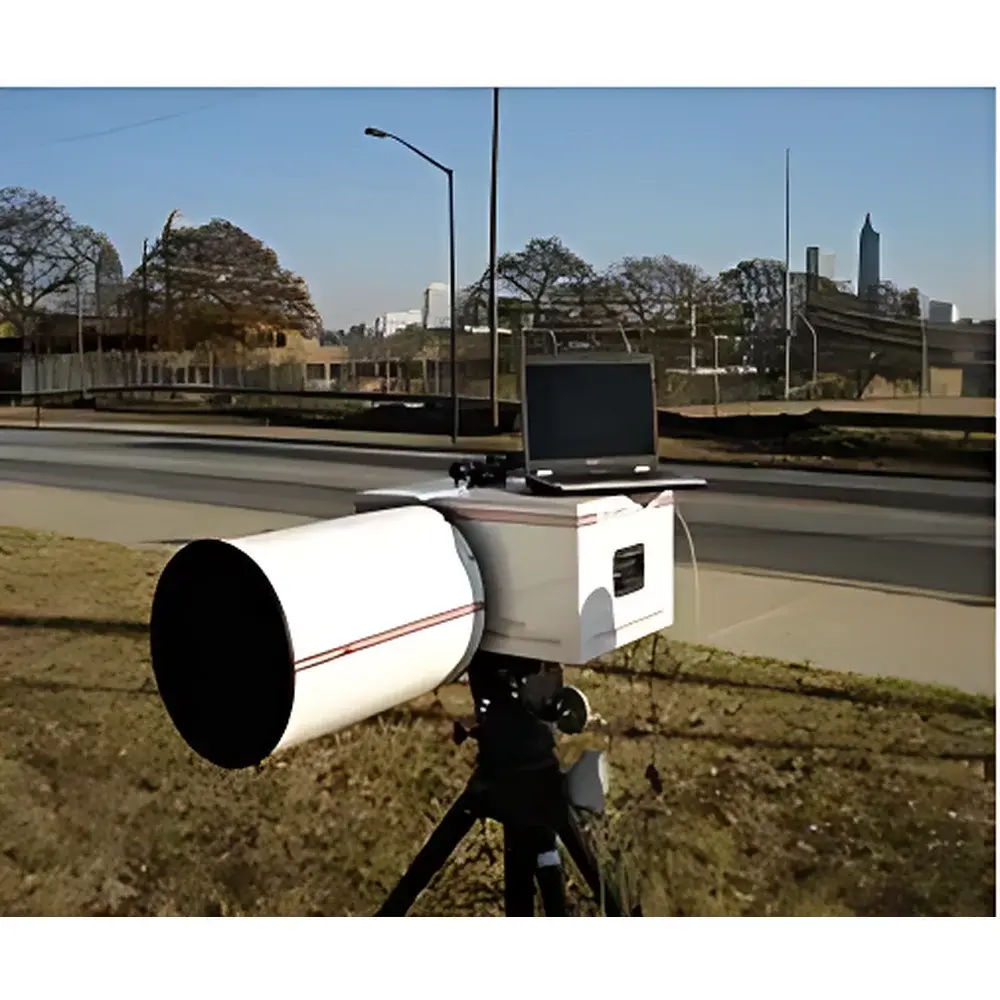
Cerex AirSentry OP-FTIR Portable Open-Path Fourier Transform Infrared Gas Analyzer
| Origin | USA |
|---|---|
| Supplier Type | Authorized Distributor |
| Import Status | Imported |
| Model | OP-FTIR |
| Pricing | Upon Request |
Overview
The Cerex AirSentry OP-FTIR is a field-deployable, open-path Fourier Transform Infrared (OP-FTIR) gas analyzer engineered for real-time, in-situ identification and quantification of atmospheric trace gases across path lengths from 10 m to 1,000 m. Unlike extractive sampling systems, it operates on the principle of passive or active infrared absorption spectroscopy: an interferometer (Bomem-designed, corner-cube retroreflector architecture) generates a broadband mid-infrared interferogram (typically 600–4,000 cm⁻¹), which is transmitted through ambient air and reflected back to a single co-axial detector unit. Absorption features in the resulting spectrum are resolved via fast Fourier transformation and matched against reference spectra using multivariate least-squares fitting algorithms. This enables simultaneous detection of >400 compounds—including greenhouse gases (CO₂, CH₄, N₂O), volatile organic compounds (VOCs), inorganic species (NH₃, SO₂, NO₂, HCl, HF), perfluorocarbons (SF₆, CF₄), and chemical warfare agent simulants—without physical sample collection or pre-concentration. Its measurement sensitivity is expressed in ppm·m units, with detection limits as low as 0.2 ppm·m for key analytes such as SF₆ and chlorodifluoromethane.
Key Features
- Single-unit coaxial design integrating emitter and receiver optics, eliminating alignment drift and enabling rapid deployment on tripods, vehicles, or fixed infrastructure
- Automated Stirling-cycle cryocooler maintaining mercury cadmium telluride (MCT) detector at 77 K—eliminating reliance on liquid nitrogen while ensuring high signal-to-noise ratio and thermal stability
- Adjustable optical pathlength (10–1,000 m) via precision-positioned ZnSe-coated cube retroreflectors (30-Cube, 60-Cube, or multipass cell options)
- Bomem-built interferometer with monolithic corner-cube mirror assembly, delivering long-term spectral fidelity and immunity to mechanical vibration-induced phase errors
- Real-time modulation of the IR beam to reject ambient solar and thermal background radiation—critical for daytime outdoor operation
- Embedded spectral library containing >400 validated gas-phase reference spectra, compliant with ASTM E1421 and ISO 14956 standards for quantitative FTIR analysis
- Full raw interferogram and processed absorbance spectra stored onboard with timestamped metadata, supporting audit-ready data integrity per FDA 21 CFR Part 11 requirements
Sample Compatibility & Compliance
The AirSentry OP-FTIR is validated for direct measurement of gaseous species in ambient air, stack emissions, fugitive plumes, and industrial boundary zones. It complies with EPA Method TO-16 for open-path VOC monitoring and supports compliance reporting under EU Industrial Emissions Directive (IED) Annex V, US Clean Air Act §112(r), and OSHA PEL/STEL guidelines. Its non-contact methodology avoids catalytic degradation, adsorption losses, or dilution artifacts inherent in extractive systems. The instrument meets IEC 61326-1 for electromagnetic compatibility and IP54 ingress protection when deployed with optional weatherproof enclosures. All calibration procedures follow NIST-traceable protocols using certified permeation tubes or dynamic dilution standards; QA/QC routines include daily zero/span checks via internal flow-through cell (P/N 282307) or external multipass cell (P/N 282522).
Software & Data Management
The system runs Cerex’s Continuous Monitoring Software (CMS), a Windows-based application supporting automated spectral acquisition, real-time concentration mapping, and plume dispersion modeling when integrated with a 3-D sonic anemometer (P/N 81000). CMS implements chemometric algorithms (classical least-squares, partial least-squares regression) and includes built-in spectral subtraction for background correction. Data export formats include CSV, NetCDF, and HDF5 for interoperability with GIS platforms and regulatory reporting tools (e.g., EPA’s AERMOD, CALPUFF). Audit trails record all user actions, parameter changes, and calibration events with digital signatures. Optional software modules enable Radial Plume Mapping (RPM), time-resolved concentration contouring, and GLP-compliant electronic lab notebook (ELN) integration.
Applications
- Emergency response to hazardous material releases (HAZMAT teams, first responders)
- Fugitive emission monitoring at landfills, refineries, chemical plants, and semiconductor fabrication facilities
- Continuous perimeter surveillance for chemical threat detection (CWAs, TICs, TICs) in critical infrastructure and military installations
- Greenhouse gas flux quantification (CO₂, CH₄, N₂O) for carbon accounting and verification under GHG Protocol or ISO 14064
- Stack and duct monitoring in power generation, cement production, and waste incineration
- Indoor air quality assessment in laboratories, cleanrooms, and occupational environments
- Engine exhaust characterization during R&D and emissions certification testing
- Environmental HAPS (Hazardous Air Pollutants) network monitoring per U.S. EPA requirements
FAQ
How does the AirSentry OP-FTIR differ from extractive FTIR or GC-MS systems?
It eliminates sampling lines, pumps, and conditioning hardware—removing transport delays, adsorption losses, and cross-contamination risks. Measurements reflect true ambient concentrations without dilution or phase change artifacts.
What is the typical detection limit for methane (CH₄)?
The system achieves a minimum detectable concentration of 3.5 ppm·m under standard atmospheric conditions (100 m pathlength yields ~35 ppb sensitivity).
Can the system operate unattended for extended periods?
Yes—field deployments exceeding 30 days have been documented with solar-charged battery support and remote telemetry via cellular or satellite uplink.
Is the spectral library upgradable?
Yes—new compound spectra can be added via secure firmware update; custom libraries may be generated using Cerex’s Spectral Library Builder tool and validated per ISO/IEC 17025 guidelines.
Does the system comply with FDA 21 CFR Part 11 for regulated environments?
Full electronic signature, audit trail, and role-based access control are implemented in CMS v5.2+, satisfying Part 11 requirements for GMP/GLP-aligned operations.




