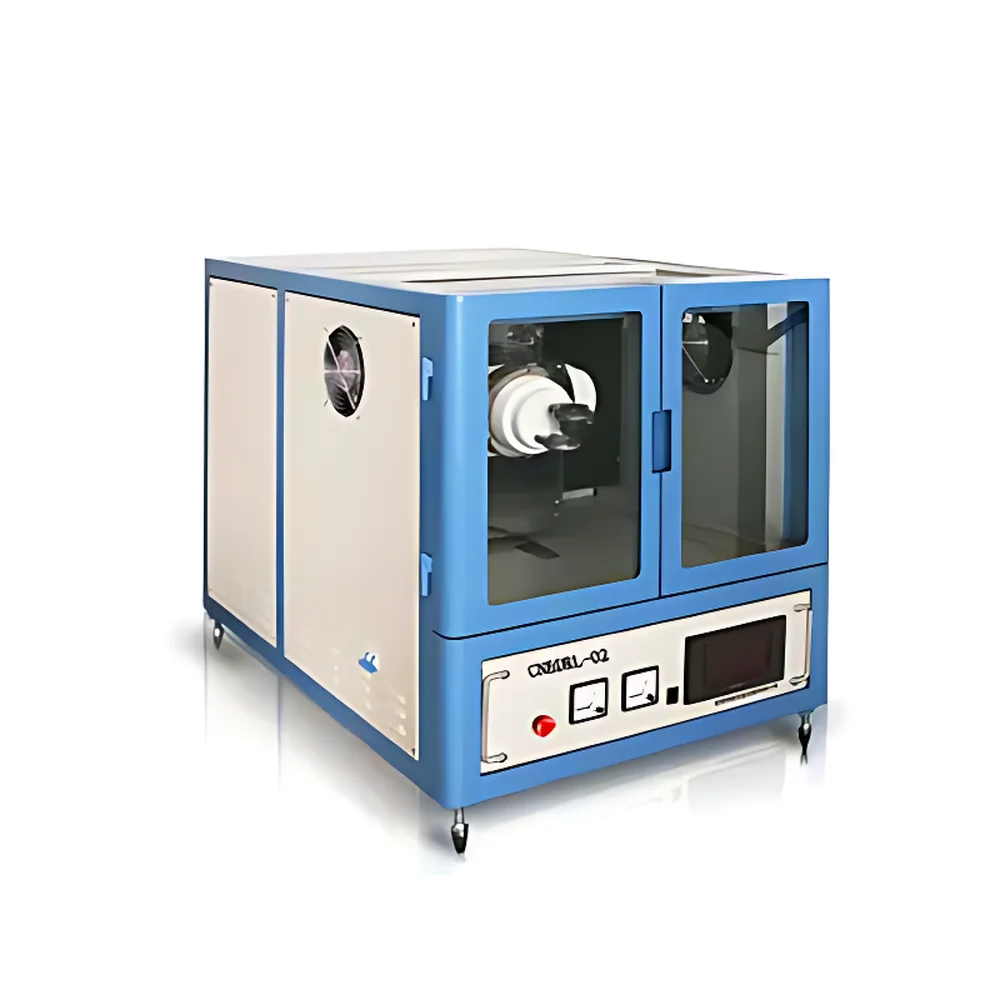
Chuonai CNBDRL-02 Fully Automated Fusion Machine

| Origin | Henan, China |
|---|---|
| Manufacturer Type | Authorized Distributor |
| Origin Category | Domestic (PRC) |
| Model | CNBDRL-02 |
| Price Range | USD 14,000–28,000 |
| Dimensions (L×W×D) | 550 mm × 600 mm × 800 mm |
| Temperature Control Accuracy | ±2 °C |
| Maximum Operating Temperature | 1100 °C |
| Sample Capacity | 4 positions |
| Heating Rate | 50 °C/min (avg.) |
| Crucible Rotation Angle | ±40° |
| Rotation Frequency | 15 rpm |
| Power Rating | 4.5 kW |
| Voltage | 220 V AC, 50 Hz |
| Weight | 100 kg |
Ask about pricing, availability and specifications.
Overview
The Chuonai CNBDRL-02 Fully Automated Fusion Machine is a precision-engineered thermal sample preparation system designed specifically for the production of homogeneous, bubble-free glass beads used in wavelength dispersive X-ray fluorescence (WDXRF) and energy dispersive X-ray fluorescence (EDXRF) analysis. It operates on the principle of high-temperature flux fusion—melting solid powdered samples with lithium tetraborate (Li₂B₄O₇), lithium metaborate (LiBO₂), or mixed fluxes at controlled ramp rates and dwell times under inert or ambient atmosphere. The furnace utilizes dual-zone silicon carbide (SiC) heating elements and PID-based digital temperature regulation to achieve stable operation up to 1100 °C, enabling complete dissolution of refractory oxides including Al₂O₃, Cr₂O₃, ZrO₂, and SiO₂-rich matrices common in metallurgical slags, cement clinkers, geological ores, and refractory ceramics.
Key Features
- Fully automated fusion cycle—including crucible preheating, flux/sample dosing (manual loading only), programmed heating ramp, homogenization rotation (±40° oscillation at 15 rpm), automatic pouring into platinum-gold alloy molds, and controlled cooling—all executed via intuitive 7-inch capacitive touchscreen interface.
- High-reproducibility thermal profile management with ±2 °C stability during isothermal holds, critical for minimizing volatility losses of alkali metals (e.g., Na, K) and volatile anions (e.g., Cl⁻, SO₄²⁻) while preserving stoichiometric integrity of fused beads.
- Robust mechanical architecture featuring reinforced ceramic fiber insulation, corrosion-resistant stainless-steel housing, and integrated safety interlocks (over-temperature cutoff, door-open shutdown, emergency stop).
- Energy-efficient design with 4.5 kW rated power and average heating rate of 50 °C/min, reducing cycle time without compromising thermal uniformity across the crucible zone.
- Compact footprint (550 × 600 × 800 mm) optimized for integration into analytical labs with limited floor space, while maintaining full 4-position processing capacity per batch.
Sample Compatibility & Compliance
The CNBDRL-02 accommodates standard 35 g Pt–Au (95/5) or Pt–Rh (90/10) crucibles and matching graphite or ceramic molds. It supports all major fusion protocols compliant with ASTM E1338, ISO 9516-1, and GB/T 176–2017 for cement and building materials analysis. The system meets CE electromagnetic compatibility (EMC) requirements and conforms to IEC 61010-1 for laboratory electrical safety. While not certified for GLP/GMP environments out-of-the-box, its repeatable thermal performance and programmable method storage enable alignment with internal SOPs requiring audit-ready fusion records.
Software & Data Management
The embedded control firmware stores up to 100 user-defined fusion methods—including multi-step ramps, hold durations, rotation parameters, and cooling profiles—with timestamped execution logs exportable via USB. Although no cloud connectivity or remote desktop capability is built-in, the machine supports external PLC integration through RS-485 Modbus RTU for centralized lab automation systems. All temperature and motion data are logged at 1 Hz resolution and can be exported in CSV format for traceability in QA/QC documentation.
Applications
- Preparation of fused beads for quantitative elemental analysis of iron ore, sinter, pig iron, and steelmaking slags in metallurgical QC labs.
- Routine sample digestion of Portland cement, fly ash, limestone, and kiln feed in cement manufacturing R&D and quality control.
- Geochemical mapping of silicate rocks, soils, and mineral concentrates using XRF, where matrix-matched calibration requires consistent bead geometry and homogeneity.
- Production of certified reference material (CRM) validation samples in accredited testing laboratories operating under ISO/IEC 17025.
- Research-scale development of novel flux formulations for low-melting-point alloys and rare-earth oxide systems.
FAQ
What types of fluxes are compatible with the CNBDRL-02?
Lithium tetraborate (Li₂B₄O₇), lithium metaborate (LiBO₂), and binary or ternary mixtures (e.g., Li₂B₄O₇ + LiBO₂ + NH₄NO₃) are routinely used; compatibility with ammonium nitrate-based oxidizing fluxes requires optional fume extraction integration.
Is platinum crucible handling automated?
No—the CNBDRL-02 requires manual placement and removal of crucibles and molds; automation covers only thermal cycling, rotation, and pouring mechanics.
Can the instrument be validated for regulatory compliance (e.g., FDA 21 CFR Part 11)?
It does not include electronic signature, audit trail, or role-based access control features required for Part 11 compliance; however, raw log files support retrospective verification when paired with lab-specific procedural controls.
What maintenance is required for long-term thermal accuracy?
Annual recalibration of the Type S thermocouple and visual inspection of SiC heating elements and insulation integrity are recommended; no consumable parts beyond crucibles and molds are specified.
Does the system support inert gas purging?
A dedicated N₂ inlet port is provided on the furnace chamber; optional mass flow controller integration enables controlled purge environments for redox-sensitive samples.