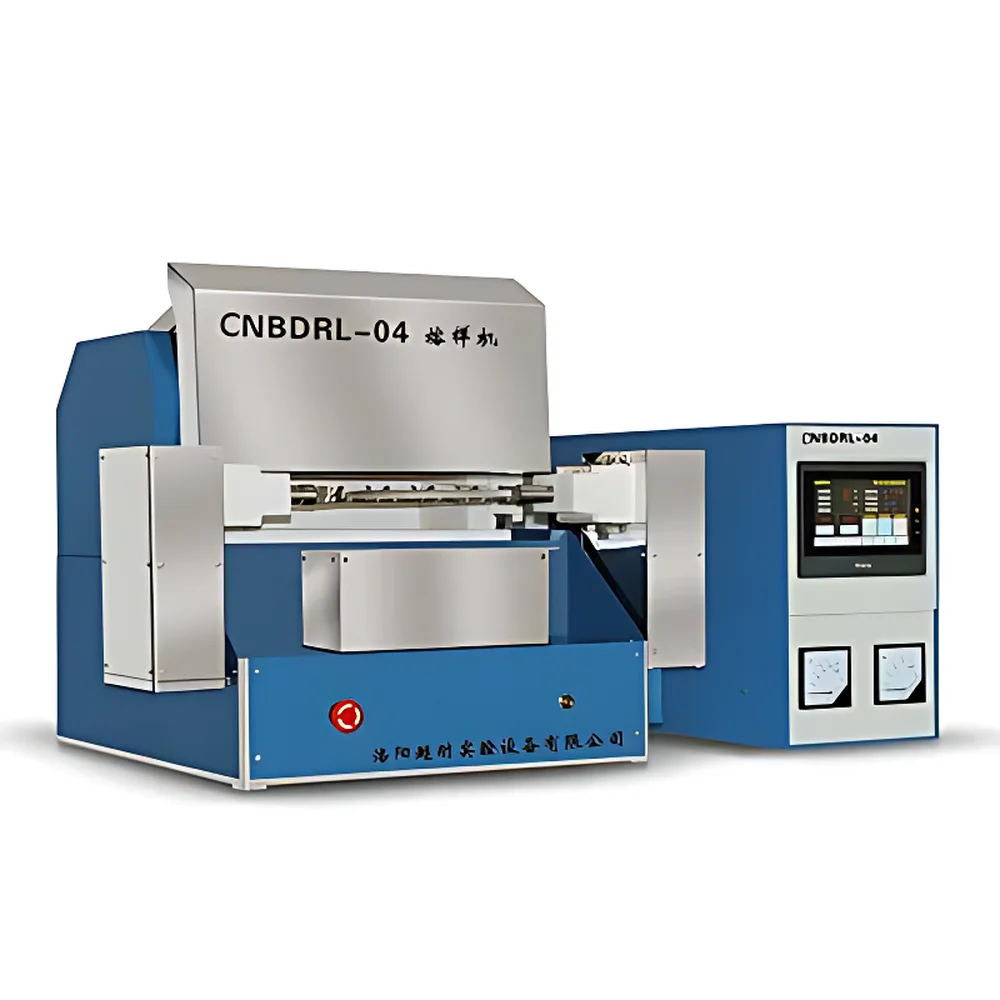
Chuonai CNBDRL-04 Fully Automated Fusion Machine

| Origin | Henan, China |
|---|---|
| Manufacturer Type | Authorized Distributor |
| Origin Category | Domestic (China) |
| Model | CNBDRL-04 |
| Price Range | USD 14,000 – 28,000 |
| Dimensions (L×W×D) | 730 mm × 600 mm × 650 mm |
| Temperature Control Accuracy | ±1 °C |
| Maximum Operating Temperature | 1100 °C |
| Sample Capacity | 4 positions |
| Heating Rate | 30 °C/min (average) |
| Tilting Angle Range | ±40° (adjustable) |
| Tilting Frequency | 1 Hz (adjustable) |
| Rated Power | 7.5 kW |
| Rated Voltage | 220 V AC, single-phase |
| Rated Frequency | 50 Hz |
| Net Weight | 150 kg |
Ask about pricing, availability and specifications.
Overview
The Chuonai CNBDRL-04 Fully Automated Fusion Machine is a high-precision, benchtop fusion system engineered for the preparation of homogeneous, glassy beads used in wavelength-dispersive X-ray fluorescence (WDXRF) and energy-dispersive X-ray fluorescence (EDXRF) analysis. It operates on the principle of flux-assisted high-temperature fusion—melting solid samples with lithium tetraborate (Li₂B₄O₇), lithium metaborate (LiBO₂), or mixed fluxes at controlled temperatures up to 1100 °C, followed by automated tilting and mold-based casting to produce optically flat, bubble-free discs. Designed specifically as an analytical sample preparation platform for geochemical, metallurgical, cement, ceramics, refractory, and industrial mineral laboratories, the CNBDRL-04 integrates thermal, mechanical, and control subsystems into a compact, GMP-aligned architecture. Its ability to achieve stable operation at 1100 °C—combined with ±1 °C thermal regulation during hold phases—ensures reproducible melt viscosity, complete dissolution of refractory oxides (e.g., Al₂O₃, Cr₂O₃, ZrO₂), and minimal elemental volatility loss.
Key Features
- Fully automated sample handling: Integrated robotic arm enables cold-to-cold loading/unloading—eliminating operator exposure to radiant heat and reducing manual intervention.
- Precision tilting mechanism: Motor-driven oscillation (±40°, 1 Hz adjustable frequency) ensures uniform mixing during melt homogenization and consistent flow during mold filling.
- High-stability furnace core: Constructed with proprietary refractory ceramic insulation and high-purity Kanthal A1 heating elements, delivering rapid ramp rates (~30 °C/min) and long-term thermal uniformity across the crucible zone.
- Intuitive HMI interface: 7-inch capacitive touchscreen with multilingual OS (English default), preloaded fusion protocols, real-time temperature profiling, and event logging.
- Dual-layer safety architecture: Hardware-based overtemperature cutoff (independent thermocouple + SSR fail-safe) and software-enforced positional limits prevent crucible tipping, thermal runaway, or mechanical overtravel.
- Energy-optimized design: Insulation geometry and duty-cycle modulation reduce standby power consumption by >35% versus conventional resistance-heated fusion units.
Sample Compatibility & Compliance
The CNBDRL-04 accommodates standard 32-mm platinum-gold (Pt/Au) or platinum-rhodium (Pt/Rh) crucibles and matching graphite or ceramic molds. It supports all common fusion chemistries—including binary Li₂B₄O₇–LiBO₂ blends, oxidizing additives (NH₄NO₃, V₂O₅), and reducing agents (NH₄I)—for samples ranging from low-Z silicates to high-melting-point alloys and slags. Method validation aligns with ISO 9516-1:2021 (iron ores), ASTM E2469-22 (cement clinker), and USP (glass disc quality criteria). The system’s audit trail functionality—including timestamped parameter changes, operator ID tagging, and thermal profile export—meets GLP and FDA 21 CFR Part 11 requirements when deployed with optional networked data archiving.
Software & Data Management
Built-in firmware supports protocol cloning, multi-step ramp-soak-cool sequences, and customizable tilt timing per stage. All fusion runs generate .CSV logs containing time-stamped temperature, tilt angle, power draw, and alarm status. Optional Ethernet/Wi-Fi connectivity enables remote monitoring via Chuonai FusionLink™ web dashboard (HTTPS-secured), allowing lab managers to review instrument uptime, thermal history, and QC pass/fail metrics without local access. Data exports comply with LIMS integration standards (ASTM E1482, ASTM E1578) and support direct ingestion into laboratory informatics platforms via RESTful API.
Applications
- Preparation of fused beads for major/minor/trace element quantification in iron ore, sinter, pig iron, and steel scrap.
- Routine analysis of raw meal, clinker, and finished cement according to ISO 29581-1.
- Geochemical mapping of exploration drill cores and soil samples using portable XRF field calibration.
- Quality control of refractory linings, alumina ceramics, and zirconia-based composites.
- Regulatory compliance testing for heavy metals (Pb, Cd, As, Hg) in construction materials per EN 12457-4.
FAQ
What crucible materials are compatible with the CNBDRL-04?
Standard 32-mm Pt/Au (95/5) and Pt/Rh (90/10) crucibles are supported; graphite crucibles may be used only for non-oxidizing fusions below 900 °C.
Does the system support method transfer from legacy fusion instruments?
Yes—predefined ramp/soak profiles can be imported via USB or configured manually using absolute time/temperature targets and tilt event triggers.
Is maintenance documentation available in English?
All user manuals, calibration certificates, and preventive maintenance checklists are supplied in English and comply with IEC 61000-6-2 EMC standards.
Can the CNBDRL-04 be integrated into a fully automated lab workflow?
It features RS-485 Modbus RTU and optional TCP/IP Modbus TCP interfaces for synchronization with robotic sample handlers and LIMS dispatch systems.
What is the expected service life of the heating elements under continuous operation?
Under nominal load (≤1050 °C, 8 h/day), Kanthal A1 elements maintain ≥95% resistance stability for ≥12,000 operational hours before scheduled replacement.