
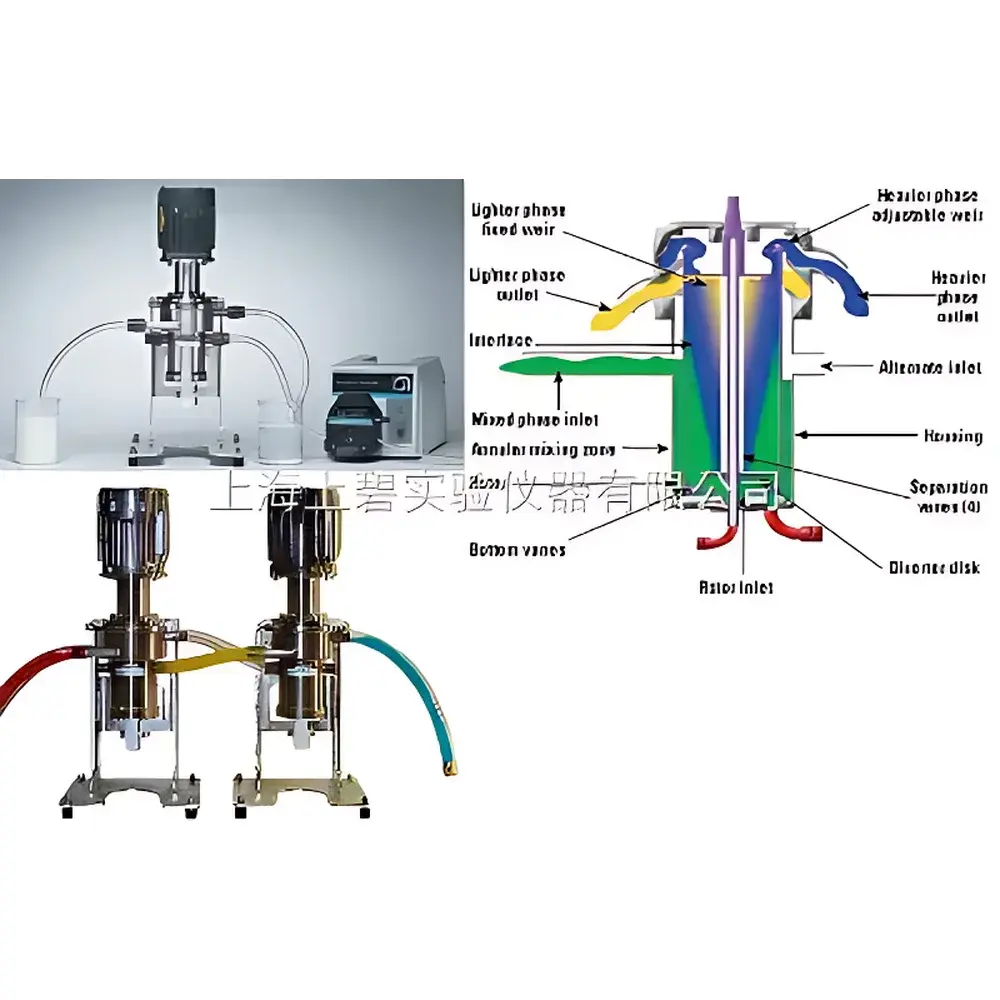
CINC V2 Multifunctional Centrifugal Extractor
| Origin | USA |
|---|---|
| Manufacturer Type | Distributor |
| Origin Category | Imported |
| Model | V-2CP |
| Price | Upon Request |
Overview
The CINC V2 Multifunctional Centrifugal Extractor is a continuous, high-efficiency liquid–liquid separation and extraction system engineered for precision process development in biopharmaceutical, fine chemical, and academic research laboratories. Based on the principle of centrifugal force-driven phase separation—leveraging density differentials (≥0.05 g/cm³) between immiscible liquids—the V2 operates as a true countercurrent centrifugal contactor. Unlike conventional disc-stack centrifuges or gravity settlers, it integrates mixing, reaction, and separation in a single compact rotor chamber with adjustable residence time and interfacial control. Its design conforms to fundamental hydrodynamic principles of Taylor–Couette flow within a rotating cylindrical geometry, enabling stable emulsion formation and controlled coalescence under variable throughput conditions. The system is purpose-built for applications requiring strict adherence to process reproducibility, scalability from lab-scale screening (≤2 L/h) to pilot-scale validation (up to 114 L/h), and compatibility with Good Manufacturing Practice (GMP) and Good Laboratory Practice (GLP) workflows.
Key Features
- Modular rotor architecture with interchangeable overflow weirs (10 standard sizes: 0.825″–1.050″, i.e., 20.96–26.67 mm) to optimize phase ratio, residence time, and separation efficiency across varying viscosity and interfacial tension regimes
- Stainless steel 316L wetted components—including rotor, housing, and feed manifolds—certified for Clean-in-Place (CIP) and Steam-in-Place (SIP) sterilization up to 121°C
- PTFE O-rings and Viton®-encapsulated PTFE shaft seals ensure chemical compatibility with aggressive solvents (e.g., chlorinated hydrocarbons, alcohols, acids) and long-term seal integrity
- Variable-frequency drive (VFD)-controlled motor (2000–6000 rpm) enables precise rotational speed regulation for emulsification intensity and phase dispersion control
- Dual-frequency mixing base (high-frequency for initial dispersion; low-frequency for gentle coalescence) supports multi-stage extraction protocols without external staging
- Integrated auxiliary inlet port (≥20 mL/min capacity) allows inline addition of modifiers, pH adjusters, or precipitants during operation—enabling reactive extraction, washing, or back-extraction
- Compact footprint (22.8 × 63.5 × 22.8 cm) and NPT 3/8″ fluid connections facilitate integration into existing process skids or glovebox environments
Sample Compatibility & Compliance
The V2 handles aqueous–organic systems including but not limited to: aqueous acetic acid / ethyl acetate; phosphate-buffered saline / dibutyl phthalate; cell lysate / butanol; and fermentation broth / methyl isobutyl ketone (MIBK). It achieves droplet size reduction down to 10 µm and maintains stable operation across dynamic feed conditions—variable concentration, fluctuating flow rate (10–1900 mL/min), and transient fluid fragmentation. All wetted materials comply with USP Class VI and FDA 21 CFR Part 11 requirements for data integrity when paired with validated software. The XP-motor variant (NEMA 4X, Class I Div 2 Group D) meets ATEX/IECEx standards for hazardous area installation. System documentation includes traceable material certifications, ASME BPE-compliant surface finish reports (Ra ≤ 0.8 µm), and ISO 9001-aligned manufacturing records.
Software & Data Management
The included CD-ROM contains proprietary Weir Selection Guide software and operational manual, supporting empirical correlation of weir diameter, flow rate, and phase ratio to achieve target separation efficiency (e.g., ≥98% recovery of target solute per stage). While the base unit does not feature embedded digital controllers, its analog I/O signals (0–10 V speed feedback, 4–20 mA current draw monitoring) are compatible with third-party SCADA platforms (e.g., Siemens Desigo, Rockwell FactoryTalk) for audit-trail-enabled process logging. Optional firmware upgrades support timestamped event logging, alarm history export (CSV), and user-access-level configuration locking—meeting FDA 21 CFR Part 11 electronic record requirements when deployed with validated IT infrastructure.
Applications
- Downstream purification of monoclonal antibodies via aqueous two-phase extraction (ATPS)
- Recovery of intracellular metabolites (e.g., organic acids, terpenoids) from microbial fermentation broths
- Radiochemical solvent extraction in nuclear medicine precursor synthesis
- Process intensification studies for pharmaceutical active ingredient (API) isolation using green solvents (e.g., Cyrene™, limonene)
- Development of continuous-flow biocatalytic cascades integrating enzymatic reaction and product removal
- Validation of extraction kinetics and mass transfer coefficients (KLa, EO) under non-ideal mixing conditions
FAQ
What is the minimum density difference required for effective separation?
The V2 achieves reliable phase separation for liquids with a specific gravity differential ≥0.05 g/cm³ under optimized weir and rotational speed settings.
Can the V2 be used for sterile processing?
Yes—when configured with SIP-capable 316L stainless steel components and validated autoclave cycles (121°C, 20 min), it complies with ISO 13408-1 for aseptic processing equipment.
Is third-party pump integration supported?
Yes—Masterflex® peristaltic pumps (or equivalent pulseless flow devices) are recommended for feed delivery in low-backpressure configurations to prevent cavitation and maintain laminar inflow.
How is calibration performed for quantitative extraction yield?
Calibration relies on gravimetric or HPLC-UV quantification of inlet/outlet streams; no internal sensor-based calibration is provided, preserving method independence per ICH Q2(R2) guidelines.
Are spare parts available with documented lot traceability?
Yes—Spare Part Kit V2 includes wear items (seals, weirs, gaskets) supplied with CoA (Certificate of Analysis) and material traceability to ASTM A276 and ASTM F519 specifications.





