
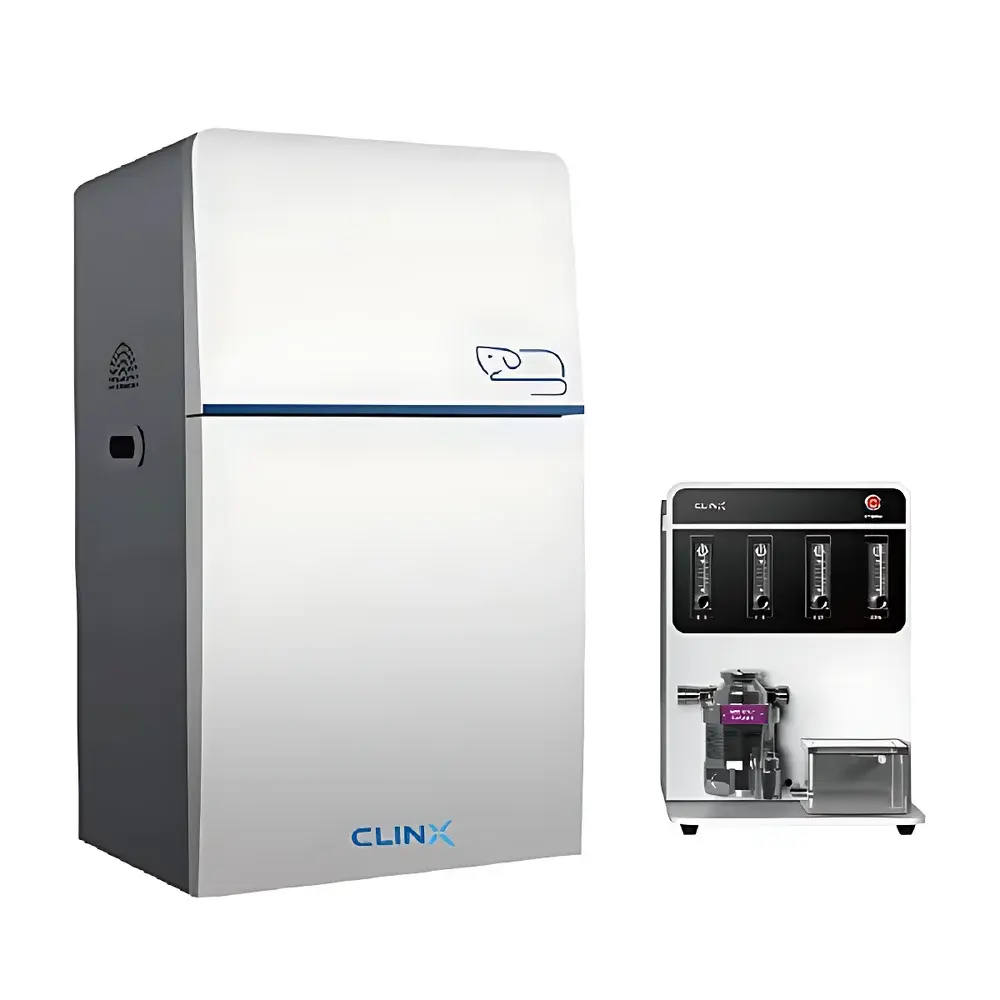
Clinox IVScope 8200 Small Animal In Vivo Optical Imaging System
| Brand | Clinox |
|---|---|
| Origin | Shanghai, China |
| Model | IVScope 8200 |
| Imaging Modality | Optical (Bioluminescence & Fluorescence) |
| Camera | 6 MP, Front-Illuminated Cooled CCD (Optional Water-Cooled) |
| Cooling Temperature | Down to −90 °C |
| Lens | Motorized f/0.8 Aperture |
| Field of View | Adjustable from 10.5 cm × 8.4 cm to 23.5 cm × 18.8 cm |
| Maximum FOV | 24 cm × 24 cm |
| Spatial Resolution | 1024 × 1024 pixels |
| Minimum Exposure Time | <10 ms |
| Sample Capacity | Up to 5 Mice Simultaneously |
| Stage Temperature Control | Ambient to 42 °C |
| Illumination Sources | White Light (Reflectance), Optional UV/Visible/NIR LED Arrays & Upconversion Laser Module |
| Filter Wheel | Motorized, Supports Multiple Emission Filters |
| Software | Integrated Acquisition & Quantitative Analysis Suite with ROI-Based Radiance Calibration |
Overview
The Clinox IVScope 8200 is a high-sensitivity, multi-modal small animal in vivo optical imaging system engineered for quantitative longitudinal monitoring of bioluminescent and fluorescent signals in live rodents. It operates on the principle of photon detection under ultra-low-noise conditions—leveraging deep-cooled front-illuminated CCD technology and an f/0.8 motorized lens to maximize signal capture efficiency across broad spectral ranges (300–900 nm). Unlike conventional widefield fluorescence systems, the IVScope 8200 integrates a light-tight imaging chamber, precision thermal regulation, and integrated anesthesia delivery to maintain physiological homeostasis during acquisition—ensuring data integrity across repeated timepoints. Its design conforms to core requirements for preclinical imaging workflows in academic, pharmaceutical, and contract research settings where reproducibility, traceability, and compliance with GLP-aligned documentation practices are essential.
Key Features
- Ultra-Low-Noise Detection: Equipped with a 6-megapixel front-illuminated CCD sensor cooled to −90 °C (optional water-circulation chiller), enabling sub-picomolar sensitivity for bioluminescent reporters such as firefly luciferase (Fluc) and Renilla luciferase (Rluc).
- High-Efficiency Optics: An f/0.8 motorized lens ensures optimal photon throughput across variable magnifications, supporting both high-resolution localized imaging and wide-field whole-body acquisition without manual refocusing.
- Dynamic Field-of-View Adjustment: Continuously adjustable FOV from 10.5 cm × 8.4 cm to 23.5 cm × 18.8 cm—scalable up to 24 cm × 24 cm—enabling flexible experimental configurations for single-animal or multi-animal (up to five mice) studies.
- Integrated Physiological Support: Precision stage temperature control (ambient to 42 °C) and compatible vaporizer-based isoflurane anesthesia system preserve metabolic stability and minimize motion artifacts during extended acquisitions.
- Multi-Spectral Excitation & Detection: Standard white-light reflectance imaging combined with optional modular light sources—including UV (365 nm), visible (470/535 nm), NIR (670/740/800 nm), and upconversion laser excitation—supports diverse fluorophore families (e.g., GFP, mCherry, Cy5.5, IRDye800CW, and lanthanide-doped nanoparticles).
Sample Compatibility & Compliance
The IVScope 8200 accommodates standard laboratory rodent models including nude, NSG, BALB/c, C57BL/6, and transgenic strains weighing ≤35 g. Its enclosed chamber design meets ISO 14644-1 Class 5 cleanroom-compatible handling protocols when used with laminar flow hoods. All hardware components comply with IEC 61000-6-3 (EMC emissions) and IEC 61000-6-2 (immunity) standards. The system supports audit-ready data management through timestamped metadata embedding (exposure time, binning, filter position, temperature, gas concentration), aligning with FDA 21 CFR Part 11 requirements for electronic records and signatures when paired with validated software configuration.
Software & Data Management
Clinox ImageStudio Pro v4.x provides end-to-end acquisition, visualization, and quantification capabilities. It features automated background subtraction, spectral unmixing for overlapping fluorophores, region-of-interest (ROI)-based radiance calibration (photons/sec/cm²/sr), and batch processing for longitudinal cohort analysis. Export formats include TIFF (16-bit), CSV (quantitative metrics), and NIfTI for cross-platform compatibility with MATLAB, Python (scikit-image, napari), and commercial platforms like Amira or Imaris. Audit trails log all user actions, parameter changes, and calibration events—supporting GLP/GMP-compliant study reporting and regulatory submissions.
Applications
- Tumor xenograft progression and metastasis tracking using luciferase-labeled cancer cell lines
- In vivo evaluation of CAR-T and NK-cell trafficking and persistence in immunocompetent or humanized mouse models
- Real-time monitoring of bacterial/viral load dynamics in infection models (e.g., Staphylococcus aureus, influenza A, SARS-CoV-2 pseudovirus)
- Neuroinflammatory response assessment via Iba1- or GFAP-targeted fluorescent probes
- Pharmacokinetic and biodistribution profiling of antibody-drug conjugates (ADCs), siRNA nanoparticles, and PET/MRI contrast agents
- Gene therapy vector distribution and promoter activity validation using dual-reporter constructs
FAQ
Does the IVScope 8200 support spectral unmixing for multiplexed fluorescence imaging?
Yes—ImageStudio Pro includes linear unmixing algorithms calibrated against reference spectra for common fluorophores, enabling simultaneous quantification of up to four spectrally distinct probes within a single acquisition.
Is the system compatible with third-party anesthesia delivery units?
The IVScope 8200 features standardized gas inlet/outlet ports (¼″ Swagelok) and pressure-sensing interfaces compatible with major vendors including Kent Scientific, Euthanex, and VetEquip.
Can raw image data be exported without proprietary compression?
All acquired images are stored in uncompressed 16-bit TIFF format with embedded EXIF metadata, ensuring full fidelity for external analysis pipelines.
What validation documentation is provided for regulatory submissions?
Clinox supplies IQ/OQ documentation templates, camera dark-current and flat-field calibration reports, and software verification protocols compliant with ISO/IEC 17025 and ASTM E2500-13 guidelines.
How is photobleaching minimized during repeated fluorescence imaging sessions?
The system implements exposure optimization algorithms that dynamically adjust illumination intensity and integration time based on real-time signal-to-noise estimation—reducing cumulative phototoxicity while preserving quantitative linearity.






