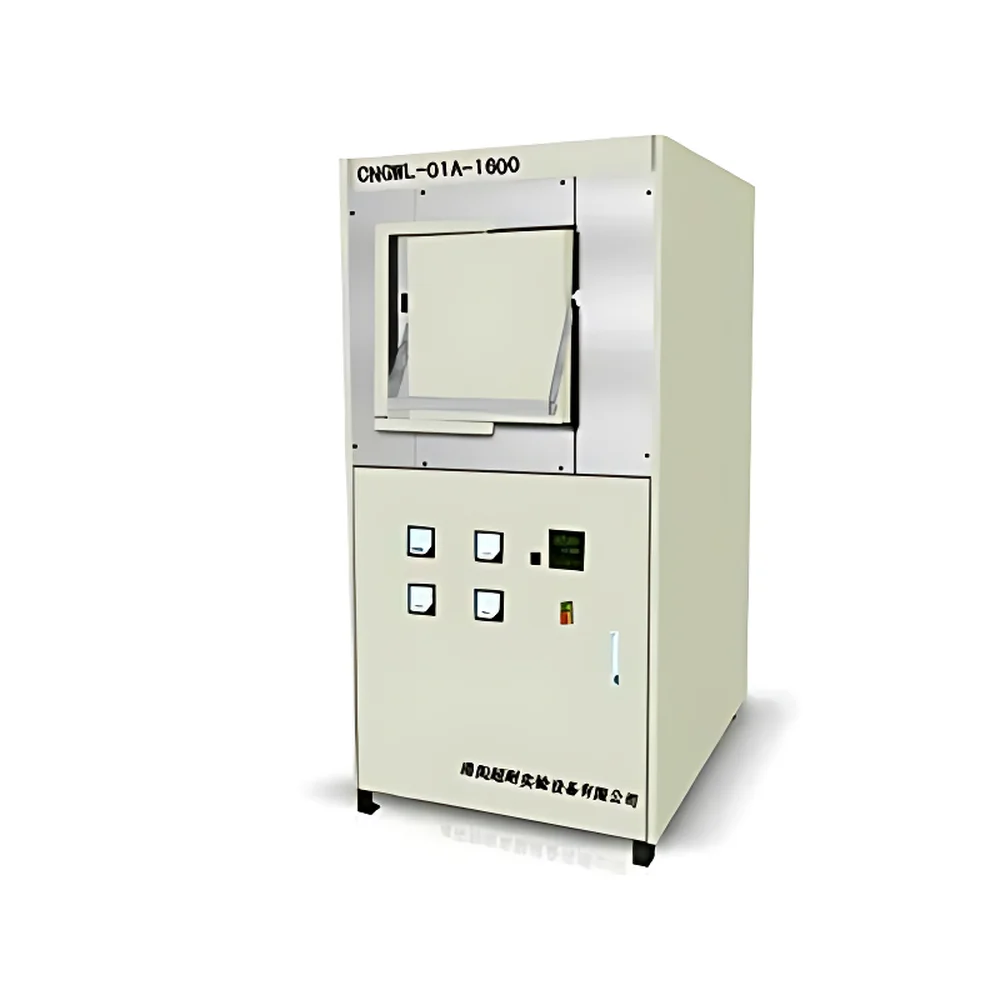
CNGWL-01A-1600 High-Temperature Box-Type Muffle Furnace

| Origin | Henan, China |
|---|---|
| Manufacturer Type | Authorized Distributor |
| Origin Category | Domestic (China) |
| Model | CNGWL-01A-1600 |
| Instrument Type | Box-Type Muffle Furnace |
| Maximum Temperature | 1650 °C |
| Temperature Control Accuracy | ±1 °C |
| Rated Power | 16 kW |
| Heating Rate (to Max Temp) | 0–15 °C/min |
| Heating Method | Electrical Resistance Heating |
| Internal Chamber Dimensions | 320 × 240 × 190 mm |
| Rated Voltage | 380 V (3-phase) |
| Rated Current | 43 A (per phase) |
| External Dimensions | 800 × 700 × 1700 mm |
| Net Weight | 600 kg |
| Insulation Material | High-Density Ceramic Fiber |
| Control System | AI-Based Programmable Temperature Controller with Multi-Curve Capability (up to 5 independent ramp/soak profiles) |
Ask about pricing, availability and specifications.
Overview
The CNGWL-01A-1600 is a high-precision, industrial-grade box-type muffle furnace engineered for sustained operation in the 1100 °C to 1650 °C temperature range. Designed around a robust ceramic fiber insulation architecture and silicon carbide (SiC) or high-purity alumina heating elements—depending on configuration—it delivers exceptional thermal uniformity, minimal heat loss, and long-term stability under continuous duty cycles. Its core operating principle relies on resistive Joule heating within a fully isolated, refractory-lined chamber, ensuring sample containment without atmospheric contamination—a critical requirement for ashing, calcination, sintering, and heat treatment protocols compliant with ASTM E1112, ISO 5667-17, and USP <231>. The furnace’s muffle design physically separates the heating elements from the process chamber, eliminating direct flame exposure and enabling inert or air-atmosphere processing without cross-contamination.
Key Features
- AI-based programmable temperature controller supporting up to five independent multi-segment heating profiles—each configurable with ramp rates, soak durations, and hold temperatures—enabling precise replication of complex thermal schedules used in metallurgical annealing or ceramic densification.
- ±1 °C temperature control accuracy across the full operating range (RT to 1650 °C), verified per IEC 60584-2 thermocouple calibration standards using Type S (platinum-rhodium) sensors.
- Full-ceramic fiber insulation (density ≥128 kg/m³) reduces thermal mass and improves energy efficiency—typical surface temperature rise remains below 45 °C at maximum operating temperature, meeting EN 60519-2 safety requirements for laboratory equipment.
- Phase-angle controlled SCR (Silicon Controlled Rectifier) power regulation ensures smooth, non-intrusive voltage delivery to heating elements—minimizing current surges, electromagnetic interference, and thermal shock to furnace components.
- Integrated dual-stage safety system: primary overtemperature cutoff via independent limit controller (setpoint adjustable), and secondary fail-safe protection triggered by thermocouple break detection (open-circuit alarm) or excessive rate-of-rise deviation.
- Front-loading horizontal chamber with reinforced stainless-steel door, high-temperature ceramic gasket, and counterbalanced hinge mechanism for repeatable sealing integrity and operator ergonomics.
Sample Compatibility & Compliance
The CNGWL-01A-1600 accommodates standard crucibles (alumina, zirconia, platinum, graphite) and refractory boats up to 320 mm × 240 mm × 190 mm internal volume. It supports both ambient-air and low-flow inert gas purging (via optional 1/4″ NPT inlet/outlet ports), facilitating oxidation-sensitive processes such as catalyst pre-treatment or lithium-ion cathode material synthesis. The furnace conforms to GLP and GMP documentation requirements when paired with validated data logging systems—its controller provides time-stamped event logs (power-on, profile start, alarm triggers) compatible with FDA 21 CFR Part 11-compliant audit trail modules. All electrical design complies with IEC 61000-6-3 (EMC emissions) and IEC 61000-6-2 (immunity), and mechanical construction meets CE Machinery Directive 2006/42/EC essential health and safety requirements.
Software & Data Management
While the base unit operates via an integrated 5.7″ TFT touchscreen HMI, optional RS485 Modbus RTU or Ethernet TCP/IP interfaces enable integration into centralized lab automation platforms (e.g., LabVantage, Thermo Fisher SampleManager). Third-party SCADA-compatible drivers allow real-time monitoring of chamber temperature, setpoint deviation, output power %, and alarm status. Raw temperature data can be exported in CSV format with millisecond-resolution timestamps—supporting statistical process control (SPC) analysis per ISO 7870-2. Firmware updates are performed via USB flash drive, and configuration backups are retained internally with password-protected access levels (Operator, Technician, Administrator).
Applications
- Quantitative ash content determination in coal, biomass, and polymer samples per ASTM D3174 and ISO 1171.
- Pre-sintering and final densification of advanced ceramics (Al₂O₃, Si₃N₄, ZrO₂) under controlled ramp/soak conditions.
- Heat treatment of tool steels and superalloys—including solution annealing, stress relieving, and homogenization—at temperatures up to 1650 °C.
- Thermal gravimetric analysis (TGA) sample preparation and residue stabilization prior to SEM-EDS or XRD characterization.
- Calibration and verification of high-temperature reference materials used in metrology labs accredited to ISO/IEC 17025.
FAQ
What type of thermocouple is used for temperature sensing and control?
Type S (Platinum/10% Rhodium vs. Platinum) thermocouples are factory-installed and certified to ITS-90 traceability; optional Type B or R configurations are available upon request.
Is inert gas purging supported, and what fittings are provided?
Yes—two 1/4″ NPT threaded ports (inlet and outlet) are standard; optional mass flow controller integration and gas manifold kits are available for precise atmosphere management.
Can the furnace be validated for GMP compliance?
Yes—the unit supports IQ/OQ documentation packages; temperature mapping (per ASTM E2251) and performance qualification protocols can be executed using external calibrated reference thermometers and data loggers.
What maintenance intervals are recommended for optimal longevity?
Ceramic fiber integrity inspection every 500 operational hours; heating element resistance check and thermocouple recalibration annually or after 1,000 thermal cycles—whichever occurs first.
Does the controller support remote diagnostics or firmware updates?
Firmware updates are performed locally via USB; remote diagnostics require optional Ethernet gateway module and secure VPN-configured network access—no cloud connectivity is embedded by default.