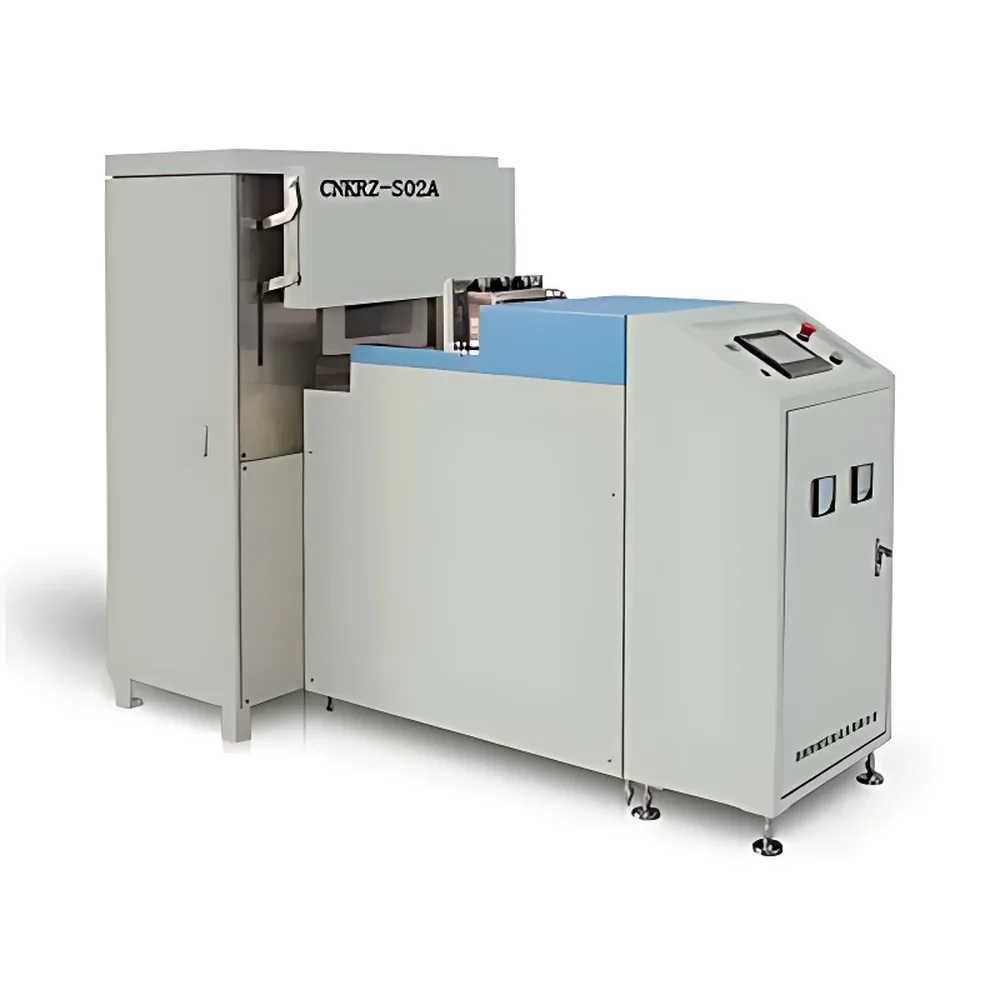
CNKRZ-S02A Fully Automated Water-Cooled Thermal Shock Testing Machine

| Origin | Henan, China |
|---|---|
| Manufacturer Type | Authorized Distributor |
| Origin Category | Domestic (China) |
| Model | CNKRZ-S02A |
| Quotation | Upon Request |
| Rated Temperature | 1200 °C (Max. 1300 °C) |
| Cooling Medium | Flowing Deionized Water |
| Specimen Dimensions | 230 × 114 × 165 mm (Standard Refractory Brick) |
| Specimen Capacity | 3 Units per Cycle |
| Rated Power | 12 kW |
| Rated Voltage | 380 V / 220 V AC (±10% Tolerance) |
| Rated Current | 55 A |
| Rated Frequency | 50 Hz |
| Control System | Industrial PLC with Auto-Initialization & Multi-Layer Safety Interlocks |
| Compliance | YB/T 376.1–2016 (Refractory Products – Thermal Shock Resistance by Water Quenching), YB/T 2206.2–2018 (Refractory Castables – Thermal Shock Resistance Test Method) |
Ask about pricing, availability and specifications.
Overview
The CNKRZ-S02A Fully Automated Water-Cooled Thermal Shock Testing Machine is an industrial-grade thermal cycling system engineered for quantitative evaluation of thermal shock resistance in refractory ceramics, monolithic castables, and high-temperature structural materials. It operates on the principle of controlled rapid thermal cycling—repeatedly heating specimens to elevated temperatures (up to 1300 °C) in a programmable muffle furnace zone, followed by immediate immersion or forced water quenching under standardized flow conditions. This methodology replicates real-world service stresses encountered in kiln linings, ladle refractories, and incinerator components, where abrupt temperature differentials induce microcracking, spalling, or structural degradation. Designed and validated in accordance with Chinese national standards YB/T 376.1–2016 and YB/T 2206.2–2018, the system delivers repeatable, traceable, and auditable test sequences suitable for quality control laboratories, R&D centers, and third-party certification facilities operating under GLP or ISO/IEC 17025 frameworks.
Key Features
- Industrial PLC-based control architecture with deterministic real-time cycle sequencing and auto-initialization at power-up
- Dual-voltage compatibility (380 V / 220 V AC) with ±10% voltage fluctuation tolerance, enabling stable operation across diverse site electrical infrastructures
- High-reliability heating system rated at 12 kW, utilizing premium-grade silicon carbide (SiC) heating elements and low-thermal-mass insulation for precise temperature ramping and dwell stability (±2 °C at 1200 °C)
- Water-cooling module with regulated deionized water flow, pressure monitoring, and temperature feedback to ensure consistent quench severity per ASTM C704 and ISO 5068 analogues
- Three-position specimen holder accommodating standard 230 × 114 × 165 mm refractory bricks—designed for uniform thermal exposure and mechanical alignment during transfer
- Comprehensive safety interlock suite including thermocouple break detection (TC fault), overtemperature cutoff (>1350 °C), water flow loss alarm, and emergency stop circuitry compliant with IEC 60204-1
Sample Compatibility & Compliance
The CNKRZ-S02A is optimized for rigid, non-porous ceramic specimens conforming to YB/T 376.1 geometry specifications. It supports comparative testing of fired bricks, sintered alumina, magnesia-carbon composites, and calcium-aluminate-based castables. While calibrated for standard brick dimensions, minor dimensional deviations (±2 mm) are accommodated via adjustable support rails. All operational parameters—including heating rate (programmable up to 10 °C/min), soak duration (0–999 min), quench delay (<1.5 s), and total cycle count (1–999)—are logged with timestamped metadata. The system’s test protocol aligns with internationally referenced thermal shock methodologies, facilitating cross-laboratory data correlation and supporting regulatory submissions under GB/T, ISO, and ASTM harmonized frameworks.
Software & Data Management
The embedded HMI interface provides intuitive touch-screen navigation for test setup, real-time temperature profiling, and cycle status monitoring. All critical process variables—including furnace thermocouple readings (Type S), water inlet/outlet temperatures, and elapsed cycle time—are sampled at 1 Hz and stored internally with UTC timestamps. Exportable CSV logs include full thermal history traces, alarm events, and operator-initiated interventions. Optional RS485/Modbus RTU integration enables connection to centralized LIMS or MES platforms. Audit trail functionality records user logins, parameter modifications, and test execution—supporting compliance with FDA 21 CFR Part 11 requirements when deployed in GMP-regulated environments.
Applications
- Quality assurance of refractory bricks supplied to steelmaking, cement, and non-ferrous metallurgy plants
- Development screening of new binder systems in low-cement castables
- Failure analysis of spalled linings through accelerated life-cycle simulation
- Validation of thermal expansion mismatch mitigation strategies in composite refractories
- Third-party certification testing for ISO 9001:2015 and API RP 934-C compliance documentation
FAQ
What standards does the CNKRZ-S02A comply with?
It is fully aligned with YB/T 376.1–2016 and YB/T 2206.2–2018, and its operational methodology is technically equivalent to ASTM C704, ISO 5068, and EN 993-11.
Can the system accommodate non-standard specimen geometries?
The primary fixture is designed for 230 × 114 × 165 mm bricks; custom fixtures may be engineered upon request, subject to thermal mass and handling constraints.
Is remote monitoring or data export supported?
Yes—via USB export of CSV logs and optional Modbus RTU integration for SCADA/LIMS connectivity.
What maintenance intervals are recommended?
Furnace insulation integrity and thermocouple calibration should be verified every 200 cycles or semiannually; water filtration media requires replacement every 6 months under continuous use.
Does the system meet electromagnetic compatibility (EMC) requirements?
It conforms to GB/T 17626 (equivalent to IEC 61000-4 series) for industrial environments, with CE-marked power supply modules and shielded signal cabling.