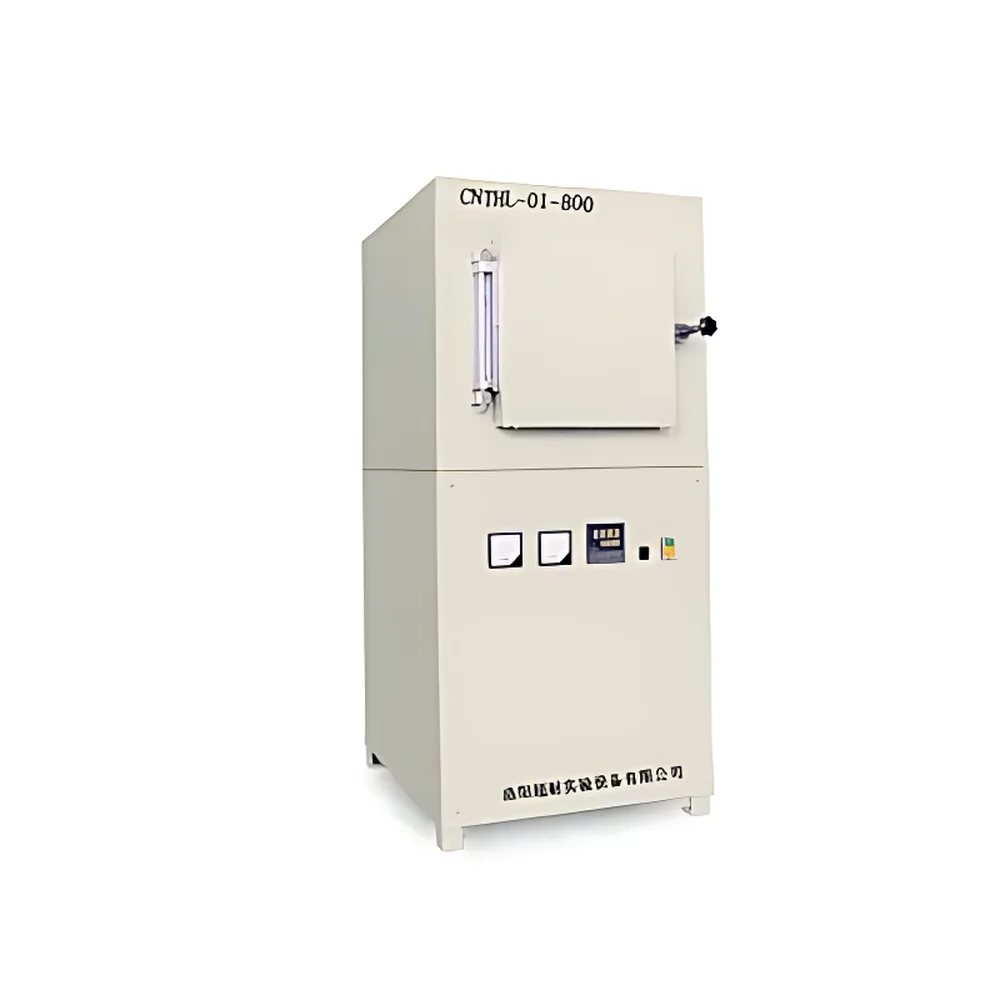
CNTHL-01-800 Benchtop Programmable Annealing Furnace

| Rated Temperature | 800 °C |
|---|---|
| Heating Rate | 5 °C/min (avg.) |
| Chamber Dimensions | 300 × 500 × 300 mm (W × D × H) |
| External Dimensions | 690 × 1010 × 1560 mm (W × D × H) |
| Rated Power | 12 kW |
| Voltage | 220 V AC, 50 Hz |
| Current | 55 A |
| Programmable Profiles | 5 curves × 10 segments each |
| Control System | SCR phase-angle fired heating circuit with PID temperature regulation |
Ask about pricing, availability and specifications.
Overview
The CNTHL-01-800 Benchtop Programmable Annealing Furnace is a precision-engineered thermal processing system designed for laboratory-scale heat treatment, materials research, and low-volume production environments. It operates on resistive heating principles, utilizing high-density ceramic fiber insulation and silicon carbide (SiC) or Kanthal A1 heating elements to achieve stable, uniform thermal distribution across the working chamber. The furnace is optimized for annealing, stress relieving, tempering, and sintering of metallic alloys, ceramics, and advanced composites—particularly where repeatable thermal profiles and tight temperature tolerance are critical. Its maximum operating temperature of 800 °C aligns with common requirements for post-processing of stainless steels, copper-based alloys, soft magnetic materials, and low-melting-point ceramics. The unit integrates a microprocessor-based temperature controller with dual thermocouple inputs (typically Type K), enabling real-time monitoring and closed-loop feedback control with ±1 °C accuracy over the full range.
Key Features
- Programmable thermal profiling: Up to five independent heating/cooling cycles, each configurable with up to ten distinct ramp-hold segments—supporting complex multi-stage processes such as slow ramp-to-soak, controlled cooling, and dwell-and-quench sequences.
- High-efficiency thermal architecture: Low-conductivity ceramic fiber insulation (≥1260 °C rated) minimizes heat loss and ensures rapid cooldown rates while maintaining external surface temperatures below 60 °C under continuous operation.
- Stable power delivery: Phase-angle controlled silicon-controlled rectifier (SCR) firing circuit provides smooth, jitter-free power modulation—eliminating thermal shock to heating elements and enhancing long-term reliability compared to on/off cycling systems.
- Robust mechanical design: Reinforced steel frame with double-layer insulated door, pneumatic counterbalance hinge, and adjustable leveling feet ensure operational stability and ergonomic access during sample loading/unloading.
- Dual safety redundancy: Independent overtemperature cutoff (OTC) relay with fail-safe contact, plus integrated door interlock that de-energizes heating elements when opened—compliant with IEC 61000-6-2 (EMC immunity) and IEC 61000-6-4 (EMC emissions) standards.
Sample Compatibility & Compliance
The CNTHL-01-800 accommodates crucibles, quartz boats, alumina setters, and custom fixtures up to 300 mm wide × 500 mm deep × 300 mm high. It supports inert, reducing, and air atmospheres (with optional gas inlet ports and purge capability). While standard configuration operates in ambient air, integration with nitrogen or argon purge lines enables oxide-sensitive treatments. The furnace meets general-purpose laboratory safety requirements per UL 61010-1 and EN 61010-1. Its programmable logic and data logging functionality support alignment with GLP documentation workflows; audit trail generation and user-access controls may be implemented via optional software extensions compliant with FDA 21 CFR Part 11 Annex 11 principles.
Software & Data Management
The embedded controller includes RS485 serial interface (Modbus RTU protocol) for integration into centralized lab management systems. Optional PC-based software enables remote profile editing, real-time temperature graphing, automated data export (CSV/Excel), and electronic signature capture for batch records. All temperature setpoints, actual readings, alarm events, and power status are timestamped and stored internally for ≥30 days. Data integrity safeguards include cyclic redundancy check (CRC) validation on transmitted profiles and write-protected firmware memory sections.
Applications
- Metallurgical R&D: Recrystallization studies, grain growth kinetics, and phase transformation analysis in ferrous and non-ferrous alloys.
- Electronics manufacturing: Stress relief of PCB substrates, solder paste reflow simulation, and thermal aging of passive components.
- Ceramic processing: Binder burnout, densification pre-sintering, and controlled oxidation of functional oxides.
- Academic laboratories: Teaching thermodynamics labs, materials science coursework, and graduate thesis experiments requiring reproducible thermal histories.
- Quality assurance: Thermal validation of incoming raw materials, verification of supplier heat treatment certifications, and internal calibration of thermocouples and reference blocks.
FAQ
What is the maximum recommended load mass for consistent temperature uniformity?
For optimal thermal homogeneity (±3 °C across the chamber), the recommended maximum load is 8 kg of typical metal or ceramic samples. Exceeding this may extend stabilization time and reduce profile fidelity.
Can the furnace be operated continuously at 800 °C?
Yes—continuous operation at rated temperature is supported with proper ventilation and periodic maintenance (e.g., element resistance checks every 200 operating hours). Ambient temperature should remain below 35 °C for sustained duty cycles.
Is third-party calibration certification available?
Factory-installed thermocouples are NIST-traceable at point of shipment. Full UKAS or ISO/IEC 17025 accredited calibration—including uniformity mapping—is available as an add-on service with documented uncertainty budgets.
Does the controller support hold-at-temperature based on sample thermocouple input?
Yes—the secondary thermocouple input can be configured as a process sensor for sample-centric control, decoupling chamber setpoint from actual specimen temperature during critical soak phases.
What maintenance intervals are recommended for the SCR power module?
Visual inspection and thermal imaging of heatsinks every 6 months; cleaning of dust filters quarterly; replacement of cooling fan assemblies every 24 months under normal lab conditions.