
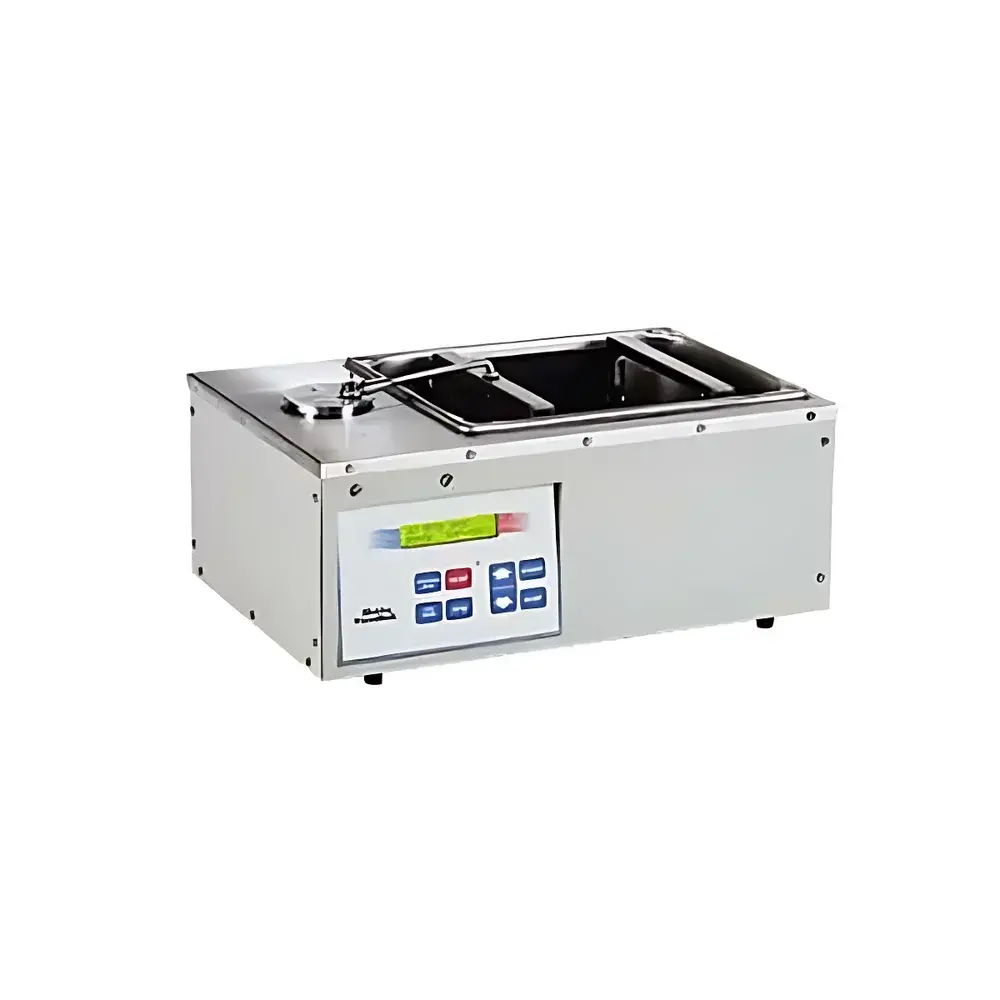
Cole-Parmer 12052-05 Advanced Heating Orbital Shaking Water Bath
| Brand | Cole-Parmer |
|---|---|
| Origin | USA |
| Model | 12052-05 |
| Bath Capacity | 20 L |
| Temperature Range | Ambient to 100 °C |
| Temperature Stability | ±0.5 °C (ambient to 100 °C) |
| Oscillation Speed | 0–150 rpm |
| Oscillation Mode | Linear reciprocating |
| Adjustable Stroke | 1/2", 1", or 1.5" |
| Heating Power | 1000 W |
| Voltage/Frequency | 240 V, 50 Hz |
| Certifications | CE |
| Construction | Seamless stainless steel bath vessel |
| Safety Features | Low-water-level auto-shutoff, power-loss memory with soft-stop/soft-start recovery |
| Optional Accessory | Lid (Part No. 12052-52) for improved thermal uniformity |
Overview
The Cole-Parmer 12052-05 is a precision-engineered heating orbital shaking water bath designed for applications requiring simultaneous temperature control and mechanical agitation under stable, reproducible conditions. Unlike static water baths or circulation-based systems, this unit employs a robust linear reciprocating drive mechanism—distinct from orbital or vortex motion—to deliver controlled, repeatable oscillation across three selectable stroke lengths (12.7 mm, 25.4 mm, and 38.1 mm). The bath operates on the principle of resistive heating combined with microprocessor-regulated PID feedback control, ensuring minimal thermal overshoot and high spatial uniformity within the 20 L stainless steel chamber. Its ambient-to-100 °C operating range supports common biochemical protocols including enzyme incubations, solubility studies, cell suspension maintenance, and accelerated stability testing. The absence of internal fluid circulation eliminates shear-induced artifacts in sensitive biological samples while maintaining thermal consistency through passive convection and optional lid integration.
Key Features
- Microprocessor-based PID temperature controller with LCD interface for real-time monitoring and adjustment of setpoints, oscillation speed (0–150 rpm), duration, and stroke length
- Seamless 304 stainless steel bath vessel resistant to corrosion, leaching, and thermal fatigue—validated for long-term use with aqueous and mild buffer solutions
- Porcelain-enamel-coated aluminum outer housing provides mechanical rigidity, electrical insulation, and ease of decontamination per GLP laboratory hygiene standards
- Integrated low-water-level sensor triggers automatic heater cutoff to prevent dry-run damage and ensure operator safety
- Intelligent power-loss management: retains user-defined parameters during interruption and initiates gradual ramp-up upon restoration to avoid sample splashing or tube dislodgement
- Spring-loaded internal clamping system accommodates standard round-bottom flasks, test tubes, and multi-well plates without auxiliary fixtures
- CE-marked design compliant with IEC 61010-1:2010 for electrical safety in laboratory environments
Sample Compatibility & Compliance
The 12052-05 accommodates vessels up to 500 mL in standard configurations, with full compatibility verified for borosilicate glass, polypropylene, and polycarbonate containers. When used with the optional lid (Part No. 12052-52), temperature uniformity improves to ±0.05 °C across the working volume—meeting ASTM E1112-22 requirements for thermal homogeneity in incubation devices. While not rated for sterile or ISO Class 5 environments, its cleanable architecture supports routine disinfection using 70% ethanol or diluted sodium hypochlorite. The unit meets essential performance criteria outlined in USP for controlled-temperature agitated baths used in pharmaceutical dissolution and extractables testing. It is not intended for flammable solvent immersion or pressurized operation.
Software & Data Management
This model operates as a standalone instrument without digital connectivity or data logging capabilities. All operational parameters are configured manually via front-panel controls and retained in non-volatile memory. For laboratories requiring audit-trail compliance under FDA 21 CFR Part 11 or ISO/IEC 17025, external validation documentation—including calibration certificates traceable to NIST standards—and periodic verification of temperature accuracy (e.g., using a calibrated PT100 probe per ISO 17025 clause 6.4.10) must be maintained manually. Optional integration with third-party environmental monitoring systems is feasible via analog voltage output modules (sold separately).
Applications
- Enzyme kinetics assays requiring constant temperature and gentle mixing to prevent denaturation
- Solubility profiling of active pharmaceutical ingredients (APIs) across temperature gradients
- Microbial culture maintenance during pre-incubation phases prior to inoculation
- Accelerated aging studies for polymer-based medical device packaging materials
- Extraction efficiency optimization in natural product isolation workflows
- Standardization of buffer equilibration steps in chromatography method development
FAQ
Does the 12052-05 support programmable ramping or multi-step temperature profiles?
No. This unit maintains a single user-defined temperature setpoint and does not offer time-based ramping or stepwise thermal programming.
Can it be operated with silicone oil instead of water?
Yes—when paired with Dow Corning 210H silicone oil (–65 °C to +280 °C), the bath extends its functional range beyond 100 °C; however, maximum safe operating temperature remains limited by the unit’s 1000 W heater rating and thermal cut-off design.
Is the oscillation motion orbital or linear?
It delivers linear reciprocating motion—not orbital—enabling predictable shear profiles suitable for fragile suspensions and heterogeneous mixtures.
What is the recommended recalibration interval?
Cole-Parmer recommends annual verification against a NIST-traceable reference thermometer, particularly when used in regulated environments where temperature accuracy directly impacts data integrity.
Are replacement parts such as the heating element or controller board available?
Yes—genuine Cole-Parmer service kits and component-level spares are distributed globally through authorized technical support channels, with documented repair procedures available under commercial service agreements.



