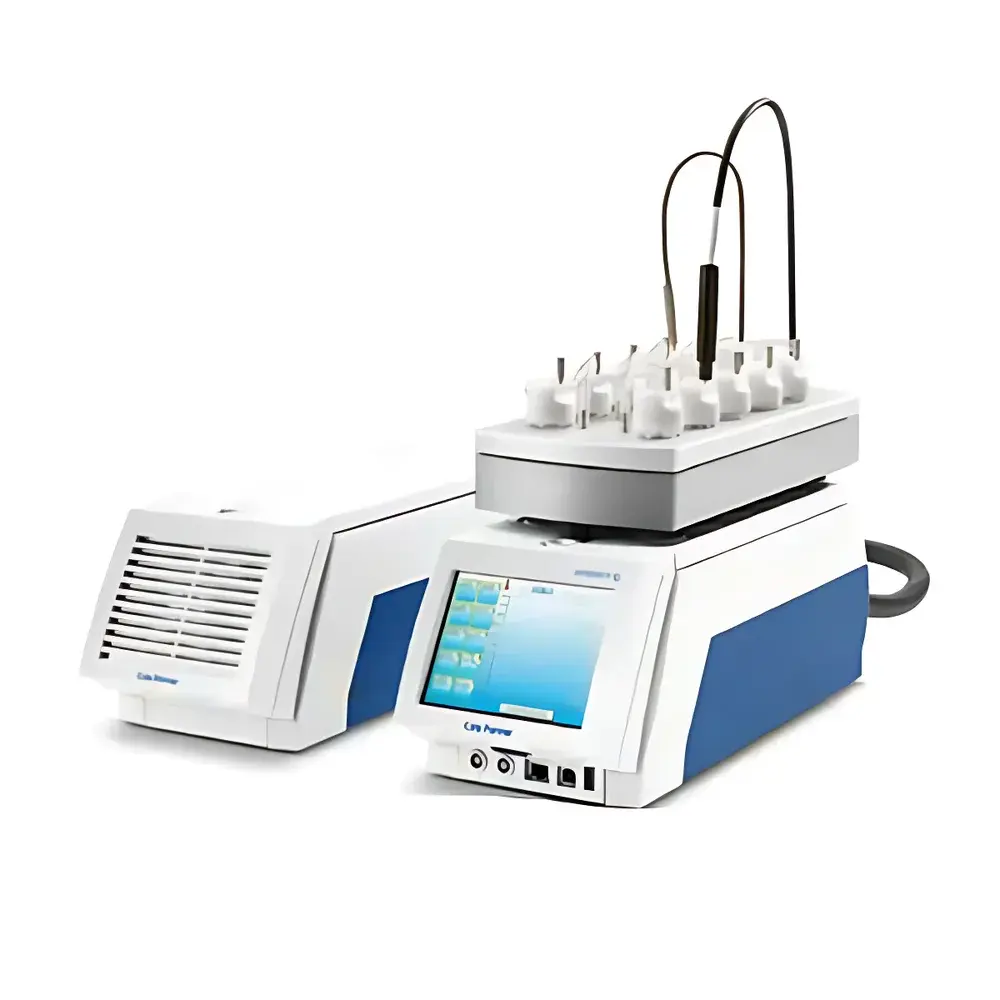
Cole-Parmer Integrity 10 Parallel Reaction & Crystallization Workstation Model 36630-01
| Brand | Cole-Parmer |
|---|---|
| Origin | USA |
| Manufacturer Type | Authorized Distributor |
| Product Category | Imported |
| Model | 36630-01 |
| Price | Upon Request |
| Number of Reaction Vessels | 10 |
| Vessel Diameter | 25.5 mm |
| Working Volume per Vessel | 1–25 mL |
| Temperature Range | −30 °C to +150 °C |
| Max Inter-Vessel Temperature Differential | 180 °C |
| Temperature Setpoint Resolution | 0.01 °C |
| Temperature Accuracy | ±0.5 °C |
| Heating/Cooling Rate | 0.1–5 °C/min (0.1 °C increments) |
| Stirring Speed Range | 350–1200 rpm |
| Stirring Speed Resolution | 1 rpm |
| Stirring Speed Accuracy | ±10 rpm |
| Recommended Stir Bars | 12×4.5 mm (bar-shaped) or 10×6 mm (elliptical) |
| Max Viscosity Handling | Glycercin at 25 °C |
| Optional Accessories | Reflux/Inert Gas Kit (36630-97), Multi-Temp10 Module (36630-80), Non-invasive IR Probe (36630-90), Immersive NIR/FIR Probes (36630-88, 36630-91), Multi-IR Probe Insertion Hub (36630-89), Integrity Software (36630-92) |
Overview
The Cole-Parmer Integrity 10 Parallel Reaction & Crystallization Workstation (Model 36630-01) is an engineered platform for high-throughput, thermally controlled reaction screening and solid-phase process development. Designed around a modular Peltier-based thermal management architecture, it enables precise, independent temperature control across ten discrete reaction zones—each operating simultaneously under distinct thermal profiles. The system implements closed-loop PID temperature regulation with real-time feedback from calibrated Pt100 sensors, delivering reproducible thermal ramping (0.1–5 °C/min) and stability within ±0.5 °C over the full operational range of −30 °C to +150 °C. Coupled with digitally regulated magnetic stirring (350–1200 rpm, ±10 rpm accuracy), the Integrity 10 supports kinetic studies, polymorph screening, solubility mapping, and nucleation onset detection—particularly when integrated with optional non-invasive or immersed infrared (NIR/FIR) probes for in situ monitoring of phase transitions and concentration changes.
Key Features
- 10 independently controlled reaction stations with individual PID temperature regulation and stir speed control
- Wide thermal operating range: −30 °C to +150 °C, with inter-vessel differential capability up to 180 °C
- High-resolution thermal programming: 0.01 °C setpoint resolution, 0.1 °C/min minimum ramp increment
- Digital magnetic stirring with 1 rpm resolution and consistent torque delivery across viscosity ranges (validated with glycerol at 25 °C)
- Touchscreen HMI with embedded microprocessor controller; no external PC required for basic operation
- Modular expansion interface supporting reflux condensation, inert gas purging (N₂, Ar), and vacuum operation via PTFE gas lines
- Compatibility with multiple vessel formats: standard 24×150 mm glass tubes (SVL 22 thread), conical microtubes (1–3 mL), and custom inserts
- Optional Multi-Temp10 module (36630-80) enables synchronized multi-point temperature validation across all vessels
Sample Compatibility & Compliance
The Integrity 10 accommodates a broad spectrum of sample types—from low-volume crystallization screens (1 mL) to 25 mL reaction batches—using chemically resistant borosilicate glass, PTFE-sealed caps, and stainless-steel hardware. All wetted components comply with USP Class VI biocompatibility standards. When configured with the Integrity Software (36630-92), the system supports audit-trail-enabled data capture aligned with FDA 21 CFR Part 11 requirements, including electronic signatures, user access controls, and immutable event logging. Temperature and stirring parameters are traceable to NIST-traceable calibration records. The platform meets ISO/IEC 17025 criteria for method validation in QC laboratories and is routinely deployed in GLP-compliant environments for early-stage API solid-form assessment per ICH Q5A and Q6A guidelines.
Software & Data Management
Integrity Software (36630-92) provides a secure, Windows-based interface for advanced protocol scripting, real-time parameter visualization, and automated data export (CSV, PDF, XML). It supports multi-step temperature ramps with hold times, conditional triggers (e.g., “hold until IR signal plateau”), and concurrent logging of temperature, stir speed, and optional probe outputs (e.g., absorbance at 1600 cm⁻¹ for carbonyl band tracking). Raw sensor data is timestamped with millisecond precision and stored in encrypted project files. The software includes built-in tools for baseline correction, derivative analysis, and comparative overlay of up to 10 parallel runs—enabling rapid identification of metastable zone widths, induction times, and polymorphic conversion kinetics. Exported datasets integrate natively with MATLAB, Python (via Pandas), and industry-standard LIMS platforms through ODBC and RESTful API endpoints.
Applications
- Polymorph and solvate screening under controlled cooling/heating gradients
- Supersaturation generation and nucleation kinetics modeling
- Solubility curve determination across temperature and solvent composition matrices
- Catalytic reaction optimization with parallel variation of T, t, and stoichiometry
- Crystallization endpoint detection using in situ IR spectroscopy (e.g., loss of solvent peak intensity)
- Thermal stability profiling of intermediates and final APIs
- Method transfer support between lab-scale screening and pilot-scale crystallizers
FAQ
What is the maximum allowable viscosity for reliable stirring at 1200 rpm?
The system is validated for continuous operation with glycerol (1412 mPa·s at 25 °C) using recommended 10×6 mm elliptical stir bars. Higher viscosities may require reduced speed or alternative bar geometry.
Can the Integrity 10 be integrated into a larger automation framework?
Yes—RS-232 and Ethernet interfaces support SCPI command sets for integration with robotic liquid handlers, environmental chambers, and centralized LIMS via Modbus TCP or OPC UA protocols.
Is calibration documentation provided with the unit?
Each unit ships with a factory calibration certificate covering temperature sensors and stir motor encoder outputs, traceable to NIST standards. Annual recalibration services are available through Cole-Parmer’s ISO/IEC 17025-accredited service centers.
How does the non-invasive IR probe (36630-90) interface with the system?
It mounts externally on compatible glass vessels and connects via fiber-optic cable to the Multi-IR hub (36630-89), enabling real-time transmission of spectral data directly into Integrity Software without vessel modification.
What safety features prevent thermal runaway during unattended operation?
Hardware-enforced thermal cutoffs (±10 °C beyond setpoint), independent overtemperature monitoring circuits, and automatic stir shutdown upon lid removal or pressure anomaly detection ensure fail-safe operation during overnight or weekend runs.
Related Products