
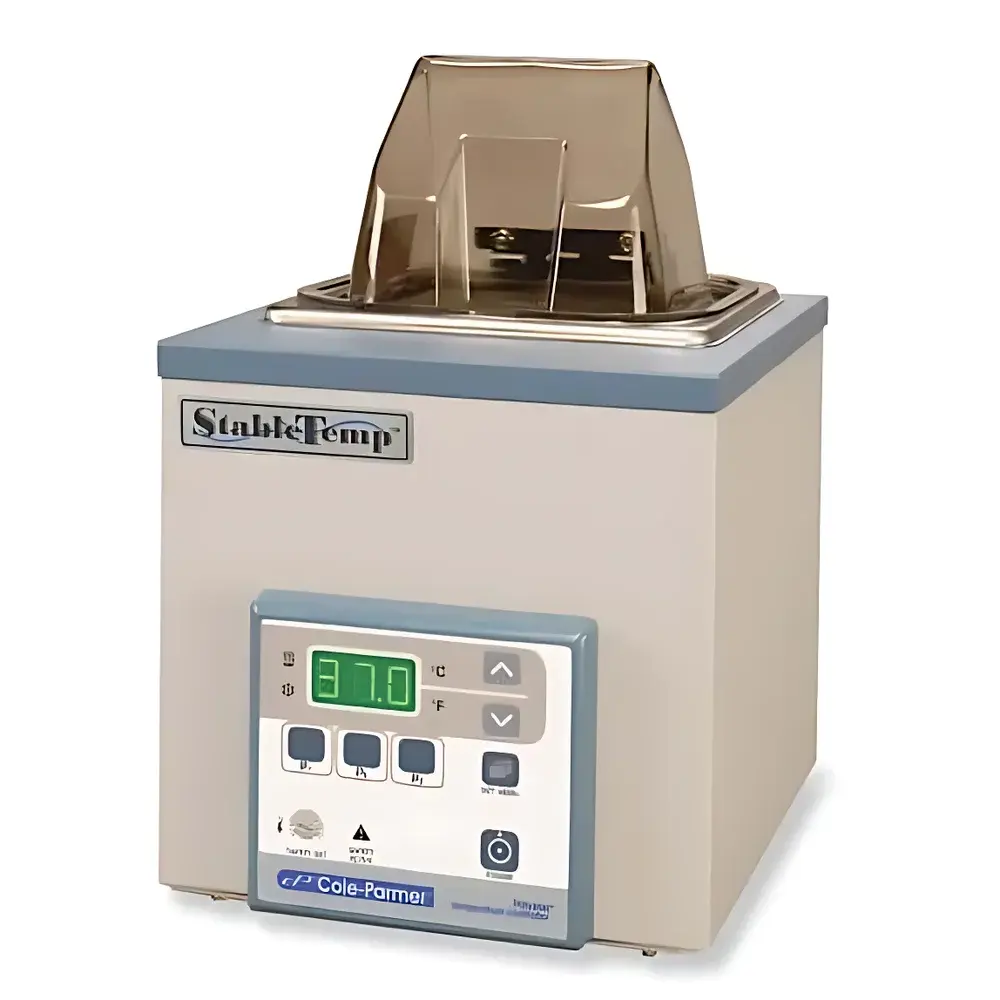
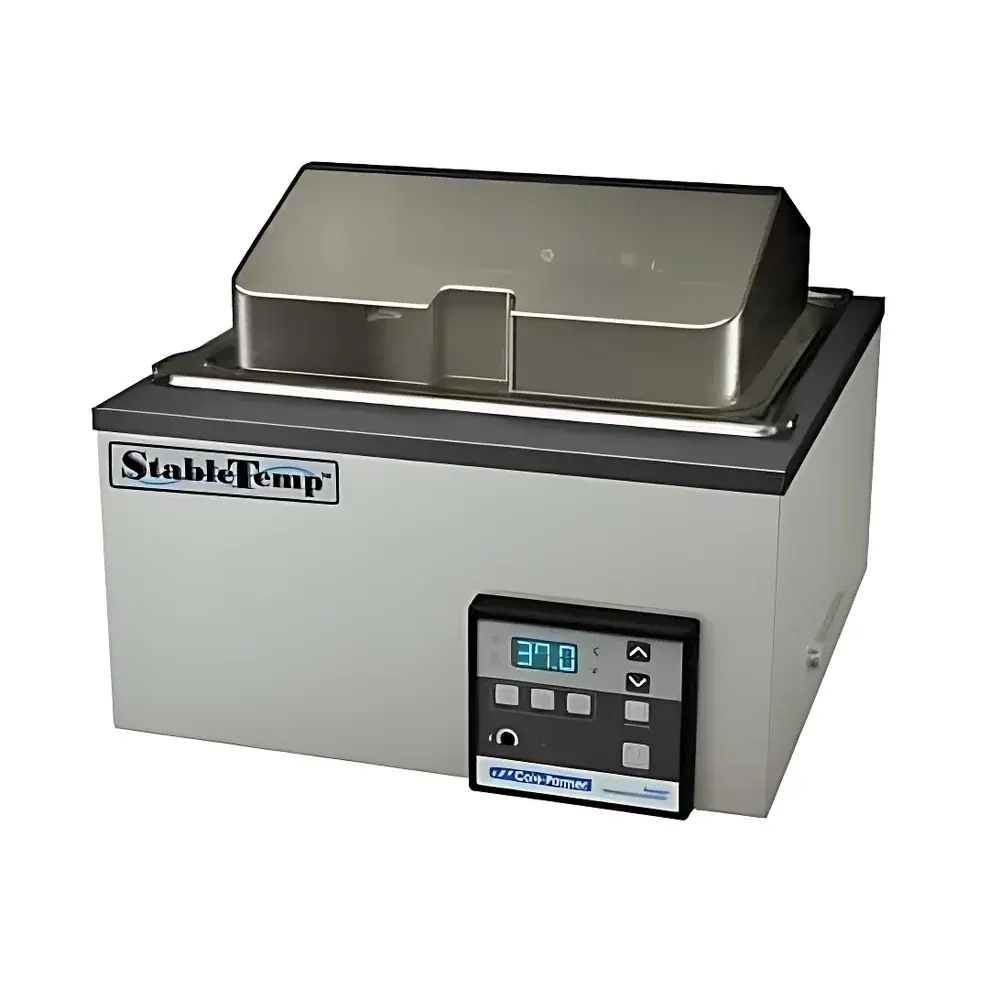
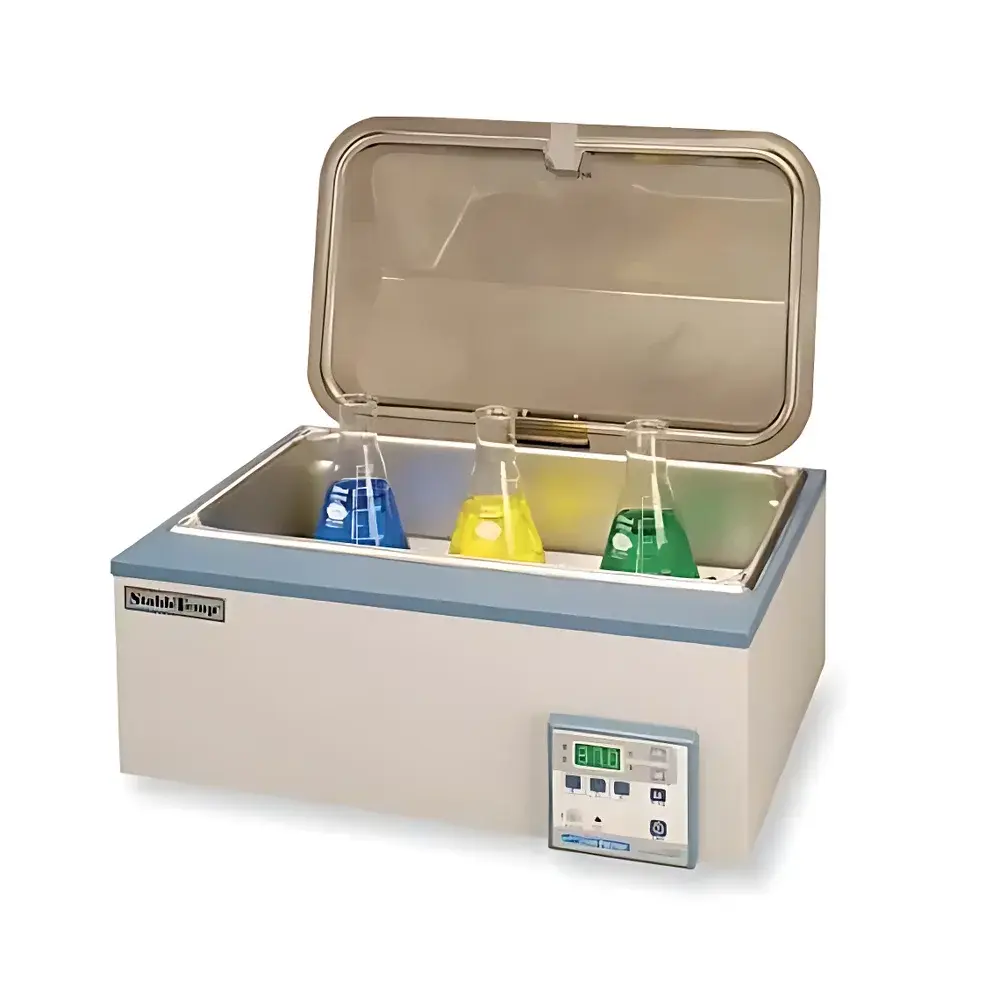
Cole-Parmer StableTemp Heated Water Bath Model 14575-02
| Brand | Cole-Parmer |
|---|---|
| Origin | USA |
| Manufacturer Type | Authorized Distributor |
| Product Category | Imported |
| Model | 14575-02 |
| Instrument Type | Constant-Temperature Bath |
| Circulation Mode | Internal & External Circulation |
| Temperature Control | Heating-Only |
| Bath Capacity | 2 L |
| Temperature Range | Ambient to 100 °C |
| Temperature Stability | ±0.25 °C |
Overview
The Cole-Parmer StableTemp Heated Water Bath Model 14575-02 is a precision-engineered, compact constant-temperature bath designed for reliable thermal control in analytical, biochemical, and pharmaceutical laboratory workflows. Operating on the principle of resistive heating combined with PID-controlled feedback regulation, this unit maintains consistent thermal environments for sample incubation, enzyme assays, viscosity standardization, and reagent pre-warming. Its 2 L stainless steel (304 SS) seamless bath chamber ensures corrosion resistance and long-term structural integrity, while the external epoxy-coated housing provides protection against moisture and chemical exposure typical in shared lab settings. The bath achieves temperature stability of ±0.25 °C at setpoints across its full operating range (ambient to 100 °C), verified under steady-state conditions per ASTM E2209–22 guidelines for liquid-bath performance evaluation. Designed for compliance-ready environments, it incorporates dual safety mechanisms — low-level water detection with audible alarm and independent overtemperature cutoff — satisfying essential requirements for GLP-aligned instrumentation.
Key Features
- 304 stainless steel seamless bath tank with electropolished interior surface for easy cleaning and minimized microbial retention
- PID microprocessor-based temperature controller with LED digital display for real-time setpoint and actual temperature readout
- High-accuracy 100 Ω platinum RTD sensor (Pt100) integrated into the bath wall for direct fluid-phase temperature measurement
- Tapered conical lid design minimizes condensation loss and directs condensed water back into the bath, preserving volume and thermal mass
- Internal and external circulation capability enables connection to external jackets, reactors, or inline chillers via standard ¼” NPT ports
- Low-water-level alarm and independent mechanical overtemperature shutoff (set at 105 °C) provide redundant thermal safety per IEC 61010-1
- 240 V AC, 50 Hz power input with CE-marked internal fuse and grounded chassis for international electrical compliance
Sample Compatibility & Compliance
The Model 14575-02 accommodates standard laboratory glassware up to 15 cm in height, including test tubes, culture flasks, centrifuge tubes, and small-volume reaction vessels. Its compact internal dimensions (9.9 × 10.9 × 14 cm L×W×H) support vertical immersion without lateral instability. The bath is compatible with aqueous solutions, buffered saline, glycerol-water mixtures, and silicone oils (e.g., Dow Corning 210H) when operated within validated viscosity and thermal conductivity limits. It meets ISO/IEC 17025:2017 clause 6.4.7 for equipment suitability in testing laboratories and supports traceable calibration per ISO/IEC 17025 Annex A.2 through optional NIST-traceable RTD verification kits (sold separately). No modifications are required to satisfy FDA 21 CFR Part 11 data integrity expectations when used with compliant logging software.
Software & Data Management
While the Model 14575-02 operates as a standalone analog-controlled instrument, it features a dedicated analog output port (0–5 V DC) compatible with third-party data acquisition systems (e.g., LabVIEW, MATLAB, or PLC-based SCADA platforms) for continuous temperature logging. Optional RS-232 interface modules (Cat. No. EW-14575-50) enable bidirectional communication for remote setpoint adjustment and alarm status polling. All recorded temperature profiles can be exported in CSV format for audit trail generation, supporting GLP/GMP documentation requirements. Firmware updates are not applicable; hardware-level calibration parameters remain fixed per factory certification, ensuring long-term metrological consistency without drift-related recalibration cycles.
Applications
- Enzyme kinetic studies requiring precise thermal stabilization during spectrophotometric monitoring
- Cell culture media pre-warming prior to aseptic transfer in biosafety cabinets
- Standardization of viscometer calibration baths per ASTM D445 and ISO 3104
- Thermal equilibration of HPLC mobile phase solvents before gradient elution
- Controlled hydrolysis reactions in organic synthesis where exothermicity must be mitigated
- Stability testing of thermolabile pharmaceutical formulations under accelerated conditions
- Calibration of thermocouples and digital thermometers using fixed-point reference standards
FAQ
Is the Model 14575-02 suitable for use with silicone oil?
Yes — when paired with Dow Corning 210H silicone oil (Cat. No. 210H), the bath can operate safely up to 280 °C; however, maximum recommended oil fill level is 80% of chamber volume to prevent overflow during thermal expansion.
Does this unit support external temperature probes?
No — temperature sensing is exclusively performed by the integrated Pt100 RTD embedded in the bath wall; external probe inputs are not supported.
Can the unit be upgraded to include shaking functionality?
No — the 2 L configuration (14575-02) does not accept oscillating base accessories; only models 14575-18 (20 L) and 14575-22 (28 L) are mechanically compatible with oscillation kits (Cat. Nos. 12504-65 and 12504-75).
What is the recommended calibration interval?
Annual verification against a NIST-traceable reference thermometer is advised per ISO/IEC 17025 Section 6.6, particularly in regulated QC/QA environments.
Is the bath compatible with vacuum-insulated containers?
Yes — the open-top design allows placement of Dewar flasks or double-walled vessels; however, thermal response time will increase due to reduced conductive coupling, and stability may degrade to ±0.5 °C under such configurations.



