
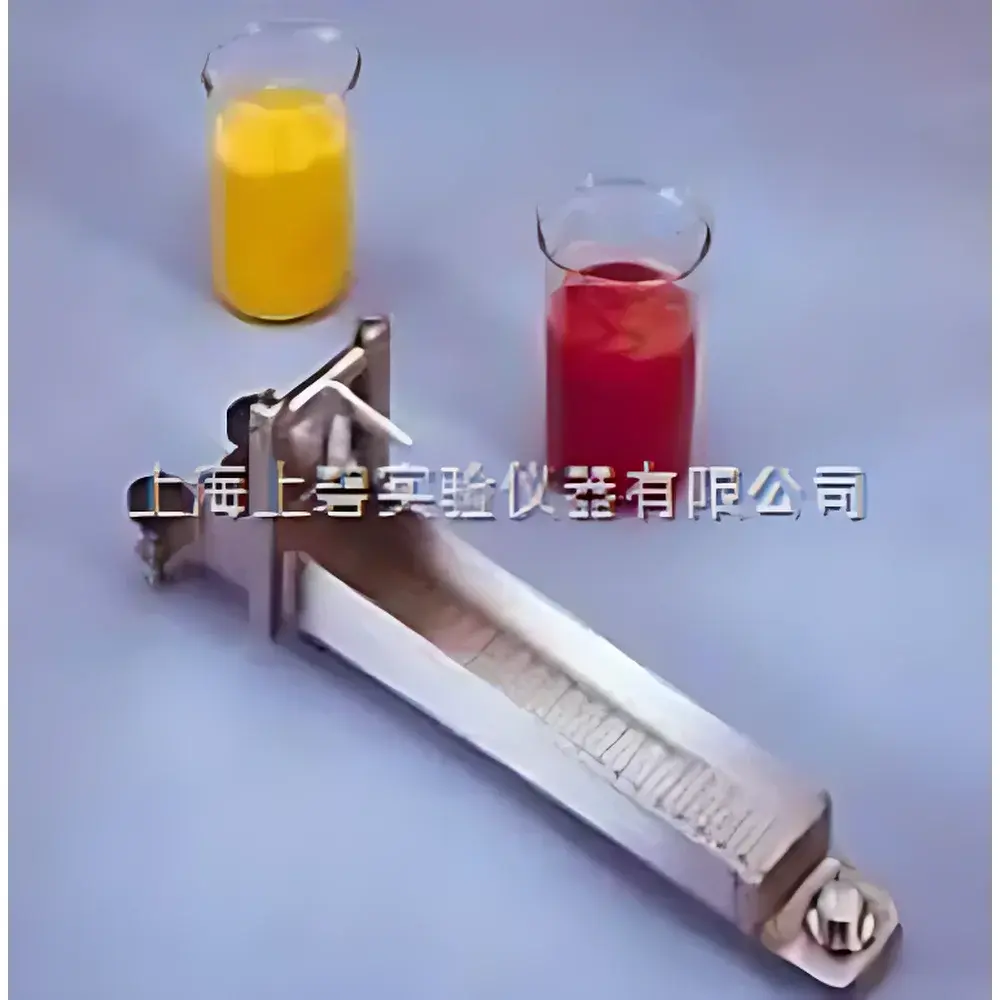
Consistometer Flow-Through Viscometer Model 24925-000
| Origin | USA |
|---|---|
| Manufacturer Type | Authorized Distributor |
| Origin Category | Imported Instrument |
| Model | 24925-000 |
| Instrument Type | Efflux Viscometer |
| Sample Volume | 75 mL |
| Orifice Distance | 0.5 cm |
| Construction Material | Corrosion-Resistant Stainless Steel |
| Dimensions (L×W×H) | 35.6 × 8.9 × 14 cm |
| Weight | 1.4 kg |
| Compliance | ASTM D1200, ISO 2431, BS 3900-A4, DIN 53211 |
Overview
The Consistometer Flow-Through Viscometer Model 24925-000 is a precision-engineered efflux viscometer designed for rapid, repeatable determination of kinematic viscosity in low-to-medium viscosity Newtonian and near-Newtonian liquids—particularly coatings, inks, varnishes, lacquers, and solvent-based formulations. Unlike rotational or capillary viscometers, the Consistometer operates on a gravity-driven efflux principle: a fixed volume (75 mL) of sample is released under its own weight through a precisely dimensioned orifice, and the time required to flow across a calibrated 0.5 cm reference distance is measured using a standard stopwatch. This time-based efflux measurement is directly correlated to kinematic viscosity via empirical calibration curves traceable to ASTM D1200 and ISO 2431 standards. Its compact, benchtop design and stainless-steel construction ensure long-term dimensional stability and resistance to chemical degradation during routine QC testing in paint manufacturing, R&D laboratories, and quality assurance environments.
Key Features
- Corrosion-resistant 316 stainless-steel body engineered for compatibility with aggressive solvents, aliphatic/aromatic hydrocarbons, and acidic or alkaline coating formulations.
- Precision-machined orifice assembly with fixed 0.5 cm linear measurement interval—minimizing parallax error and enabling consistent timing across operators.
- Integrated spring-actuated gate mechanism ensures instantaneous, reproducible sample release—eliminating manual valve lag and reducing inter-operator variability.
- Minimal sample requirement of 75 mL reduces material consumption and waste—critical for high-value or hazardous formulations.
- Benchtop footprint (35.6 × 8.9 × 14 cm) and lightweight design (1.4 kg) support portability between production lines, lab stations, and field testing locations.
- No external power, electronics, or calibration fluids required—ensuring operational simplicity and compliance with intrinsic safety requirements in solvent-handling zones.
Sample Compatibility & Compliance
The Model 24925-000 is validated for use with Newtonian and mildly shear-thinning liquids exhibiting kinematic viscosities typically ranging from ~20 to 500 cSt (mm²/s), depending on orifice geometry and temperature control. It is routinely employed in accordance with ASTM D1200 (“Standard Test Method for Saybolt Viscosity of Petroleum Products”) and ISO 2431 (“Paints and varnishes — Determination of flow time by flow cups”), as well as BS 3900-A4 and DIN 53211. While not intended for non-Newtonian or highly thixotropic systems, its results are accepted as specification-grade data in supplier qualification protocols and incoming raw material inspection per ISO 9001 and IATF 16949 frameworks. The instrument’s mechanical design conforms to GLP-aligned documentation practices—each test record includes operator ID, ambient temperature, sample batch number, efflux time, and reference standard used.
Software & Data Management
This is a fully manual, analog viscometer requiring no embedded firmware, software drivers, or digital interfaces. All measurements are recorded manually and entered into laboratory information management systems (LIMS) or electronic lab notebooks (ELN) compliant with FDA 21 CFR Part 11 when paired with validated procedural controls. Users may integrate timing data from certified digital stopwatches (e.g., NIST-traceable quartz chronometers) into structured spreadsheets or statistical process control (SPC) platforms such as Minitab or JMP. Calibration verification is performed semi-annually using certified reference oils (e.g., Cannon–Fenske standards), with records retained for audit readiness under ISO/IEC 17025 and GMP Annex 11 requirements.
Applications
- Batch release testing of architectural and industrial coatings prior to canning or shipment.
- In-process viscosity monitoring during pigment dispersion and let-down stages in paint manufacturing.
- Supplier qualification of resins, thinners, and rheology modifiers based on efflux time specifications.
- Comparative screening of formulation variants during product development (e.g., solvent substitution studies).
- Training tool for viscosity fundamentals in academic and vocational laboratory curricula.
- Field verification of viscosity stability during storage or transport of solvent-borne products.
FAQ
Is the Consistometer Model 24925-000 suitable for measuring non-Newtonian fluids?
No—its efflux principle assumes laminar, gravity-driven flow with negligible shear-rate dependence. Thixotropic, pseudoplastic, or yield-stress materials require rotational rheometry.
What temperature control is required during testing?
Testing must be conducted at standardized temperature (typically 25 °C ± 0.5 °C) using a water bath or climate-controlled lab environment; viscosity is highly temperature-sensitive.
Can this instrument be used for regulatory submissions?
Yes—when operated per ASTM D1200 or ISO 2431 with documented calibration, environmental control, and operator training, data are admissible in regulatory dossiers for coatings and related chemical products.
Does the instrument include calibration certificates?
No—calibration is performed using traceable reference oils; end users are responsible for establishing and maintaining their own calibration schedule per ISO/IEC 17025.
How often should the orifice be cleaned or inspected?
After each use with solvent-rinsing and compressed air drying; visual inspection for burrs or deposits is recommended before every test series.
Related Products



