
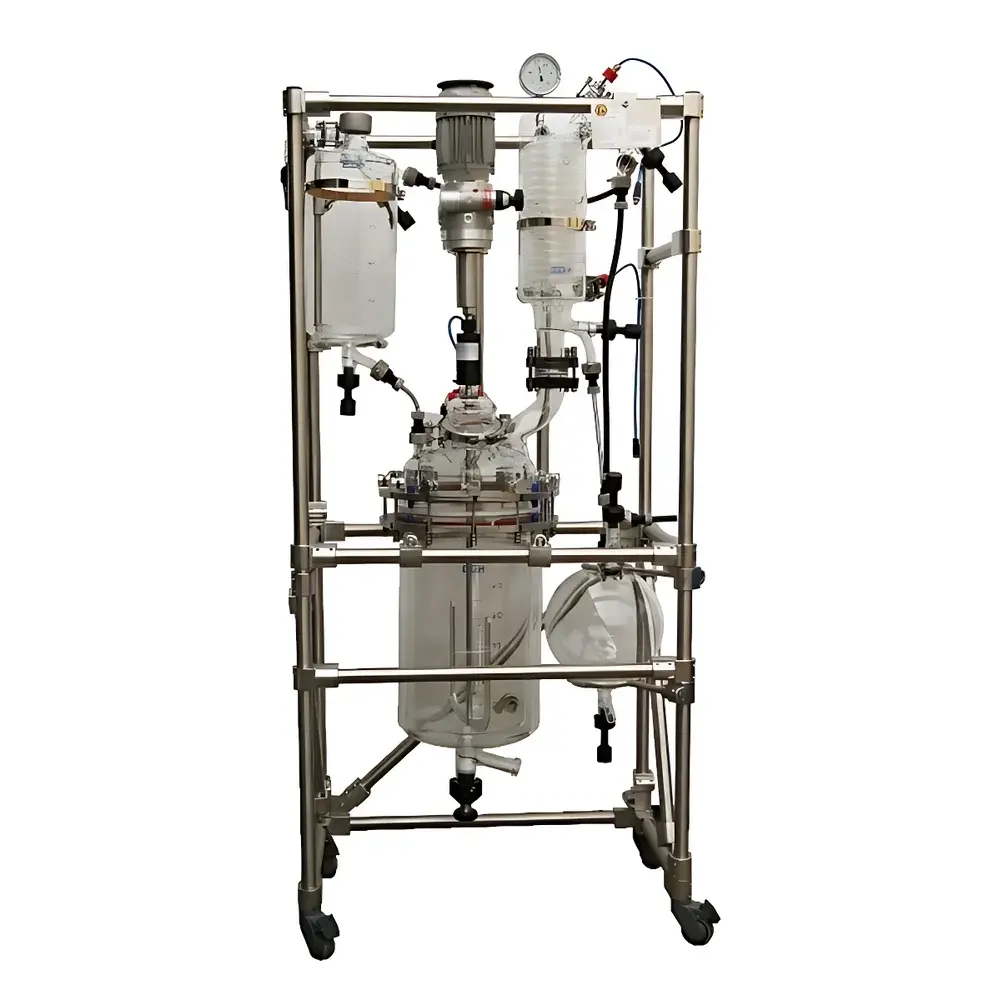
DIEHM EX-Proof GMP-Compliant Kilolab Glass Reactor Series
| Brand | DIEHM |
|---|---|
| Origin | Germany |
| Model Range | 10 L to 150 L |
| Vessel Material | Borosilicate Glass 3.3 (DIN ISO 3585) |
| Maximum Working Volume | 150 L |
| Jacketed Design | Yes |
| Operating Pressure | ≤ 0.5 bar(g) |
| Vacuum Capability | ≤ 1 mbar (abs) |
| Explosion Protection | ATEX Category 2G, II 2G Ex db IIB T4 Gb |
| GMP Compliance | Designed per EU GMP Annex 1 & USP <1058> for equipment qualification |
| Stirring System | PTFE-coated or all-glass impeller, magnetically coupled or explosion-proof motor drive |
| Sealing | FDA-compliant PTFE/FFKM elastomer seals, zero-dead-leg geometry |
| Temperature Monitoring | Integrated Pt100 sensors for jacket, vapor, and reaction mass |
| Feed & Sampling | Multiple standardized NS29/NS45 ports, bottom valve with PTFE seat, side port for in-line sampling |
| Structural Support | Stainless Steel 316L frame with adjustable leveling feet |
| Thermal Integration | Dual-port jacket (in/out) compatible with LAUDA, JULABO, Huber, and other external circulators |
Overview
The DIEHM EX-Proof GMP-Compliant Kilolab Glass Reactor Series is a purpose-engineered platform for scalable, safe, and auditable chemical synthesis and pharmaceutical process development under regulated environments. Built upon decades of German glass engineering expertise since 1985, these reactors employ borosilicate glass 3.3 (DIN ISO 3585) as the primary process-wetted material—ensuring exceptional chemical resistance, optical clarity for real-time visual monitoring, and thermal shock resilience up to ΔT = 120 °C. The reactor operates under low-pressure conditions (≤ 0.5 bar gauge) and high vacuum (≤ 1 mbar absolute), enabling solvent reflux, controlled evaporation, inert gas purging, and moisture-sensitive reactions. Its intrinsic safety architecture integrates ATEX-certified explosion protection (Category 2G, II 2G Ex db IIB T4 Gb) for use in Zone 1 hazardous areas—critical for handling flammable solvents such as acetone, THF, or ethanol during kilogram-scale batch synthesis. Designed explicitly for GMP-aligned laboratories and pilot plants, the system adheres to foundational principles outlined in EU GMP Annex 1 (sterile/non-sterile manufacturing), USP Analytical Instrument Qualification, and ICH Q7 guidelines for active pharmaceutical ingredient (API) production.
Key Features
- Modular glass vessel construction (10–150 L) with precision-ground joints (ISO 228/1, NS29, NS45) ensuring leak-tight integrity and interchangeability across configurations
- Zero-dead-leg design: PTFE-seated bottom discharge valve and smooth internal contours eliminate product retention—validated for cleaning-in-place (CIP) and meet ALCOA+ data integrity requirements
- Multi-port reactor head (4–5 standardized ports) accommodating temperature probes, pH/ORP electrodes, condenser connections, addition funnels, and inert gas inlets without compromising structural rigidity
- Double-jacketed thermal management system with dual 1.5″ BSP inlet/outlet ports, engineered for seamless integration with external heating/cooling circulators (e.g., LAUDA PRESTO, Huber CHILLER)
- Magnetically coupled or ATEX-certified explosion-proof stirring drive (IECEx/ATEX), supporting variable-speed control (0–250 rpm) and torque monitoring for crystallization, hydrogenation, or polymerization workflows
- Stainless steel 316L support frame with vibration-dampening feet, load-rated for full operational weight (up to ~220 kg at 150 L), and compliant with ISO 14644-1 Class 7 cleanroom installation standards
Sample Compatibility & Compliance
These reactors accommodate heterogeneous and homogeneous reaction mixtures—including suspensions, slurries, viscous solutions, and gas-liquid systems—without material compatibility concerns. Borosilicate glass 3.3 resists attack from strong acids (HNO₃, HCl), alkalis (NaOH ≤ 20%), and most organic solvents. All elastomeric components (seals, gaskets, diaphragms) are manufactured from FDA-listed FFKM or virgin PTFE, fully extractable-residue tested per USP . The system supports IQ/OQ/PQ documentation packages aligned with ASTM E2500, ISO 9001:2015, and 21 CFR Part 11-compliant electronic records when paired with validated SCADA or LabArchives data acquisition modules.
Software & Data Management
While the base reactor is hardware-only, it interfaces directly with third-party process control systems via 4–20 mA analog outputs (temperature, pressure, stirrer speed) and digital RS485 Modbus RTU. When integrated with certified software platforms (e.g., DeltaV, Siemens Desigo, or custom LabVIEW-based DAQ), full audit trail functionality—including user access logs, parameter change history, and timestamped event recording—is achievable. All sensor inputs comply with NIST-traceable calibration protocols; temperature uncertainty is maintained within ±0.3 °C (k=2) across the –20 °C to +200 °C operational range.
Applications
- GMP-compliant API intermediate synthesis (batch sizes 1–10 kg)
- Crystallization process optimization and polymorph screening
- Catalytic hydrogenation under controlled H₂ partial pressure
- Solvent recovery and concentration under vacuum
- Photochemical reactions using UV-transparent glass vessels
- Process safety testing (RC1, ARC) requiring transparent, pressure-rated containment
FAQ
Is this reactor suitable for sterile applications?
No—it is designed for non-sterile GMP synthesis. Sterilization by steam (SIP) is not supported due to glass thermal limits; autoclaving is prohibited.
Can the reactor be validated for regulatory submissions?
Yes. Full IQ/OQ documentation templates, FAT/SAT protocols, and material traceability dossiers (including CoA for glass and FFKM) are available upon request.
What is the maximum allowable jacket temperature?
The standard double-jacket configuration supports circulating fluids up to +200 °C (thermal oil) or down to –80 °C (specialized cryo-fluids), contingent on external circulator capability.
Are replacement parts available globally?
Yes. DIEHM maintains an authorized spare parts network across EMEA, APAC, and North America; critical components (glass vessels, seals, PTFE valves) carry ≥5-year shelf-life certification.
Does the system include pressure relief protection?
Standard configuration includes a calibrated rupture disc (set point: 0.8 bar(g)) mounted on the reactor head, compliant with PED 2014/68/EU requirements.



