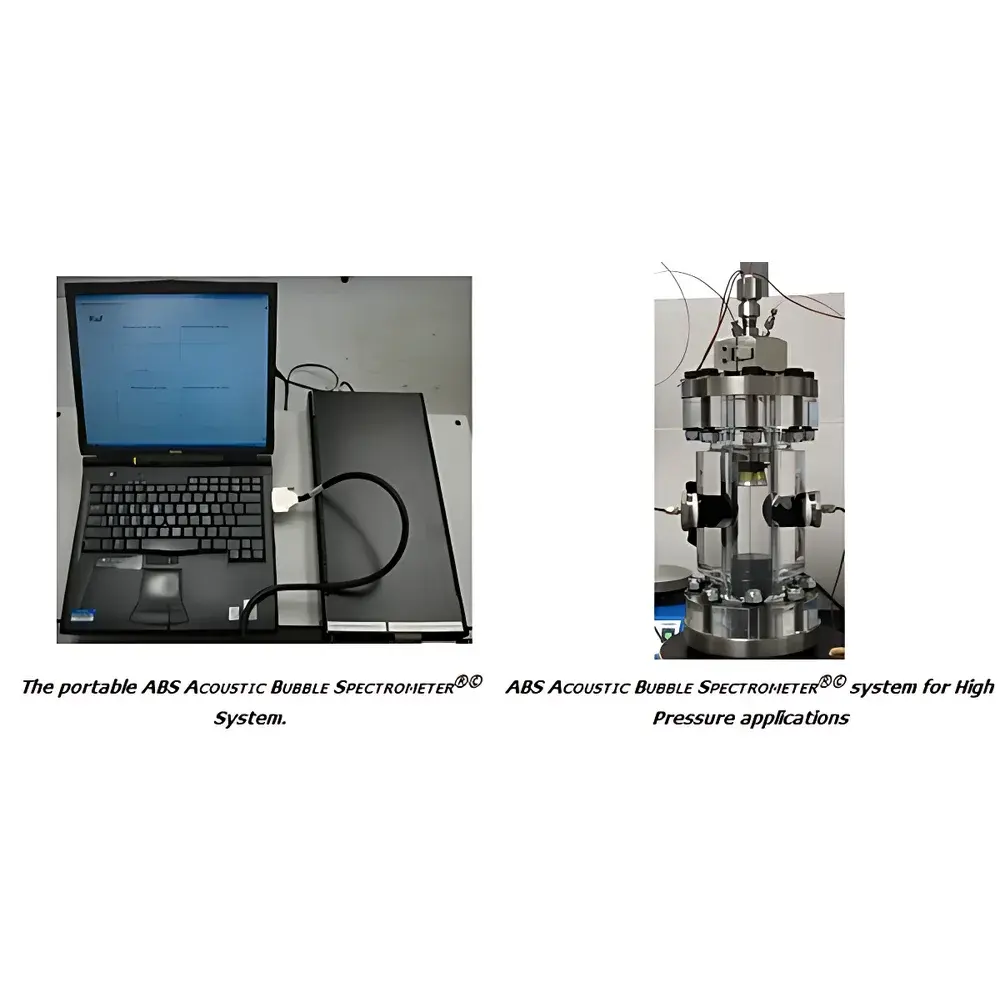
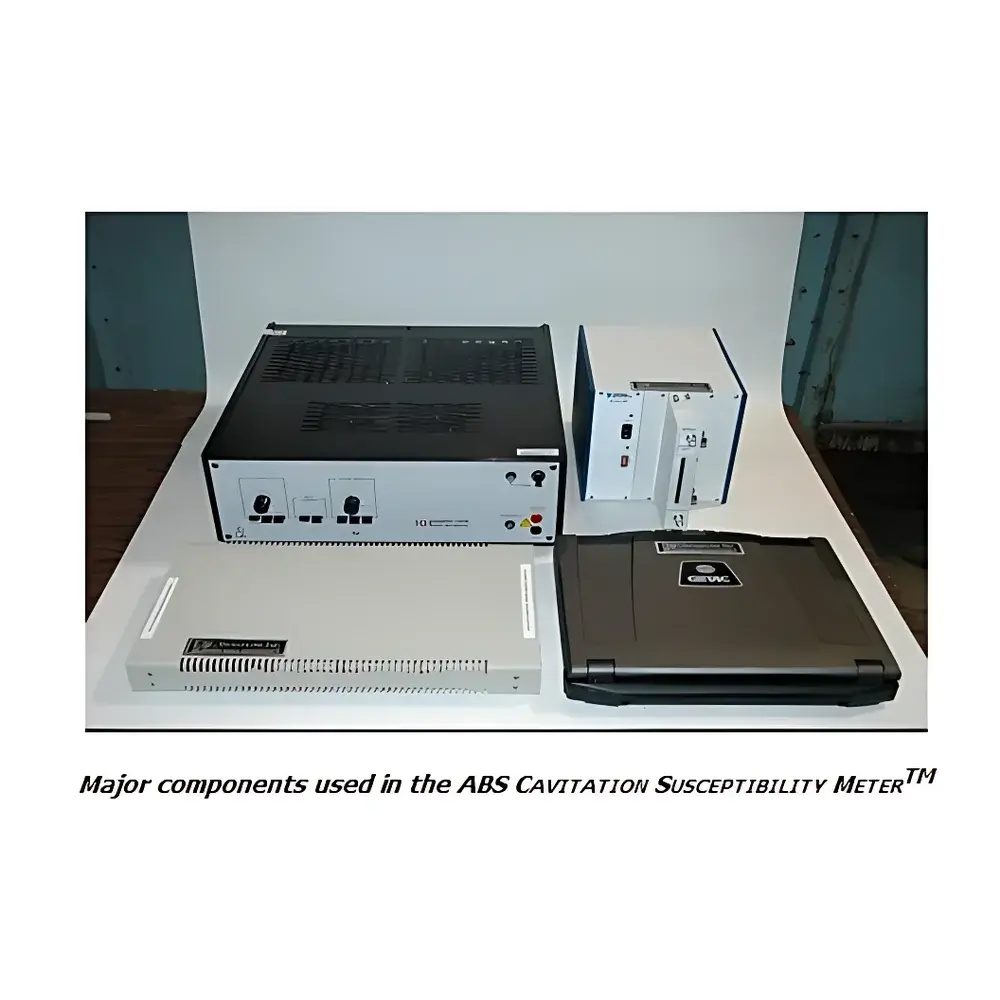
Dynaflow ABS Non-Invasive Acoustic Bubble Spectrometer
| Origin | USA |
|---|---|
| Manufacturer Type | Distributor |
| Origin Category | Imported |
| Model | Dynaflow ABS |
| Price Range | USD 14,000 – 70,000 |
Overview
The Dynaflow ABS Non-Invasive Acoustic Bubble Spectrometer is an engineered solution for quantitative, real-time characterization of gas bubble size distribution and local void fraction in opaque, multiphase liquid systems. Unlike optical techniques—such as high-speed imaging or laser diffraction—the ABS operates on the principle of broadband acoustic scattering, leveraging the orders-of-magnitude higher compressibility contrast between gas bubbles and liquid media. This enables robust discrimination of sub-millimeter bubbles (down to ~10 µm equivalent spherical diameter) from solid particles, suspended debris, or biological cells—even in highly turbid, non-transparent, or geometrically constrained environments. The system is grounded in linear acoustics theory for small-amplitude pressure waves and employs inverse scattering algorithms validated against calibrated bubbly flow standards. It is not a qualitative indicator but a metrologically traceable instrument designed for repeatable, physics-based quantification under dynamic flow conditions.
Key Features
- Non-invasive, contactless measurement—no optical access, no sample extraction, no flow interruption
- Simultaneous acquisition of bubble size distribution (BSD) and local void fraction with spatial resolution defined by transducer beam geometry and signal processing windowing
- High-fidelity broadband acoustic detection: dual-channel, 10 MS/s per channel data acquisition with synchronized excitation and reception
- Modular transducer architecture: standard ½″ hydrophone-compatible piezoelectric transducers; optional array configurations for tomographic reconstruction
- Real-time signal processing firmware with adaptive noise suppression and time-domain deconvolution for improved bubble sizing accuracy
- Windows-based ABS software suite with intuitive GUI, configurable acquisition protocols, and batch-processing pipelines for post-experiment analysis
Sample Compatibility & Compliance
The ABS is compatible with aqueous, organic, and viscous liquid media—including seawater, blood analogs, polymer solutions, and industrial process fluids—provided acoustic impedance mismatch supports sufficient scattering cross-section. It requires no sample preparation, filtration, or dilution. The system complies with IEC 61000-6-3 (EMC emission standards) and meets mechanical safety requirements per ISO 13857. While not certified as medical device (FDA 510(k) or CE-IVD), its measurement methodology aligns with ASTM E2912–21 (Standard Guide for Acoustic Characterization of Bubbly Flows) and supports GLP-compliant experimental documentation when used with audit-trail-enabled software configuration. Data export formats (CSV, HDF5, MAT) are interoperable with MATLAB, Python (SciPy/NumPy), and LabVIEW environments.
Software & Data Management
The ABS Control & Analysis Suite provides full control over pulse excitation parameters (frequency sweep range, pulse width, repetition rate), gain staging, and digital filtering. All raw RF waveforms and processed spectra are timestamped and stored with metadata (temperature, pressure, flow rate if integrated via analog input). Software features include: automated BSD fitting using Mie scattering models or empirical calibration curves; void fraction estimation via integrated backscatter intensity normalization; comparative overlay tools for multi-condition experiments; and export-ready reporting templates compliant with internal lab SOPs. Optional FDA 21 CFR Part 11 add-on module delivers electronic signature support, user role management, and immutable audit trails for regulated environments.
Applications
- Marine & Propulsion Engineering: Cavitation inception mapping on propeller blades, hydrofoil surfaces, and pump impellers; quantification of wake bubble clouds affecting sonar performance and acoustic signature
- Biomedical Fluid Dynamics: Detection and sizing of microbubbles in extracorporeal circuits, artificial heart valve outflow jets, and decompression-induced intravascular gas emboli
- Energy Systems: Void fraction profiling in nuclear reactor coolant loops, steam generator two-phase flow, and hydroelectric turbine draft tube aeration
- Environmental & Wastewater Engineering: Real-time monitoring of bubble dynamics in membrane bioreactors, fine-bubble diffusers, and flotation unit operations
- Space Fluid Physics: Microgravity multiphase flow studies aboard parabolic flight platforms or ISS payloads, where optical diagnostics are impractical
- Fundamental Research: Validation of CFD multiphase models (e.g., Euler–Euler or population balance approaches), nucleation site density mapping in controlled cavitation tunnels
FAQ
What minimum bubble size can the ABS resolve?
Under typical water-like conditions and with standard 2.25 MHz transducers, the practical lower detection limit is approximately 10–15 µm equivalent spherical diameter, dependent on signal-to-noise ratio and background attenuation.
Can the ABS distinguish between air, CO₂, and oxygen bubbles?
No—the system resolves bubbles based on compressibility and size, not gas composition. Gas identity must be inferred from process context or coupled with dissolved gas analyzers.
Is calibration required before each experiment?
A single factory calibration (traceable to NIST-standard acoustic sources) suffices for routine use. Field verification using reference bubbly flows (e.g., porous frit-generated monodisperse bubbles) is recommended for critical applications.
Does the ABS support integration with existing flow loop instrumentation?
Yes—via analog voltage inputs (0–10 V) for synchronizing with pressure transducers, flow meters, or temperature sensors; digital triggers (TTL) enable hardware-gated acquisition.
What is the maximum operating temperature and pressure?
Standard transducers are rated to 60°C and 10 bar; high-temperature variants (up to 150°C) and high-pressure housings (up to 100 bar) are available as custom options.