
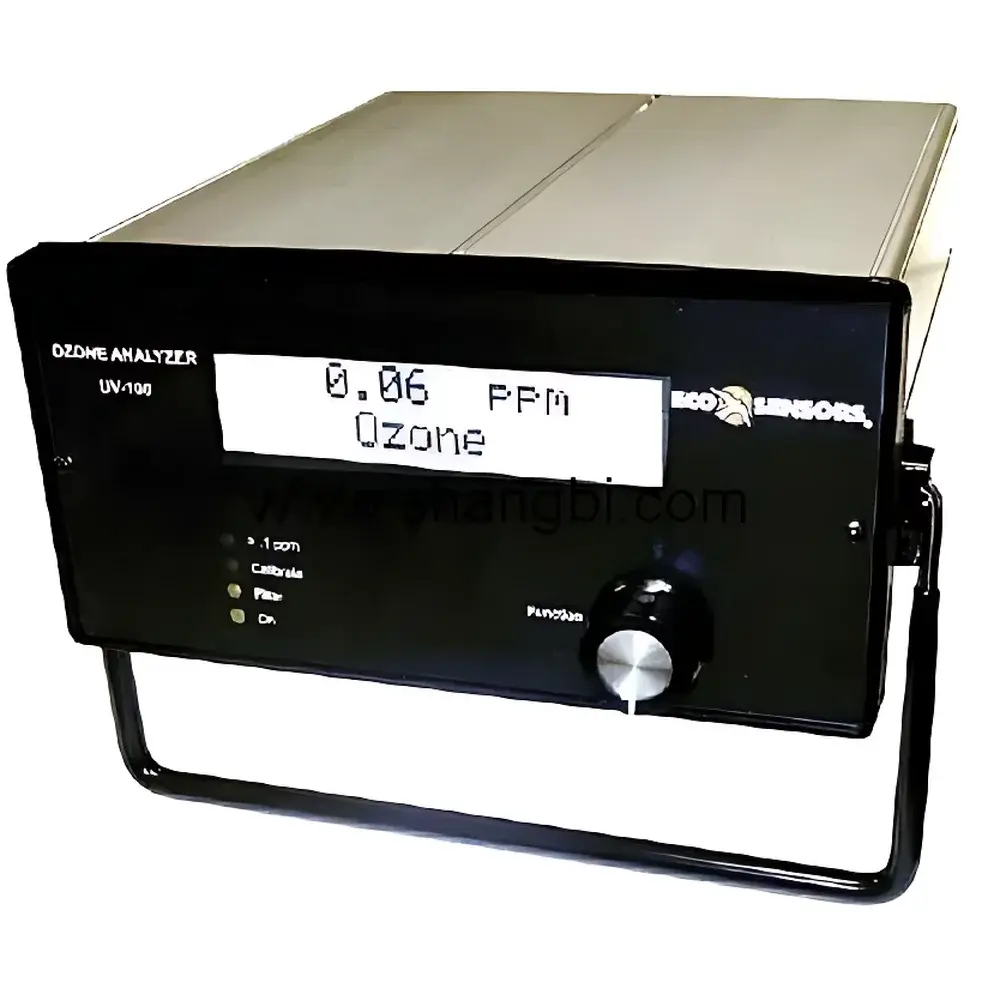
Eco Sensors UV-100 Ultraviolet Ozone Analyzer
| Origin | USA |
|---|---|
| Manufacturer Type | Authorized Distributor |
| Origin Category | Imported |
| Model | UV-100 |
| Price | Upon Request |
Overview
The Eco Sensors UV-100 Ultraviolet Ozone Analyzer is a precision-engineered, benchtop-grade gas analyzer designed for continuous, real-time measurement of ozone (O₃) concentration in ambient air and process streams. It operates on the well-established principle of ultraviolet absorption spectroscopy at 254 nm — the characteristic absorption peak of ozone — enabling highly selective and interference-resistant quantification. The instrument employs a low-pressure mercury vapor lamp as its stable UV source and utilizes a dual-beam optical path architecture to compensate for lamp intensity drift and optical fouling, ensuring long-term baseline stability and measurement reproducibility. Engineered for both laboratory validation and industrial process monitoring, the UV-100 delivers trace-level sensitivity with minimal maintenance requirements and no consumables beyond periodic lamp replacement (typical lifetime > 12 months). Its compact form factor and integrated environmental compensation algorithms make it suitable for deployment across diverse operational environments — from cleanroom HVAC verification to outdoor ambient air quality networks.
Key Features
- Triple-range automatic switching (0–1 ppm, 1–10 ppm, 10–900 ppm) with seamless transition and no manual range selection required
- Dew-Line™ proprietary humidity compensation technology reduces ozone measurement error due to water vapor interference from >100 ppb to <5 ppb — a critical advancement over conventional UV ozone analyzers
- Integrated temperature, relative humidity, and barometric pressure compensation; altitude correction up to 3,000 m (10,000 ft) mitigates up to 14% systematic bias per 1,000 m elevation gain
- Built-in data logger with non-volatile memory (retains ≥ 30 days of 1-minute averaged data)
- Standard analog outputs: 0–2.5 VDC and 4–20 mA (user-configurable scaling), plus RS-232 serial interface for direct PC connectivity without proprietary software
- Onboard LED status indicators for calibration mode, lamp health, and flow integrity
- Integrated particulate filter with replaceable hydrophobic membrane to prevent moisture ingress and aerosol contamination of the optical cell
- Fast response time: T₉₀ ≤ 10 seconds under standard conditions (25°C, 1 atm, 1 L/min flow)
Sample Compatibility & Compliance
The UV-100 is optimized for sampling clean, dry-to-moderately humid ambient air or filtered process gas streams. It is not intended for use with corrosive, condensing, or high-particulate matrices without appropriate external conditioning (e.g., Nafion dryers, heated sample lines, or coalescing filters). The analyzer meets fundamental performance criteria outlined in U.S. EPA Reference Method EQOA-01 for ozone monitoring instruments and complies with ISO 13964:2022 (Ambient air — Determination of ozone — UV photometric method). Its analog output signals are compatible with SCADA, DCS, and PLC systems adhering to IEC 61000-4 electromagnetic compatibility standards. For regulated environments, the device supports audit-ready operation when paired with validated data loggers (e.g., DL-3 accessory) and maintains full traceability of calibration events and environmental corrections — essential for GLP and ISO/IEC 17025-accredited laboratories.
Software & Data Management
No dedicated software installation is required for basic operation or data retrieval. Raw sensor readings, compensated ozone values, environmental parameters (T, RH, P), and diagnostic flags are accessible via ASCII protocol over RS-232 using standard terminal emulators (e.g., PuTTY, Tera Term). The built-in memory stores timestamped records at user-selectable intervals (1 sec to 60 min). Optional Eco Sensors DL-3 Data Logger provides extended storage (≥ 1 million points), USB mass-storage export, and CSV-compatible reporting — fully compliant with FDA 21 CFR Part 11 when deployed with electronic signature and audit trail configuration. All firmware updates are delivered via serial interface and include version-controlled changelogs and cryptographic checksums.
Applications
- Ambient air quality monitoring networks (AQS, EEA, national regulatory programs)
- Indoor air quality assessment in hospitals, laboratories, and semiconductor fabrication facilities
- Ozone generator output verification and dose control in water treatment and sterilization processes
- Calibration transfer standard for field-deployable electrochemical or metal oxide sensors
- Research applications requiring high-fidelity ozone kinetics studies, atmospheric chemistry modeling, and photochemical reaction chamber monitoring
- Compliance verification for OSHA PEL (0.1 ppm TWA) and NIOSH REL (0.1 ppm ceiling) occupational exposure limits
FAQ
Does the UV-100 require daily zero/span calibration?
No — the UV-100 is designed for stable operation between scheduled calibrations. A zero check with certified zero air is recommended weekly; span calibration with NIST-traceable ozone standard gas is advised every 30–90 days depending on application severity and regulatory requirements.
Can the UV-100 be used outdoors without environmental enclosure?
It is rated for indoor use only (IP20). Outdoor deployment requires a temperature- and humidity-controlled NEMA 4X enclosure with active ventilation and desiccant-based moisture management.
What is the expected lifetime of the UV lamp?
The low-pressure mercury lamp typically operates for 12–18 months under continuous use; output intensity is monitored internally and reported via LED indicator and serial diagnostics.
Is the Dew-Line™ humidity correction algorithm validated against independent hygrometry?
Yes — validation data per ISO 13964 Annex B confirms residual humidity-induced error remains below ±3 ppb across 10–90% RH at 25°C when using factory-calibrated parameters.
How does the UV-100 handle cross-sensitivity to NO₂ or SO₂?
NO₂ exhibits weak absorption at 254 nm, but the UV-100’s dual-beam design and spectral filtering reduce NO₂ interference to <0.5% of reading at 1 ppm NO₂; SO₂ shows negligible absorption at this wavelength and poses no practical interference.







