
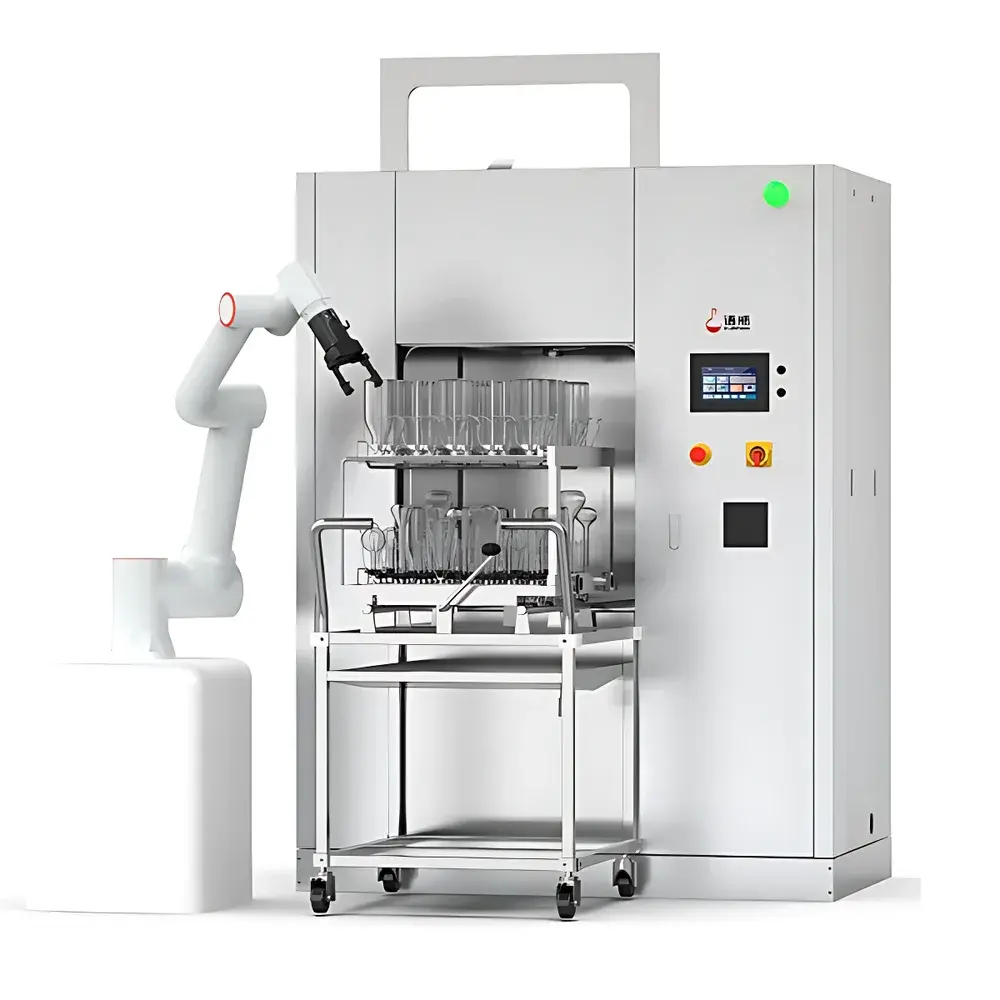
EURPING Poseidon 200 GMP-Compliant Automated Laboratory Bottle Washer
| Brand | EURPING |
|---|---|
| Origin | Tianjin, China |
| Manufacturer Type | Direct Manufacturer |
| Country of Origin | China |
| Model | Poseidon 200 |
| Chamber Volume | 410 L |
| Heating Power | 9 kW |
| Temperature Range | Ambient to 95 °C |
| Wash Pump Flow Rate | 0–800 L/min (VFD-controlled) |
| Cleaning Agent Type | Alkaline Detergent |
| External Dimensions (L×W×D) | 925 × 1488 × 1990 mm |
Overview
The EURPING Poseidon 200 is a fully automated, GMP-compliant laboratory bottle washer engineered for high-integrity cleaning, disinfection, and thermal drying of critical labware used in pharmaceutical, biotechnology, and clinical testing environments. It operates on a validated, closed-loop process architecture grounded in ISO 15883-1 (washer-disinfectors for medical devices) and aligned with USP Analytical Instrument Qualification, FDA 21 CFR Part 11, and EU Annex 11 requirements for data integrity. The system employs multi-stage thermally validated cycles—pre-rinse, alkaline wash, intermediate rinse, final rinse (with conductivity monitoring), and HEPA-filtered hot-air drying—to ensure removal of organic residues, endotoxins, and microbial contaminants from glassware, stainless steel vessels, silicone tubing, and complex geometries. Its monolithic 316L stainless steel chamber features seamless, electropolished construction (Ra ≤ 0.4 µm), zero-weld design, and gravity-assisted drainage (≥2% slope across floor, sump, manifolds, and main piping), eliminating harborage points and enabling full CIP validation.
Key Features
- PLC-based control system (Siemens S7-1200 or equivalent) with 7-inch HMI touchscreen interface, supporting ≥10 pre-configured and user-programmable cleaning protocols
- Four-tier role-based access control (Operator, Supervisor, QA, Administrator) with full audit trail per 21 CFR Part 11 §11.10(e)
- Real-time process monitoring: spray arm rotational speed, recirculation pump flow (0–800 L/min, VFD-regulated), chamber pressure differential, inlet/exhaust air pressure, water conductivity (µS/cm), temperature profiling (±0.5 °C accuracy), and compressed air supply status
- Comprehensive alarm management: 22 discrete fault conditions—including low/high liquid level, pump failure, door interlock breach, heater overtemperature, fan stall, filter clogging, detergent depletion, and motor thermal overload—with contextual remediation guidance displayed directly on HMI
- Sanitary-grade recirculation pump (surface roughness ≤ 0.8 µm) and dual HEPA-filtered forced-air drying system with post-cycle cooling to <40 °C
- Integrated thermal printer for immediate hardcopy batch records; 32 GB onboard non-volatile storage for raw cycle data (time-stamped, immutable)
Sample Compatibility & Compliance
The Poseidon 200 accommodates diverse load configurations—including volumetric flasks, centrifuge tubes, serum bottles, bioreactor accessories, peristaltic pump tubing, and custom fixtures—via adjustable rack systems and configurable spray arm geometry. All wetted surfaces comply with ASME BPE-2022 surface finish standards and meet EN 15883-1 mechanical and thermal stability criteria. Validation documentation supports IQ/OQ/PQ execution per ASTM E2500 and ISO 9001:2015. The system satisfies GLP/GMP traceability requirements through time-synchronized electronic signatures, encrypted data logs, and exportable PDF reports (including cycle parameters, alarms, timestamps, and operator IDs). It interfaces natively with LIMS, SCADA, and MES platforms via Ethernet TCP/IP using OPC UA or Modbus TCP protocols.
Software & Data Management
Firmware includes embedded data integrity safeguards: automatic checksum verification, write-once-read-many (WORM) log archiving, and cryptographic hash generation for each completed cycle. System backups are performed automatically at cycle completion and stored redundantly on internal flash and removable USB media. Disaster recovery enables full configuration restoration from external backup within <5 minutes. All data exports (U盘 or network transfer) retain native timestamping, digital signature metadata, and hierarchical folder structures compliant with ALCOA+ principles (Attributable, Legible, Contemporaneous, Original, Accurate, Complete, Consistent, Enduring, Available). Audit trails capture every parameter change, login/logout event, program modification, and alarm acknowledgment with user ID and UTC timestamp.
Applications
This washer serves as a core utility in QC/QA laboratories performing residual solvent analysis (e.g., ICH Q2(R2)), bioburden testing, extractables/leachables studies, and cell culture support workflows. It is routinely deployed in API manufacturing suites for cleaning glass-lined reactors and sampling vessels, in fill-finish facilities for vial and stopper preparation, and in R&D labs requiring reproducible cleaning validation for method development. Its ability to process irregularly shaped items—such as coiled silicone tubing or multi-port connectors—without manual repositioning reduces human error and supports lean processing objectives.
FAQ
Does the Poseidon 200 support installation qualification (IQ) and operational qualification (OQ) documentation?
Yes—EURPING provides vendor-qualified IQ/OQ templates compliant with ASTM E2500 and GAMP 5, including test scripts, acceptance criteria, and blank execution records.
Can the system be integrated into an existing MES without custom middleware?
Yes—it supports direct Ethernet connectivity with native Modbus TCP and OPC UA server functionality, enabling real-time push of cycle start/end timestamps, alarm logs, and parameter deviations.
What is the maximum allowable particulate load for validation of the final rinse stage?
Per ISO 15883-1 Annex C, the system achieves ≤10 particles ≥0.5 µm per mL in final rinse water when operated with purified water (PW) meeting USP Purified Water specifications.
Is the drying phase validated for moisture residue on stainless steel surfaces?
Yes—drying efficacy is verified using Karl Fischer titration on representative loads, consistently achieving <50 ppm residual moisture on 316L substrates after standard cycle completion.
How frequently must the conductivity sensor be calibrated?
The inline conductivity probe is factory-calibrated and requires annual recalibration traceable to NIST standards; drift verification is performed automatically before each cycle.



