
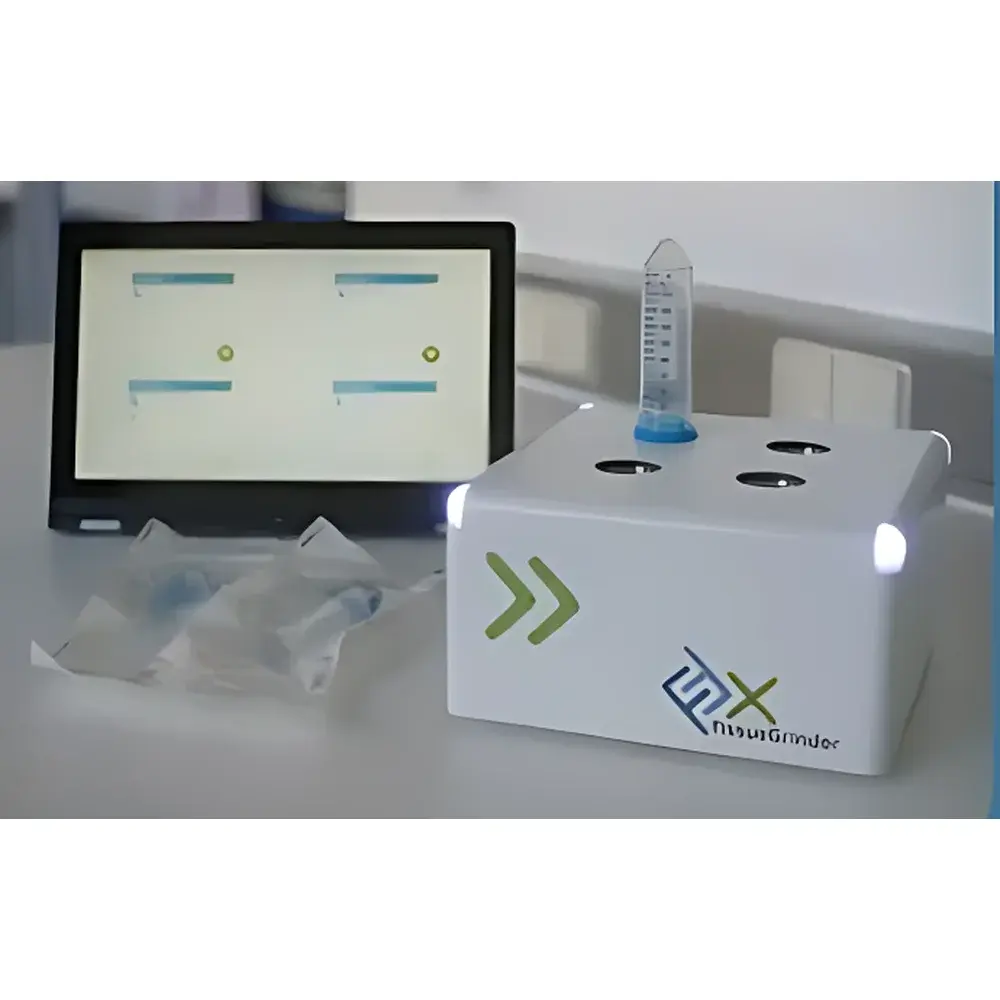
FFX-TG Automated Single-Cell Suspension Preparation System
| Origin | Germany |
|---|---|
| Manufacturer Type | Authorized Distributor |
| Origin Category | Imported |
| Model | FFX-TG |
| Price Range | USD 13,500 – 40,500 (FOB Hamburg) |
| Separation Method | Fully Automated |
| Leukocyte (Nucleated Cell) Recovery Rate | ≥95% |
| Cell Viability | ≥90% |
| Sample Throughput | Up to 4 independent tissue samples per run |
| Tissue Input Mass | 10–300 mg |
| Processing Time | 2–3 minutes per sample |
| Rotor-Stator Gap | 100 µm |
Overview
The FFX-TG Automated Single-Cell Suspension Preparation System is an engineered platform for reproducible, enzyme-free dissociation of fresh, frozen, or formalin-fixed paraffin-embedded (FFPE) tissues into high-viability single-cell suspensions and subcellular lysates. Based on precision-controlled mechanical homogenization—utilizing a patented rotor-stator assembly with a fixed 100 µm clearance—the system applies consistent shear forces under programmable rotational speed and duration profiles. Unlike enzymatic digestion methods, this approach eliminates batch-to-batch variability associated with protease activity, endotoxin contamination, or over-digestion artifacts. Designed for integration into GLP-compliant core facilities and translational research laboratories, the FFX-TG delivers standardized outputs suitable for downstream applications including flow cytometry, single-cell RNA sequencing (scRNA-seq), cell sorting, primary cell culture, and molecular extraction workflows.
Key Features
- Fully automated operation with preloaded and user-definable protocols—enabling precise control over rotation speed, time, and acceleration ramping.
- Disposable, sterile, single-use processing tubes with integrated rotor-stator geometry—ensuring cross-sample integrity and eliminating carryover risk.
- Gentle yet efficient mechanical dissociation optimized for viability retention: ≥90% post-processing cell viability confirmed via AO/PI staining and flow-based assessment.
- Simultaneous parallel processing of up to four heterogeneous tissue specimens (e.g., tumor + matched normal + lymph node + lung) within one instrument cycle.
- Scalable input capacity (10–300 mg wet weight) accommodating diverse tissue densities—from soft neural parenchyma to fibrous colon or desiccated FFPE blocks.
- Sealed, closed-system architecture compliant with ISO 5 cleanroom handling requirements; compatible with biosafety cabinets and laminar flow hoods.
Sample Compatibility & Compliance
The FFX-TG supports broad tissue compatibility—including spleen, liver, lung, kidney, brain, ovary, testis, colon, lymphoid tumors, and decalcified bone marrow aspirates—without requiring pre-treatment or collagenase optimization. FFPE sections (5–20 µm thickness) are processed following standard deparaffinization and rehydration steps. The system meets ISO 13485 design controls for in vitro diagnostic support instrumentation and adheres to EU MDR Annex I essential requirements for safety and performance. All disposable components are certified sterile (ISO 11137) and pyrogen-free (USP ). Instrument software supports audit trails and electronic signatures per FDA 21 CFR Part 11 when deployed in regulated environments.
Software & Data Management
The embedded touchscreen interface runs FFX-Control v3.2 firmware, enabling protocol library management, real-time torque monitoring, and automatic calibration logging. Each run generates a timestamped metadata file containing speed profile, total runtime, tube ID, operator ID, and ambient temperature/humidity (via optional sensor module). Export formats include CSV and XML for LIMS integration. Remote diagnostics and firmware updates are supported via encrypted HTTPS connection. Audit trail functionality records all parameter modifications, user logins, and error events with immutable timestamps—fully traceable for internal QA review or regulatory inspection.
Applications
- Preparation of viable single-cell suspensions for mass cytometry (CyTOF) and spectral flow cytometry.
- Generation of input material for 10x Genomics Chromium, BD Rhapsody, or Parse Biosciences sequencing libraries.
- Isolation of intact nuclei for ATAC-seq or snRNA-seq from archived FFPE cohorts.
- Routine production of cytoplasmic/nuclear lysates for Western blotting, ELISA, or qPCR without detergent-induced epitope masking.
- Standardized dissociation of patient-derived xenograft (PDX) tissues for functional drug screening assays.
FAQ
Does the FFX-TG require enzymatic pretreatment for FFPE samples?
No. FFPE sections must undergo standard xylene deparaffinization and graded alcohol rehydration prior to loading—but no enzymatic digestion is needed.
Can the system process calcified bone or cartilage directly?
Not without prior decalcification (e.g., EDTA-based demineralization); the rotor-stator design is optimized for soft-to-moderately-fibrous tissues.
How is sterility maintained across multiple runs?
Each sample uses a new, gamma-irradiated disposable tube; the instrument housing features smooth, non-porous surfaces validated for ethanol and hydrogen peroxide vapor decontamination.
Is method validation support available for GMP environments?
Yes—application scientists provide IQ/OQ documentation templates, protocol qualification packages, and on-site installation qualification support upon request.
What maintenance is required for long-term operational reliability?
Annual calibration verification and rotor bearing inspection are recommended; no routine lubrication or consumable replacement beyond disposable tubes is necessary.
Related Products



