
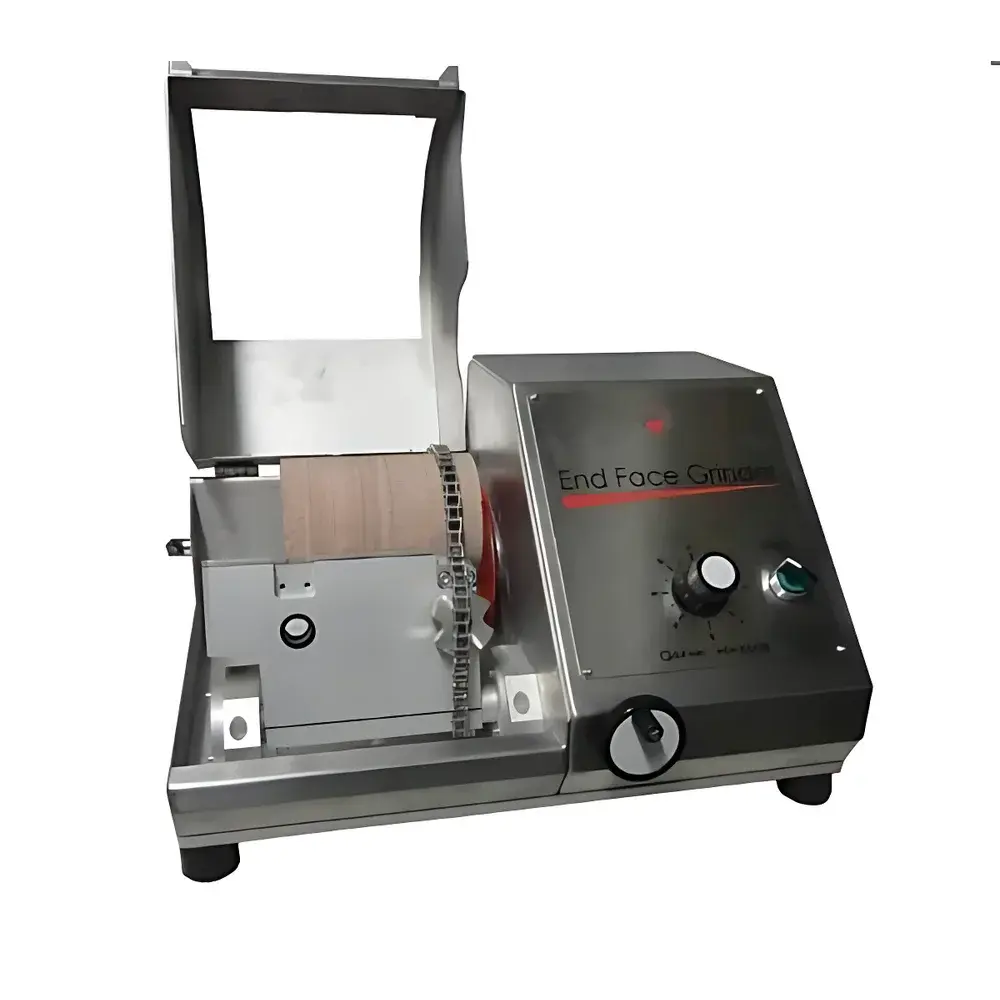
FLOXLAB SPECIMEN GRINDER
| Brand | FLOXLAB |
|---|---|
| Origin | France |
| Model | SPECIMEN GRINDER |
| Max Sample Diameter | 100 mm (4 in) |
| Max Sample Length | 200 mm (8 in) |
| Grinding Accuracy | ±0.001 in (±0.025 mm) |
| Grinding Wheel Diameter | 150 mm |
| Motor Power | 550 W |
| Speed | 3,000 rpm |
| Dimensions | 600 × 500 × 500 mm |
| Weight | 40 kg |
| Power Supply | 220 V, 50–60 Hz |
| Compliance | ASTM D4543 |
Overview
The FLOXLAB SPECIMEN GRINDER is a precision-engineered benchtop specimen preparation system designed for the controlled, repeatable grinding of rock, concrete, ceramic, and other brittle or quasi-brittle materials to produce flat, parallel end faces required for standardized mechanical testing. It operates on a fixed-axis abrasive grinding principle using a high-rigidity spindle and a dynamically balanced 150 mm diameter grinding wheel rotating at 3,000 rpm. Unlike manual lapping or unguided surface finishing methods, this instrument ensures geometric fidelity through mechanical constraint of sample translation and rotation—critical for achieving the dimensional tolerances mandated by geomechanical test standards such as ASTM D4543, ASTM D7012, and ISRM suggested methods. The unit is optimized for preparing cylindrical core specimens (up to 100 mm in diameter and 200 mm in length), enabling consistent contact area definition in uniaxial compressive strength (UCS), triaxial, and Brazilian tensile tests.
Key Features
- Rigid cast-iron base and precision-machined guide rails ensure minimal deflection during grinding, supporting high positional repeatability across multiple specimens.
- Adjustable sample holder with micrometer-controlled vertical feed (0.01 mm resolution) enables fine-tuning of material removal depth per pass.
- Integrated coolant delivery system minimizes thermal distortion and suppresses dust generation—essential for maintaining dimensional stability and operator safety in accordance with OSHA 29 CFR 1910.1053 (respirable crystalline silica).
- Motor-driven wheel head with constant-speed regulation (±1% speed stability) guarantees uniform abrasion kinetics across varying load conditions.
- Quick-release wheel mounting mechanism allows rapid changeover between silicon carbide, diamond-impregnated, or resin-bonded grinding wheels for material-specific optimization.
- Front-access service panel and modular electrical enclosure simplify preventive maintenance and comply with IEC 61000-6-2/6-4 electromagnetic compatibility requirements.
Sample Compatibility & Compliance
The SPECIMEN GRINDER accommodates cylindrical, prismatic, and irregularly shaped specimens composed of igneous, metamorphic, and sedimentary rocks; hardened cementitious composites; sintered ceramics; and polymer-matrix composites. Specimen geometry is constrained only by the maximum envelope of 100 mm diameter × 200 mm length. Surface finish quality meets ASTM D4543’s requirement for end-face planarity (≤0.025 mm deviation over full diameter) and parallelism (≤0.025 mm between opposing faces). All operational parameters—including feed rate, dwell time, and coolant flow—are documented in the machine log for traceability under GLP and ISO/IEC 17025-accredited laboratory environments.
Software & Data Management
While the SPECIMEN GRINDER is a manually operated, non-CNC system, it supports digital workflow integration via optional USB-connected data logger (sold separately). This module records timestamped motor current draw, coolant pressure, and manual feed position inputs—enabling correlation of grinding energy consumption with final surface roughness (Ra < 0.8 µm typical after two-pass finishing). Raw logs export to CSV format for post-processing in MATLAB, Python (pandas), or LIMS platforms. Audit trails adhere to FDA 21 CFR Part 11 principles when paired with validated electronic signature modules.
Applications
- Preparation of rock core specimens for uniaxial and triaxial compression testing in geotechnical laboratories.
- End-face conditioning of concrete cylinders prior to ASTM C39/C39M compressive strength evaluation.
- Surface planarization of ceramic tiles and refractory bricks for thermal expansion coefficient determination (ASTM E228).
- Standardized specimen fabrication for fracture toughness (ASTM E399) and indirect tensile strength (ASTM D3967) measurements.
- Quality control grinding in construction materials R&D facilities requiring strict adherence to EN 12390-3 and BS EN 12390-4.
FAQ
What standards does the SPECIMEN GRINDER support?
It is explicitly engineered to meet the specimen preparation requirements of ASTM D4543, ASTM D7012, and ISRM Suggested Methods for rock mechanics testing.
Can the grinder handle non-cylindrical specimens?
Yes—rectangular prisms, irregular rock fragments, and custom-shaped samples up to 100 mm × 200 mm envelope are compatible with appropriate fixturing.
Is coolant mandatory during operation?
Coolant is strongly recommended for all grinding cycles exceeding 30 seconds to prevent thermal microcracking and maintain dimensional accuracy; dry grinding is permitted only for short-duration calibration or soft-material trials.
What maintenance intervals are recommended?
Grinding wheel truing every 50 operating hours; spindle bearing lubrication every 500 hours; coolant filter replacement every 200 hours or per fluid contamination level.
Does the unit include calibration certification?
Each unit ships with a factory-verified dimensional compliance report against NIST-traceable gauges, including face parallelism and runout verification data.



