
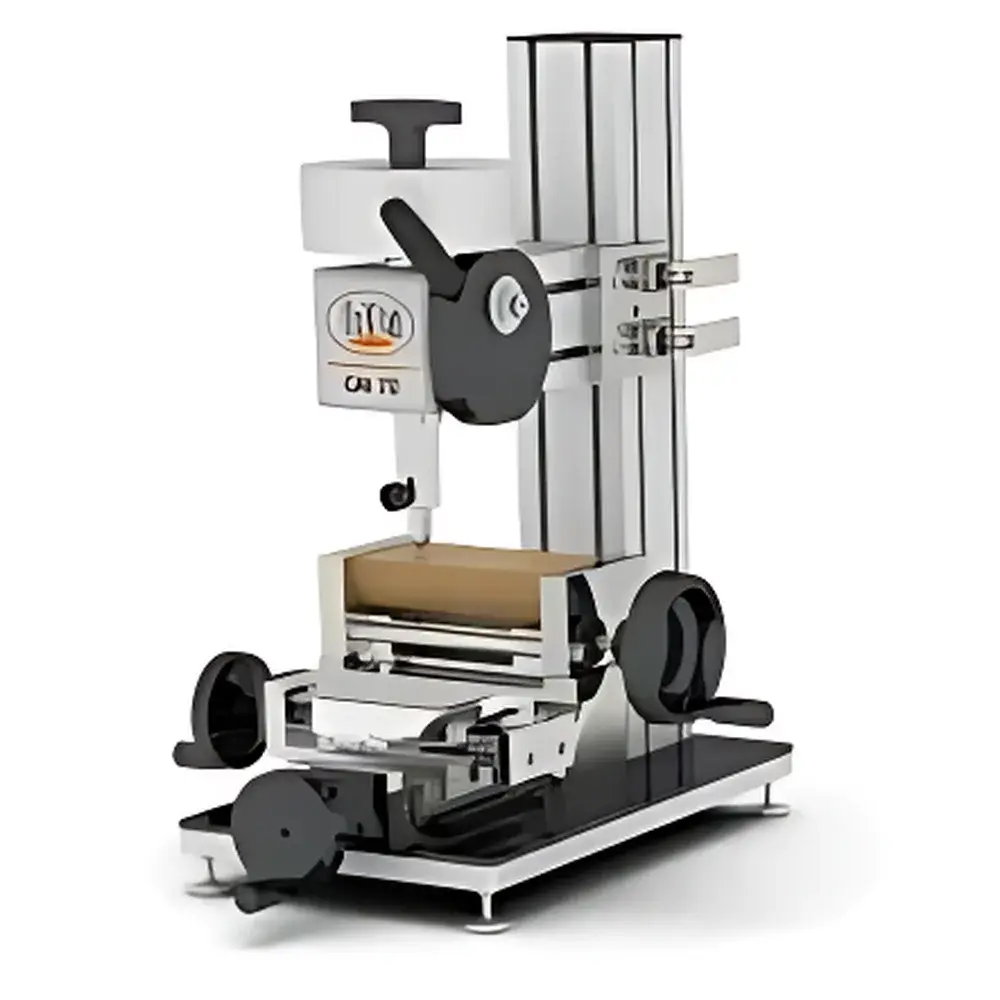
Floxlabs CAI70 Cerchar Abrasivity Index Tester
| Brand | Floxlabs |
|---|---|
| Origin | France |
| Model | CAI 70 |
| Standard Compliance | ASTM D7625-10 |
| Load | 70 N |
| Max Sample Length | 150 mm |
| Max Sample Diameter | 76 mm |
| Scratch Resolution | 0.01 mm |
| Indenter Material | Steel, Rockwell Hardness HRC 54–56 |
| Weight | 25 kg |
| Dimensions (W × L × H) | 330 × 500 × 500 mm |
Overview
The Floxlabs CAI70 Cerchar Abrasivity Index Tester is a precision-engineered laboratory instrument designed for the quantitative determination of rock abrasivity according to the standardized Cerchar abrasion test method. Rooted in the fundamental principle of controlled linear scratching under constant normal load, the CAI70 measures the depth and morphology of wear tracks generated by a hardened steel indenter traversing a prepared rock surface at defined kinematic parameters. This mechanical interaction directly correlates with the material’s resistance to abrasive wear—a critical parameter in mining, tunneling, and hard-rock excavation planning. Unlike empirical hardness scales, the Cerchar index (CAI) provides a functional, process-relevant metric that reflects real-world tool wear behavior during cutting, drilling, or grinding operations. The CAI70 delivers repeatable, traceable results aligned with ASTM D7625-10, enabling direct comparison across geological formations and supporting predictive modeling of cutter life, energy consumption, and equipment selection.
Key Features
- Calibrated constant-load actuation system delivering precisely 70 N nominal normal force, maintained within ±0.5 N tolerance across the full stroke via high-stiffness load cell feedback and closed-loop servo control.
- High-resolution linear displacement transducer with 0.01 mm resolution for accurate measurement of scratch depth profiles, integrated with synchronized position tracking for spatially resolved wear analysis.
- Robust indenter assembly fabricated from through-hardened tool steel, heat-treated to Rockwell C-scale hardness of 54–56 HRC, ensuring dimensional stability and minimal plastic deformation during repeated testing.
- Modular sample stage accommodating cylindrical or prismatic specimens up to 150 mm in length and 76 mm in diameter, with adjustable clamping geometry to ensure perpendicular alignment of the rock surface relative to the indenter path.
- Compact benchtop footprint (330 × 500 × 500 mm) and 25 kg mass optimized for vibration damping and operational stability in standard geotechnical or materials laboratories without requiring dedicated foundations.
- Electromechanical drive architecture compliant with IEC 61000-6-2/6-3 for electromagnetic compatibility, certified for CE marking and safe operation in ISO/IEC 17025-accredited testing environments.
Sample Compatibility & Compliance
The CAI70 accepts consolidated rock specimens—typically core samples, drill cuttings, or sawn blocks—with surfaces prepared to flatness tolerances ≤0.05 mm over the 10 mm scratch zone. Specimen mineralogical heterogeneity, grain size distribution, and microfracture density are documented per test protocol to contextualize CAI values. All measurements conform strictly to ASTM D7625-10 “Standard Test Method for Determining the Cerchar Abrasivity Index (CAI) of Rock,” including prescribed indenter geometry, traverse speed (10 mm/s), stroke length (10 mm), and environmental conditioning (20 ± 2 °C, 40–60% RH). The instrument supports GLP-compliant workflows through audit-ready calibration records, operator ID logging, and timestamped raw data export. While not a regulatory device per se, CAI70-generated data are routinely accepted in feasibility studies submitted to mining regulators and infrastructure authorities under EU Directive 2006/21/EC (mining waste) and national geological survey reporting frameworks.
Software & Data Management
The CAI70 operates via embedded firmware with optional PC-based acquisition software (Floxlabs CAI Suite v3.2, Windows 10/11 compatible). Software modules support real-time force-displacement curve visualization, automatic CAI calculation (CAI = 10 × average scratch depth in mm), statistical batch reporting (mean, SD, CV%), and export to CSV, PDF, or XML formats compliant with ASTM E2819 (data exchange for geomechanical testing). Audit trails record all parameter modifications, calibration events, and user actions in accordance with FDA 21 CFR Part 11 requirements when configured with electronic signatures. Raw sensor data—including load, displacement, and encoder position at ≥1 kHz sampling—is retained locally on non-volatile memory and synchronized upon network connection for centralized LIMS integration.
Applications
- Preliminary assessment of tunnel boring machine (TBM) cutter wear rates in sedimentary, metamorphic, and igneous rock formations.
- Ranking of aggregate sources for asphalt and concrete production based on predicted polishing resistance and crusher liner wear.
- Correlation studies between CAI values and other rock properties (e.g., UCS, Schmidt rebound number, quartz content) for empirical model development.
- Quality assurance of quarry-blasted material prior to transport and processing in open-pit mining operations.
- Research into abrasive wear mechanisms in low-permeability reservoir rocks during hydraulic fracturing proppant embedment analysis.
- Training and certification of geotechnical technicians under EN 1997-2 (Eurocode 7) Annex A guidelines for field characterization methods.
FAQ
What rock types are suitable for CAI testing?
The CAI70 is validated for intact, dry, and unweathered rock specimens with unconfined compressive strength ≥10 MPa. Highly fractured, porous, or clay-rich materials (e.g., shales, tuffs, chalk) require supplementary interpretation and may be tested only with documented deviation protocols.
Is specimen surface preparation standardized?
Yes. Per ASTM D7625-10, the test surface must be ground flat to ≤0.05 mm deviation over a 10 mm × 10 mm area using SiC abrasive paper (grit #220 minimum), cleaned ultrasonically in acetone, and dried at ambient conditions for ≥2 hours prior to testing.
How often does the indenter require recalibration or replacement?
The indenter is calibrated before first use and after every 500 test cycles or upon visual inspection showing visible rounding, chipping, or >0.02 mm tip radius deviation measured via optical profilometry. Certificate of calibration traceable to NIST or COFRAC standards is provided with each replacement unit.
Can the CAI70 be integrated into an automated lab workflow?
Yes. Digital I/O ports support TTL-level start/stop triggers and status signaling; Ethernet interface enables remote command execution (SCPI-compatible) and scheduled test queueing via third-party laboratory automation systems.
Does Floxlabs provide application support for method development?
Yes. Registered users receive complimentary access to the Floxlabs Technical Support Portal, including ASTM-aligned SOP templates, interlaboratory round-robin datasets, and quarterly webinars on advanced abrasivity correlation techniques.



