
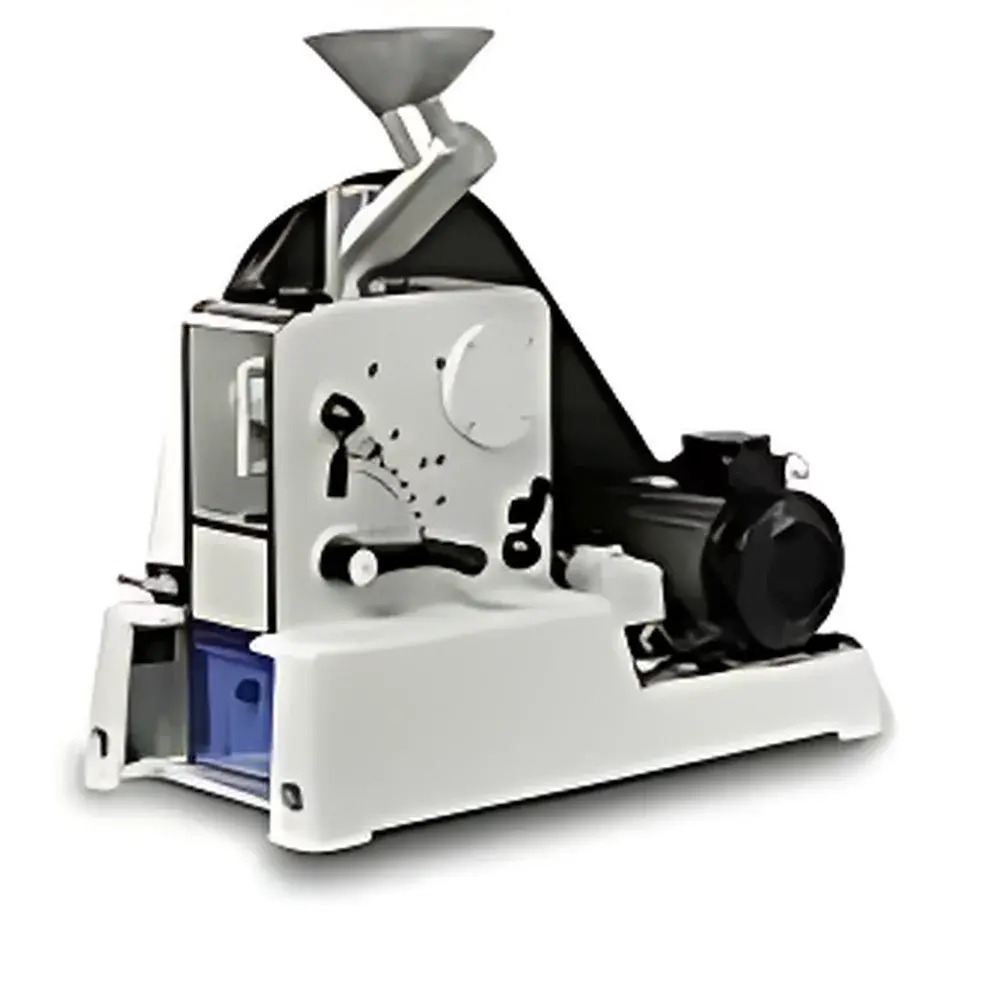
FRITSCH P-1 Jaw Crusher
| Brand | FRITSCH |
|---|---|
| Origin | Germany |
| Manufacturer | FRITSCH GmbH |
| Type | Laboratory Jaw Crusher |
| Model | P-1 |
| Max. Feed Size | 95 mm |
| Min. Discharge Size | 0.5 mm |
| Final Particle Size Range | 1–15 mm |
| Throughput Capacity | 200 kg/h |
| Motor Power | 2.2 kW |
| Weight | 205 kg |
| Dimensions (W×D×H) | 40 × 80 × 80 cm |
| Jaw Gap Adjustment | 10 discrete settings (min. gap: 1 mm) |
| Grinding Chamber Materials | Stainless steel, zirconium oxide, tempered steel, chromium-free steel, manganese steel, tungsten carbide |
| Dust Extraction Port | Yes |
| Compatibility | Direct coupling with FRITSCH P-13 Disc Mill for sub-0.1 mm final grinding |
Overview
The FRITSCH P-1 Jaw Crusher is a heavy-duty, laboratory-scale primary crushing instrument engineered for reproducible, controlled size reduction of brittle to moderately hard solid materials. Based on the classical jaw crusher principle—where compression forces are generated by the reciprocating motion of a movable jaw against a fixed jaw—the P-1 delivers consistent mechanical comminution without significant heat generation or phase alteration. Designed and manufactured in Germany to ISO 9001-certified quality standards, the P-1 serves as the foundational step in multi-stage sample preparation workflows, particularly where representative bulk reduction is required prior to downstream analytical procedures such as X-ray fluorescence (XRF), X-ray diffraction (XRD), atomic absorption spectroscopy (AAS), or geochemical assay. Its robust cast-iron frame, precision-machined jaw plates, and adjustable discharge gap ensure high throughput and long-term dimensional stability under repeated operational loads.
Key Features
- Adjustable discharge gap with 10 precisely calibrated positions (1 mm minimum setting), enabling repeatable control over final particle size distribution.
- High-capacity throughput up to 200 kg/h, optimized for continuous batch processing in geological survey labs, metallurgical QA/QC departments, and raw material testing facilities.
- Modular jaw assembly with six interchangeable grinding chamber configurations—stainless steel (standard), zirconium oxide (for ultra-low contamination), tempered steel (high impact resistance), chromium-free steel (for regulated environmental analysis), manganese steel (abrasion-resistant), and tungsten carbide (for extreme hardness applications).
- Dust extraction interface compliant with standard industrial vacuum systems (Ø 50 mm port), supporting OSHA-compliant and ISO 14001-aligned cleanroom or fume hood integration.
- Direct mechanical coupling capability with the FRITSCH P-13 Disc Mill, enabling seamless two-stage comminution from ≤95 mm feed to ≤0.1 mm final product without manual transfer or cross-contamination risk.
- Ergonomic design with tool-free jaw plate removal and smooth-surface internal geometry, minimizing residual sample retention and facilitating rapid cleaning between heterogeneous sample types.
Sample Compatibility & Compliance
The P-1 is validated for use with inorganic, non-fibrous, and non-plastic materials exhibiting Mohs hardness ≤7. Typical applications include quartzite, granite, limestone, bauxite, coal, slag, refractory ceramics, and sintered metal oxides. It is not suitable for elastomeric, fibrous, oily, or highly ductile samples. All structural components comply with EU Machinery Directive 2006/42/EC and CE marking requirements. The instrument supports GLP-compliant documentation when integrated with FRITSCH’s optional digital logging module (P-Log), which records timestamped operational parameters—including gap setting, run duration, and motor load—for audit-ready traceability. While the P-1 itself does not perform analytical measurement, its output meets ASTM D2974 (Standard Test Methods for Moisture, Ash, and Organic Matter of Peat and Other Organic Soils) and ISO 13320 (Laser Diffraction Particle Size Analysis) pre-treatment specifications for homogenized feedstock.
Software & Data Management
The P-1 operates as a standalone electromechanical unit with no embedded firmware or touchscreen interface. However, it is fully compatible with FRITSCH’s optional P-Log data acquisition system—a DIN-rail-mounted I/O module that captures real-time motor current, runtime, and gap position via analog and digital inputs. P-Log exports CSV-formatted logs synchronized to NTP time servers and integrates with LIMS platforms via OPC UA or Modbus TCP protocols. Audit trails generated through P-Log satisfy FDA 21 CFR Part 11 requirements when deployed with user authentication, electronic signatures, and immutable storage configurations. No proprietary software installation is required for basic operation; all mechanical adjustments are manual and mechanically indexed.
Applications
- Geological core sample reduction for geochemical mapping and mineralogical classification.
- Primary crushing of metallurgical feedstocks prior to leaching or smelting simulation studies.
- Preparation of certified reference materials (CRMs) in accredited calibration laboratories (ISO/IEC 17025).
- Routine QA/QC of construction aggregates, cement clinker, and refractory raw materials per EN 933 and ASTM C136 standards.
- Feedstock conditioning for thermal analysis (TGA/DSC), fusion bead preparation (XRF), and pressed pellet fabrication (XRD).
- Environmental soil and sediment processing in compliance with EPA Method 6010D and ISO 11466.
FAQ
What is the maximum hardness of material the P-1 can process?
The P-1 is rated for materials with Mohs hardness up to 7 (e.g., quartz). For harder substances such as silicon carbide or tungsten carbide, alternative milling methods (e.g., planetary ball milling) are recommended.
Is the P-1 suitable for wet grinding?
No—the P-1 is strictly a dry-crushing instrument. Introduction of moisture may cause clogging, corrosion, or inconsistent gap performance.
Can the P-1 be used in explosion-proof environments?
Not without third-party ATEX certification retrofitting. Standard units are not intrinsically safe; consult FRITSCH Engineering Services for zone-specific modifications.
How often should jaw plates be replaced?
Service life depends on abrasivity and throughput. Under typical geological sample loads (granite, basalt), stainless steel jaws last ≥1,200 operating hours; tungsten carbide variants exceed 4,000 hours.
Does FRITSCH provide validation documentation for GMP environments?
Yes—IQ/OQ documentation packages, including test protocols and acceptance criteria aligned with Annex 15 and ASTM E2500, are available upon request for regulated pharmaceutical or contract research organizations.



