
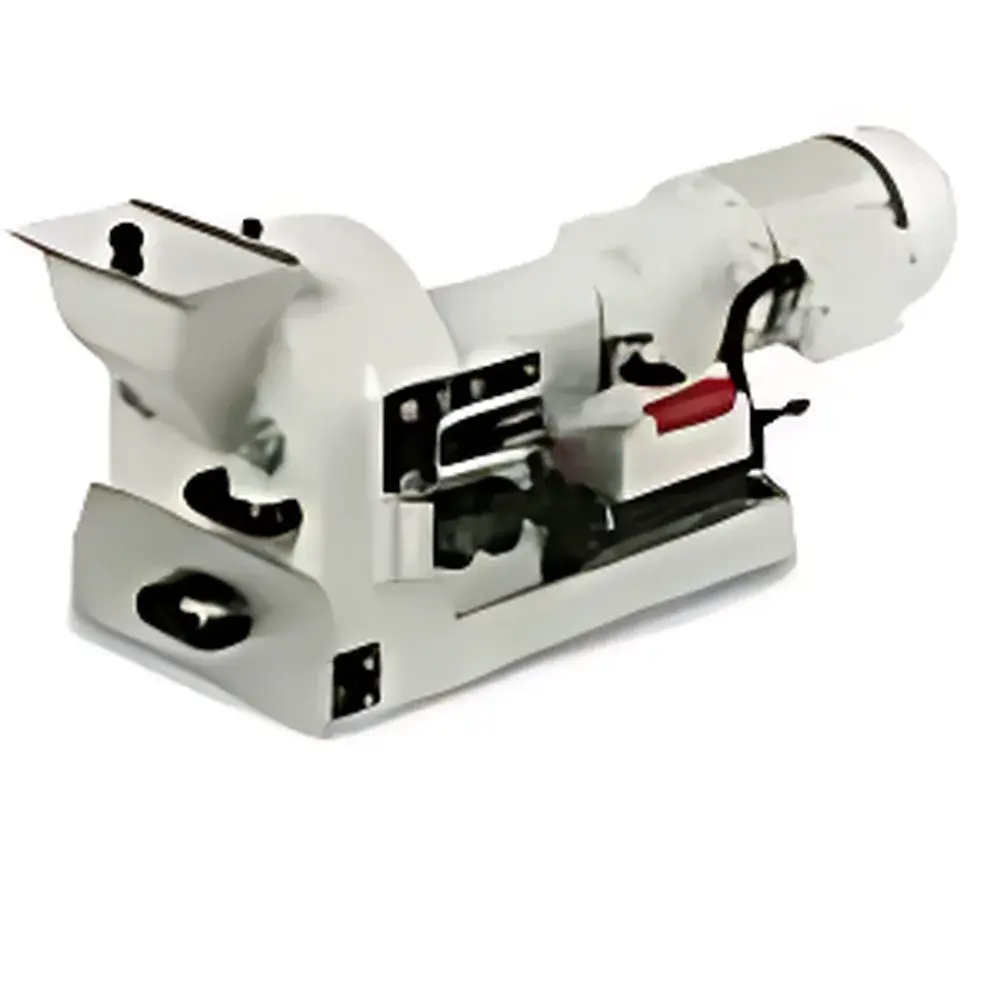
FRITSCH P-13 Disc Mill
| Brand | FRITSCH |
|---|---|
| Origin | Germany |
| Manufacturer | FRITSCH GmbH |
| Model | P-13 |
| Instrument Type | Disc Crusher/Mill |
| Sample Type | Hard and Brittle Materials |
| Max. Feed Size | < 20 mm |
| Final Particle Size Range | 0.01–0.5 mm |
| Adjustable Gap Resolution | 0.1–12 mm |
| Throughput Capacity | 150 kg/h |
| Disc Speed | 440 rpm |
| Power Supply | 400 V / 3~ / 50–60 Hz |
| Rated Power | 1830 W |
| Net Weight | 140 kg |
| Dimensions (W×H×L) | 44 × 87 × 40 cm |
| Grinding Disc Materials | Stainless Steel, Manganese Steel, Tungsten Carbide, Zirconia Oxide |
Overview
The FRITSCH P-13 Disc Mill is a high-capacity, precision-engineered laboratory disc crusher designed for the reproducible size reduction of hard, brittle, and moderately abrasive materials. Operating on the principle of controlled compression and shear between two parallel, counter-rotating (one rotating, one stationary) grinding discs, the P-13 delivers consistent particle size distribution through adjustable gap geometry and fixed rotational speed (440 rpm). Unlike impact-based mills, the P-13 minimizes heat generation and particle agglomeration, making it especially suitable for thermally sensitive or cohesive samples in mineralogical, geological, coal, metallurgical, and environmental research workflows. Its robust cast-iron housing, precision-machined disc alignment system, and modular disc material options ensure long-term dimensional stability and resistance to wear—critical for GLP-compliant sample preparation where inter-batch reproducibility is mandated.
Key Features
- Adjustable grinding gap (0.1–12 mm) with micrometer-scale repeatability, enabling precise control over final particle size distribution without mechanical recalibration.
- Reversible motor rotation direction—reducing asymmetric disc wear by up to 2× and extending service life of both active and passive grinding surfaces.
- Four interchangeable disc material configurations: stainless steel (standard), manganese steel (high toughness), tungsten carbide (extreme abrasion resistance), and zirconia oxide (non-contaminating, chemically inert).
- Integrated dust extraction interface compliant with ISO 13847 and OSHA PEL standards; compatible with standard lab vacuum systems for containment of respirable particulates (PM10/PM2.5).
- Modular integration capability with FRITSCH P-1 Jaw Crusher via mechanical coupling bracket—enabling seamless two-stage comminution from >20 mm feed to sub-0.1 mm output in a single workflow.
- CE-marked electrical system (400 V / 3~ / 50–60 Hz, 1830 W) with thermal overload protection and IP54-rated enclosure for safe operation in analytical laboratories.
Sample Compatibility & Compliance
The P-13 is validated for routine processing of quartz, feldspar, limestone, coal, slag, ceramics, ferrous/non-ferrous metal ores, and dried plant tissues. It complies with ASTM D2974 (moisture/ash determination in coal), ISO 13320 (laser diffraction particle sizing pre-treatment), and USP <429> (pharmaceutical granulation support). All disc assemblies meet DIN EN ISO 14001 environmental manufacturing standards, and the unit supports audit-ready documentation for ISO/IEC 17025-accredited labs. Optional traceability kits enable full calibration history logging per ISO/IEC 17025 Clause 6.4.10.
Software & Data Management
While the P-13 operates as a standalone electromechanical instrument, its operational parameters—including runtime, disc rotation direction cycles, and maintenance intervals—are documented in FRITSCH’s optional LabSuite™ Logbook module (v3.2+). This cloud-synced platform supports electronic signatures, 21 CFR Part 11-compliant audit trails, and export to LIMS via CSV or ASTM E1384-compliant XML schema. Calibration certificates and disc wear logs are stored with SHA-256 hash verification to satisfy GMP/GLP data integrity requirements.
Applications
- Preparation of homogenized reference materials for XRF, ICP-OES, and fusion bead analysis in geochemical labs.
- Size reduction of coal samples prior to proximate/ultimate analysis per ASTM D3172–D3176.
- Production of standardized aggregates for cementitious material testing (ASTM C109, C348).
- Homogenization of metallurgical slags for phase identification via XRD and SEM-EDS.
- Consistent fragmentation of ceramic raw materials to eliminate bias in sintering behavior studies.
- Soil and sediment comminution for heavy metal leaching tests (TCLP, SPLP) under EPA Method 1311/1312.
FAQ
What safety certifications does the P-13 hold?
The P-13 carries CE marking per Machinery Directive 2006/42/EC and EMC Directive 2014/30/EU, with conformity verified by TÜV Rheinland (Certificate No. R 50361184 0001). It meets EN 61000-6-2 (immunity) and EN 61000-6-4 (emission) standards.
Can the P-13 be used for wet grinding?
No—the P-13 is strictly a dry-grinding instrument. Its disc geometry, sealing design, and motor insulation rating (IP54) do not support liquid-phase operation or slurry handling.
Is gap adjustment traceable to NIST standards?
Yes. The micrometer-adjustment mechanism includes engraved scale markings calibrated against NIST-traceable gauge blocks (certified ±0.02 mm uncertainty at 95% confidence), with factory calibration report supplied with each unit.
How often should grinding discs be replaced?
Disc lifetime depends on material hardness and throughput. Under typical quartz processing (Mohs 7), stainless steel discs last ~1,200 operating hours; tungsten carbide variants exceed 4,500 hours. FRITSCH recommends wear inspection every 200 h using supplied depth gauge kit.
Does FRITSCH provide method validation support?
Yes. Application engineers supply SOP templates aligned with ISO 5725-2 (repeatability/reproducibility) and offer on-site method transfer services—including RSD verification across ≥3 operators and ≥5 batches per ISO/IEC 17025 Annex A.2.



