
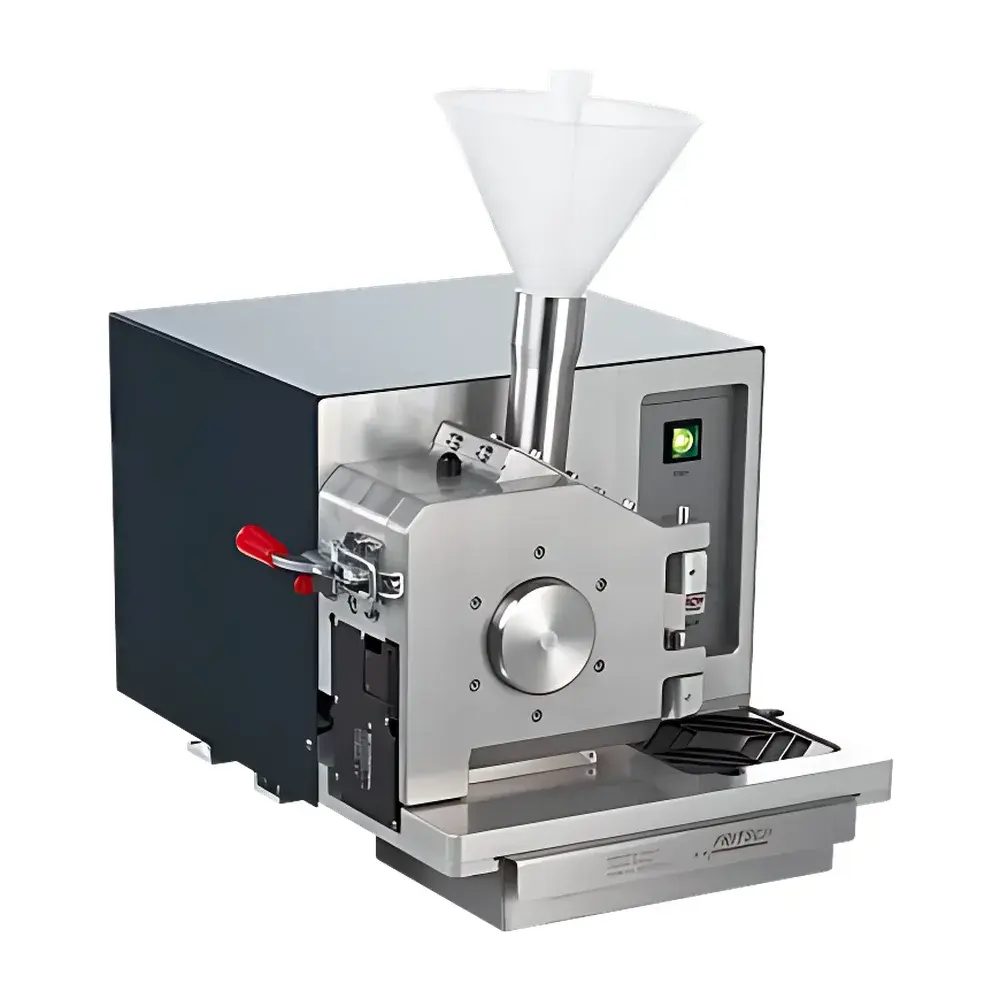
Fritsch P-19 Variable-Speed Universal Cutting Mill
| Brand | Fritsch |
|---|---|
| Origin | Germany |
| Manufacturer | FRITSCH GmbH |
| Model | P-19 |
| Instrument Type | Cutting Mill |
| Sample Type | Soft to Medium-Hard Materials |
| Max. Feed Size | < 70 mm |
| Final Particle Size | 0.01–0.5 mm (typical output), 0.25–6.00 mm (adjustable via sieve) |
| Throughput | up to 60 L/h |
| Rotor Speed | 2800 rpm |
| Net Weight | 56 kg |
| Dimensions (W×D×H) | 45 × 55 × 63 cm |
| Material Contact Parts | Chromium-Free Stainless Steel |
| Compliance | RoHS Directive 2011/65/EU, CE Marked |
Overview
The Fritsch P-19 Variable-Speed Universal Cutting Mill is an engineered solution for reproducible, contamination-controlled size reduction of heterogeneous and composite samples in analytical and industrial laboratories. Designed and manufactured in Germany by FRITSCH GmbH — a globally recognized leader in laboratory comminution and particle sizing — the P-19 operates on the principle of high-speed rotary cutting, utilizing a precisely balanced rotor equipped with geometrically optimized cutting blades. Unlike impact or shear-based mills, the P-19 achieves controlled fragmentation through tangential shearing and compressive cutting forces, minimizing heat generation and mechanical degradation of thermolabile or fibrous materials. Its architecture supports compliance-driven workflows, particularly where elemental purity and absence of heavy-metal contamination are mandatory — such as RoHS-compliant electronics waste (PCBs, cables, connectors), pharmaceutical dosage forms, animal feed matrices, and environmental solid waste samples.
Key Features
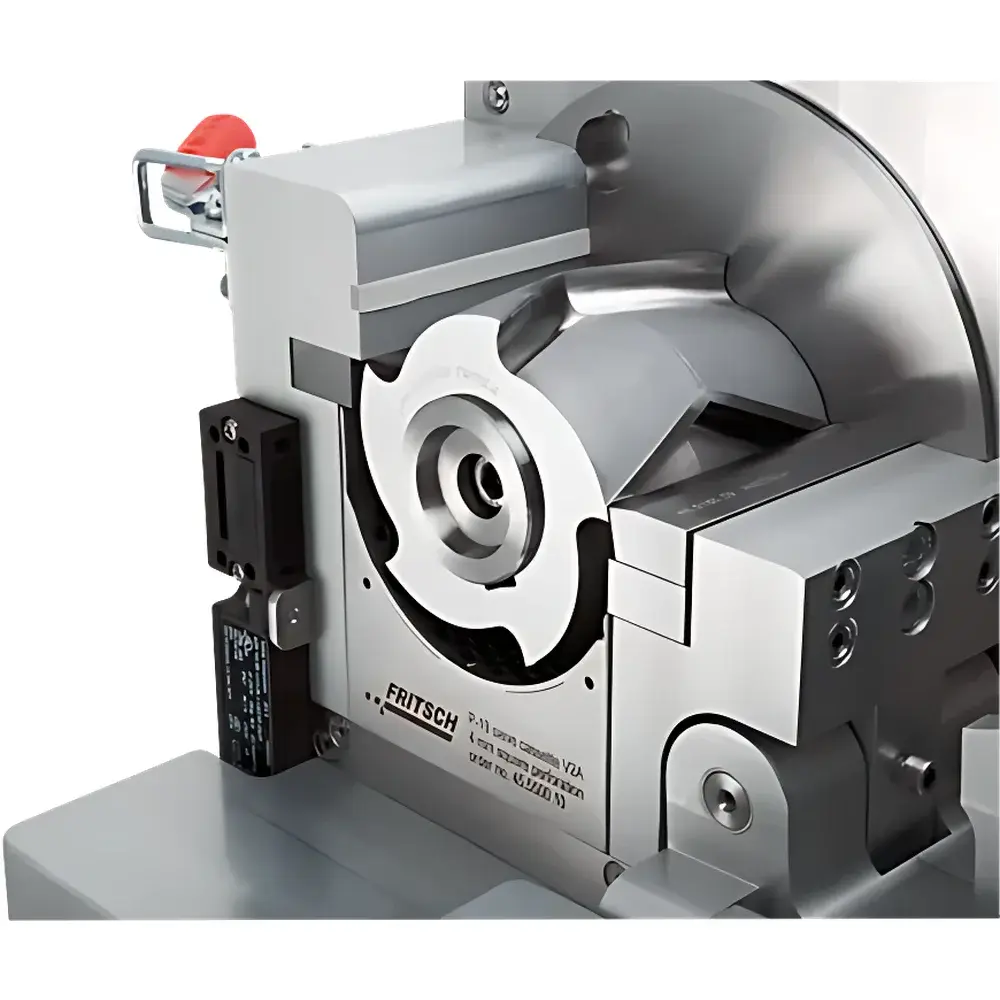
- RoHS-compliant construction: All sample-contact components — including rotor blades, fixed knives, and sieve inserts — are fabricated from chromium-free stainless steel to eliminate leachable Cr(VI) and other regulated heavy metals.
- Adjustable final particle size: Achieved via interchangeable perforated sieves (standard aperture range: 0.25–6.00 mm); fine grinding down to 0.01 mm is possible with optional fine-cutting configurations and extended residence time.
- High-efficiency cutting rotor: Operates at a fixed speed of 2800 rpm, delivering consistent energy input and enabling rapid throughput of up to 60 L/h for soft-to-medium hardness materials.
- Modular, cleanable design: The grinding chamber features smooth, non-porous surfaces with minimal dead zones; all critical parts are tool-free removable for validated cleaning protocols required under GLP and GMP environments.
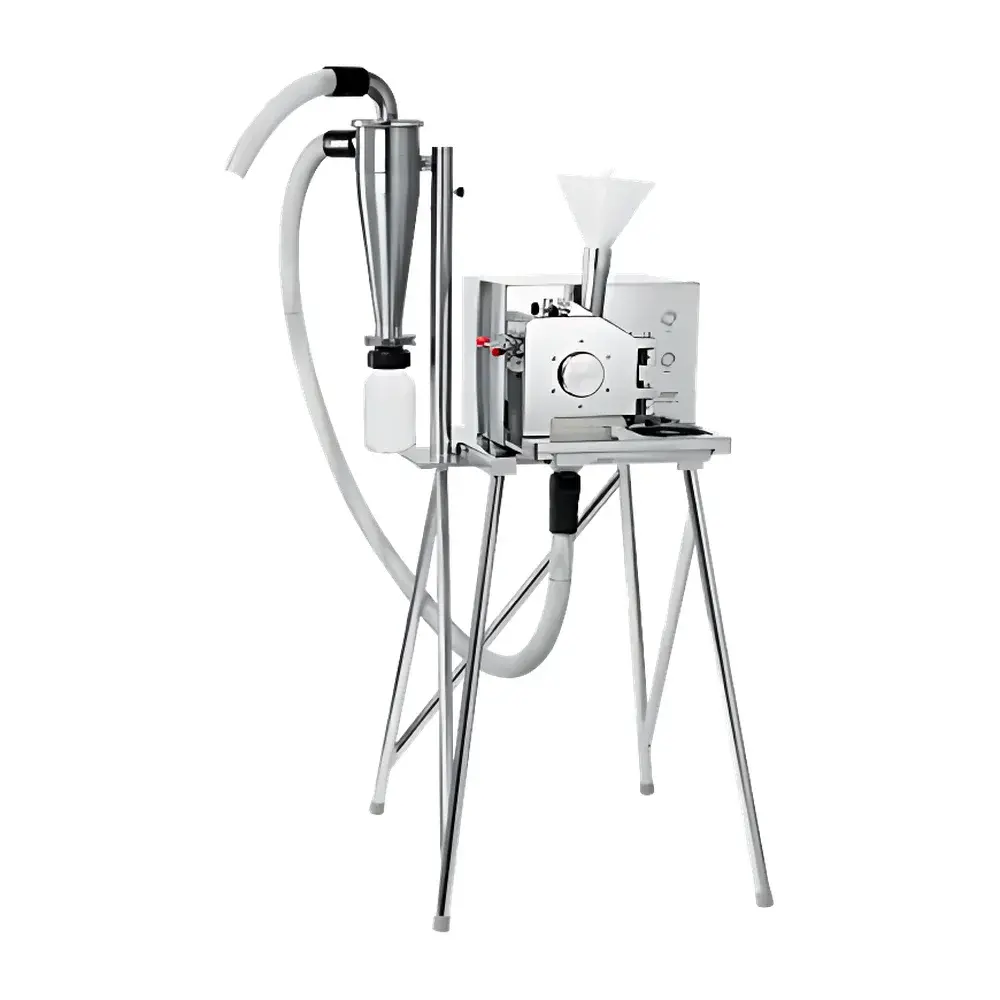
- Integrated dust extraction interface: Standard 100 mm diameter port enables direct connection to laboratory vacuum systems or central dust collectors, maintaining sample temperature stability and operator safety per EN 60335-1 and ATEX Zone 22 guidelines.
- Robust mechanical architecture: Cast aluminum housing, precision-balanced rotor assembly, and maintenance-free sealed bearings ensure long-term dimensional stability and operational repeatability across thousands of cycles.
Sample Compatibility & Compliance
The P-19 is validated for comminution of diverse organic and inorganic matrices, including but not limited to: printed circuit boards (PCBs), insulated wires and cables, rubber and leather scraps, corrugated cardboard, dried botanicals (e.g., tobacco leaves, herbs), cereal grains, animal feed pellets, pharmaceutical tablets, bone fragments, horn, and coal briquettes. It meets the material preparation requirements specified in ASTM D5630 (plastics ash content), ISO 11723 (solid biofuels sampling), and EN 13656 (waste characterization). Its RoHS-aligned construction satisfies EU Directive 2011/65/EU Annex II substance restrictions, making it suitable for accredited labs performing WEEE and ELV directive testing. Full traceability documentation, including EC Declaration of Conformity and RoHS compliance certificates, is supplied with each unit.
Software & Data Management
While the P-19 is a standalone electromechanical instrument without embedded digital control, its operation integrates seamlessly into regulated data ecosystems. Optional accessories include a calibrated digital tachometer for rotor speed verification and a certified mass flow meter for suction airflow validation — both supporting 21 CFR Part 11-compliant audit trails when paired with LIMS or ELN platforms. Maintenance logs, calibration records, and cleaning verification reports can be generated using standardized SOP templates aligned with ISO/IEC 17025:2017 clause 7.6 (traceability of measurement equipment).
Applications
- Preparation of electronic waste (e-waste) for XRF and ICP-MS analysis under RoHS/WEEE directives.
- Homogenization of heterogeneous environmental samples (e.g., municipal solid waste, compost, sludge) prior to leaching tests (EN 12457, TCLP).
- Size reduction of pharmaceutical tablets and capsules for content uniformity testing per USP <905>.
- Grinding of animal feed and agricultural commodities for proximate analysis (AOAC 967.21, ISO 6496).
- Particle conditioning of reference materials used in proficiency testing schemes (e.g., IRMM, NIST SRMs).
- Sample preparation for pyrolysis-GC/MS and thermal gravimetric analysis (TGA) where thermal history must be minimized.
FAQ
What types of materials are unsuitable for the P-19?
Materials with extreme hardness (e.g., quartz, sintered carbides), high elasticity (e.g., uncured silicone rubber), or excessive moisture content (>15% w/w) may cause clogging or incomplete comminution. Pre-drying or pre-crushing is recommended.
Can the P-19 be used for cryogenic grinding?
No — the P-19 is not designed for liquid nitrogen cooling. For cryo-applications, FRITSCH’s Planetary Micro Mill PULVERISETTE 7 premium or CryoMill are recommended alternatives.
Is routine calibration required for regulatory compliance?
Rotor speed should be verified annually using a traceable optical tachometer; sieve aperture dimensions must be inspected per ISO 3310-1 using certified gauge blocks. Documentation of these checks satisfies ISO/IEC 17025 clause 6.4.10.
How is cross-contamination prevented between batches?
The P-19’s fully accessible grinding chamber allows visual inspection and residue removal. Recommended cleaning includes compressed air purging followed by ethanol wipe-down and UV-C irradiation (if integrated into lab workflow), validated per internal SOPs.
Does the P-19 support automated feed systems?
Not natively — feeding is manual or gravity-assisted. However, custom hopper adapters and vibratory feeders can be engineered upon request for integration into continuous sample prep lines.



