
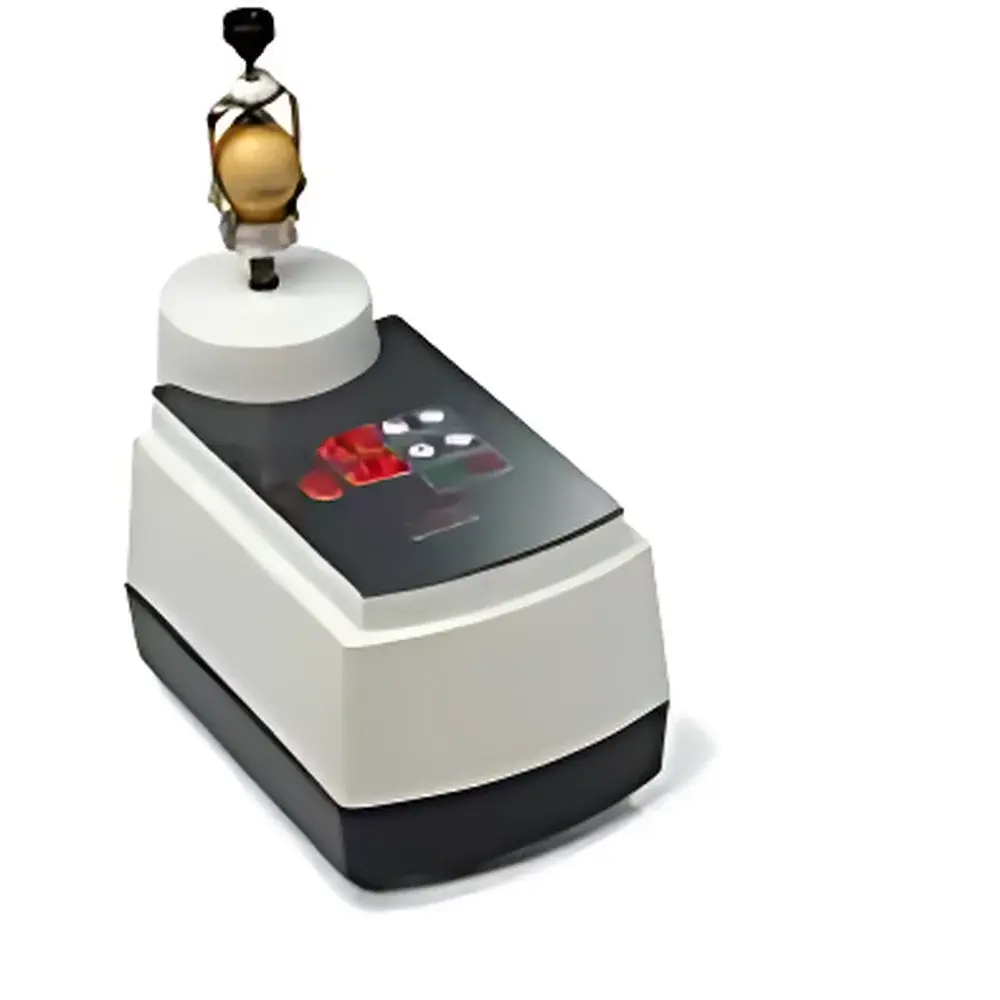
Fritsch P-23 Micro Pulverisette 23 Vibratory Micro Mill
| Brand | Fritsch |
|---|---|
| Origin | Germany |
| Manufacturer | FRITSCH GmbH |
| Model | P-23 |
| Instrument Type | Vibratory Micro Mill (Planetary Ball Mill Alternative) |
| Sample Applicability | Hard, brittle, fibrous, and temperature-sensitive materials |
| Max. Feed Size | < 6 mm |
| Batch Volume | 5 mL |
| Final Particle Size | ≤ 10 µm (typical), down to 0.01 mm (10 µm) |
| Vibration Frequency | 900–3000 min⁻¹ |
| Amplitude | 9 mm |
| Grinding Bowl Options | 5 mL, 10 mL, 15 mL |
| Grinding Ball Diameters | 3 mm, 5 mm, 10 mm, 15 mm |
| Grinding Modes | Dry & Wet |
| Bowl/Ball Materials | Zirconium Oxide, Stainless Steel, Hardened Steel, PTFE, Agate |
| Dimensions (W×D×H) | 20 × 30 × 30 cm |
| Net Weight | 7 kg |
| Operating Temperature Range | Ambient to –196 °C (with cryo-adaptation) |
Overview
The Fritsch P-23 Micro Pulverisette 23 Vibratory Micro Mill is a precision-engineered laboratory instrument designed for reproducible, high-energy comminution of minute sample quantities (as low as 5 mL batch volume). Unlike conventional planetary ball mills, the P-23 employs vertical-axis vibrational energy transfer—generated by high-frequency oscillation (900–3000 min⁻¹) with a fixed 9 mm amplitude—to drive grinding balls against the inner surface of the bowl. This mechanism delivers intense impact and shear forces ideal for brittle, hard, fibrous, or thermolabile materials without significant heat accumulation. Its compact footprint and compatibility with cryogenic operation (e.g., liquid nitrogen cooling) make it uniquely suited for applications requiring structural integrity preservation—such as enzymatic activity retention in biological tissues, crystallinity maintenance in pharmaceutical polymorphs, or phase stability in mineralogical XRD standards.
Key Features
- High-precision vibratory milling architecture delivering consistent particle size reduction to ≤10 µm (D90) under optimized dry or wet conditions.
- Digital control interface with real-time parameter display (frequency, time, pause intervals), enabling full protocol reproducibility across operators and shifts.
- Modular grinding chamber system: interchangeable bowls (5/10/15 mL) and balls (3/5/10/15 mm) fabricated from five chemically inert and wear-resistant materials—zirconium oxide, stainless steel, hardened steel, PTFE, and agate—to prevent cross-contamination and material-specific reactivity.
- Cryogenic adaptability: entire unit fits inside standard laboratory refrigerators or cryo-chambers; validated for sub-zero grinding of proteins, nucleic acids, plant tissues, and volatile organics without denaturation or volatilization loss.
- Low-noise, low-vibration mechanical design (net weight: 7 kg) with reinforced base and damping feet—enabling benchtop deployment in shared analytical labs without structural isolation requirements.
- GLP-compliant operation: time-stamped process logging (via optional software integration), manual lockout during lid-open states, and traceable parameter settings aligned with ISO/IEC 17025 documentation workflows.
Sample Compatibility & Compliance
The P-23 accommodates heterogeneous sample matrices ranging from soft organic tissues (hair, leaves, root systems) to ultra-hard ceramics and geological specimens (quartz, feldspar, basalt). It meets ASTM D5231–22 for particulate homogenization prior to elemental analysis, supports USP and requirements for pharmaceutical blend uniformity testing, and aligns with ISO 13320:2020 for laser diffraction feed preparation. All grinding components comply with FDA 21 CFR 177.2420 (food-contact polymers) and EU Regulation (EC) No 1935/2004. Trace-metal-clean versions (electropolished stainless steel, zirconia) are available for ICP-MS sample prep per EPA Method 6020B.
Software & Data Management
While the P-23 operates via standalone digital panel controls, optional Fritsch LabSoft™ v4.2 software enables remote configuration, automated sequence programming (multi-step frequency/time ramps), and CSV-exported audit trails—including timestamped start/stop events, frequency deviations, and lid-open interruptions. Data logs satisfy 21 CFR Part 11 requirements when deployed with user-authenticated access and electronic signature modules. Exported datasets integrate natively with LIMS platforms (e.g., Thermo Fisher SampleManager, LabVantage) via ODBC drivers.
Applications
- Preparative grinding for X-ray diffraction (XRD) and SEM-EDS analysis—ensuring representative microstructural homogeneity without preferred orientation artifacts.
- Routine homogenization of forensic trace evidence (paint chips, gunshot residue, textile fibers) prior to GC-MS or FTIR identification.
- Production of certified reference materials (CRMs) for geochemical and environmental monitoring programs (e.g., NIST SRM 2710a, GBW07105).
- Cryo-milling of thermosensitive APIs and biologics for solid-state characterization (DSC, TGA, PXRD) under GMP Annex 1 environmental controls.
- High-yield cell lysis of yeast, bacteria, and mammalian tissues using PTFE or agate vessels to minimize metal ion leaching during proteomic workflows.
FAQ
What is the smallest recommended batch volume for reliable reproducibility?
A minimum of 3 mL is advised for consistent energy transfer; however, method validation at 1–2 mL is feasible with optimized ball-to-sample ratio and extended dwell time.
Can the P-23 be used for wet grinding with organic solvents?
Yes—provided the selected bowl and ball material is chemically compatible (e.g., PTFE or zirconia for chlorinated solvents; stainless steel for aqueous buffers). Sealed cryo-vials with O-ring gaskets are supplied for volatile media.
Is vibration isolation required for installation?
No. The unit’s integrated mass-damping system eliminates the need for external anti-vibration tables in standard lab environments (concrete or steel-reinforced benches).
How does the P-23 differ from planetary ball mills in terms of energy input efficiency?
Vibratory action delivers higher specific impact energy per unit time due to direct vertical acceleration, reducing processing time by ~40% compared to planetary mills for equivalent fineness targets (ISO 5010:2022 benchmark data).
Are grinding parameters compliant with ISO/IEC 17025 method validation requirements?
Yes—frequency calibration certificates (traceable to PTB, Germany), documented wear-rate studies for each bowl/ball combination, and inter-laboratory round-robin test reports are included in the technical dossier supplied with each instrument.



