
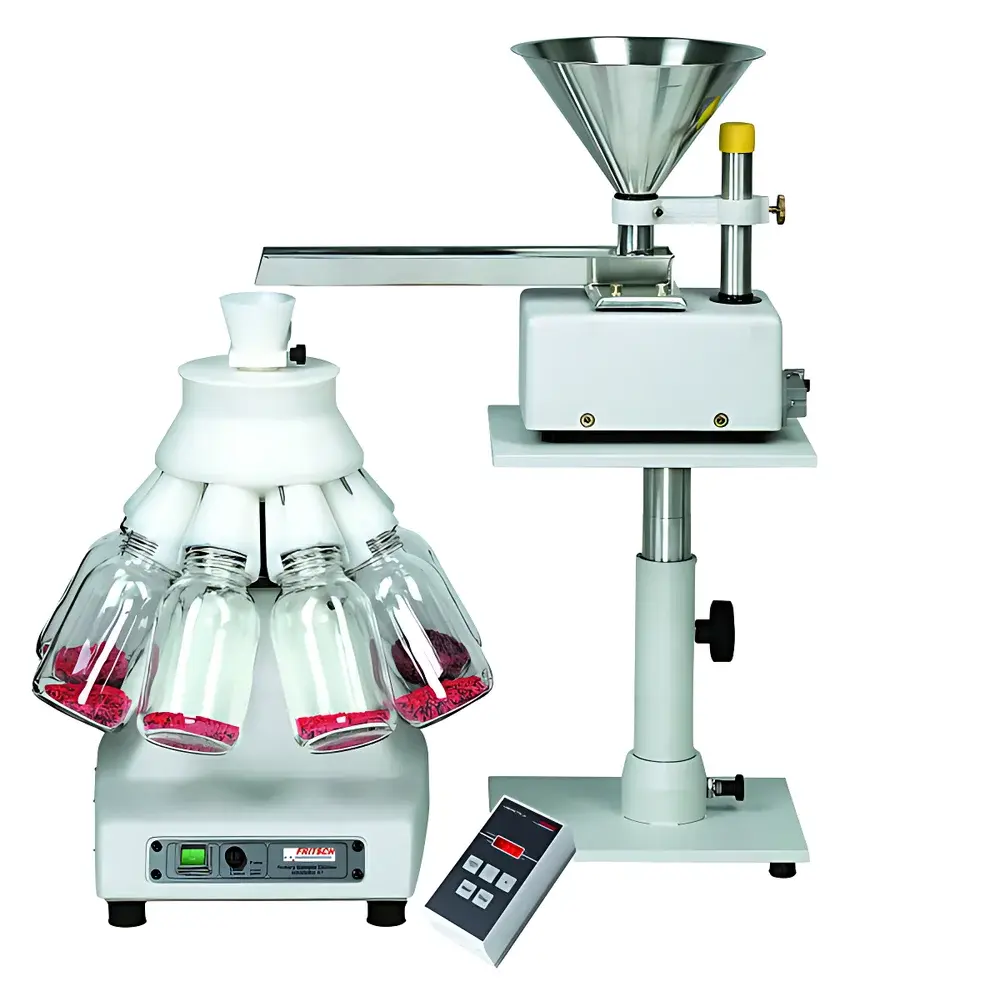
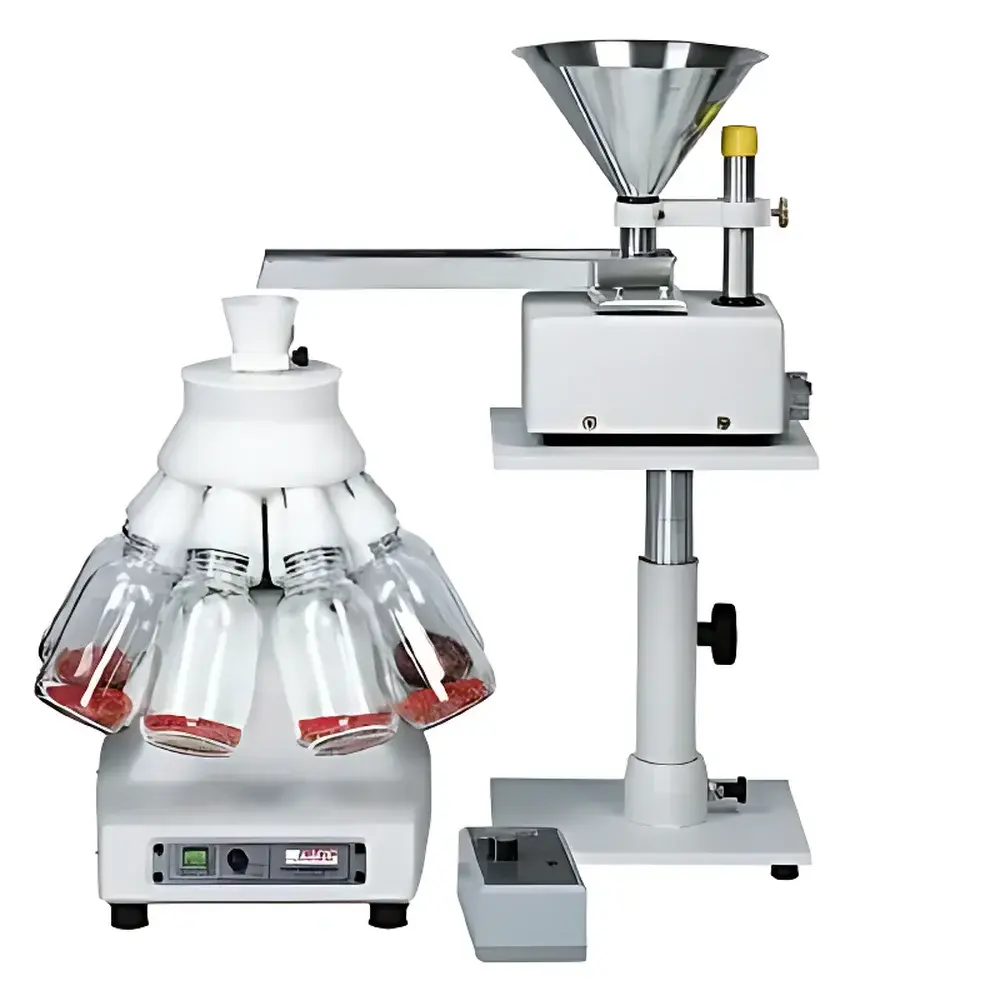
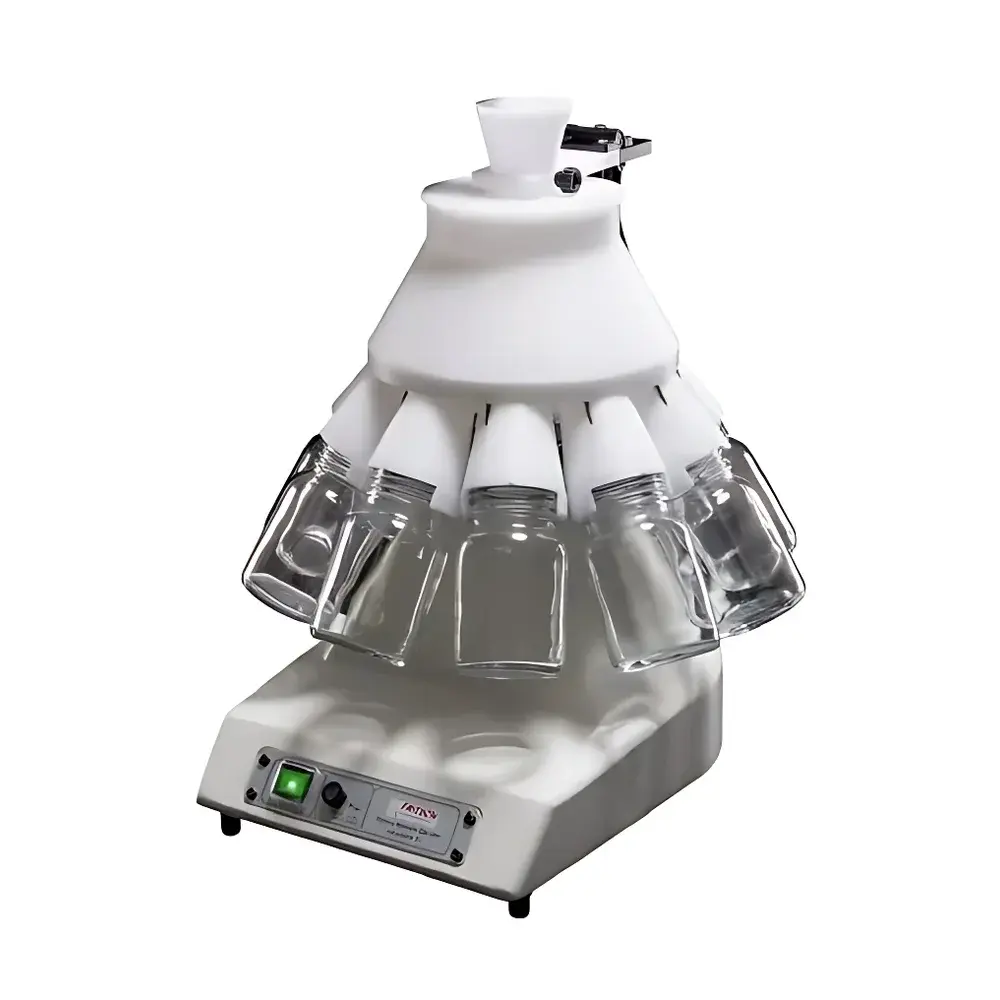
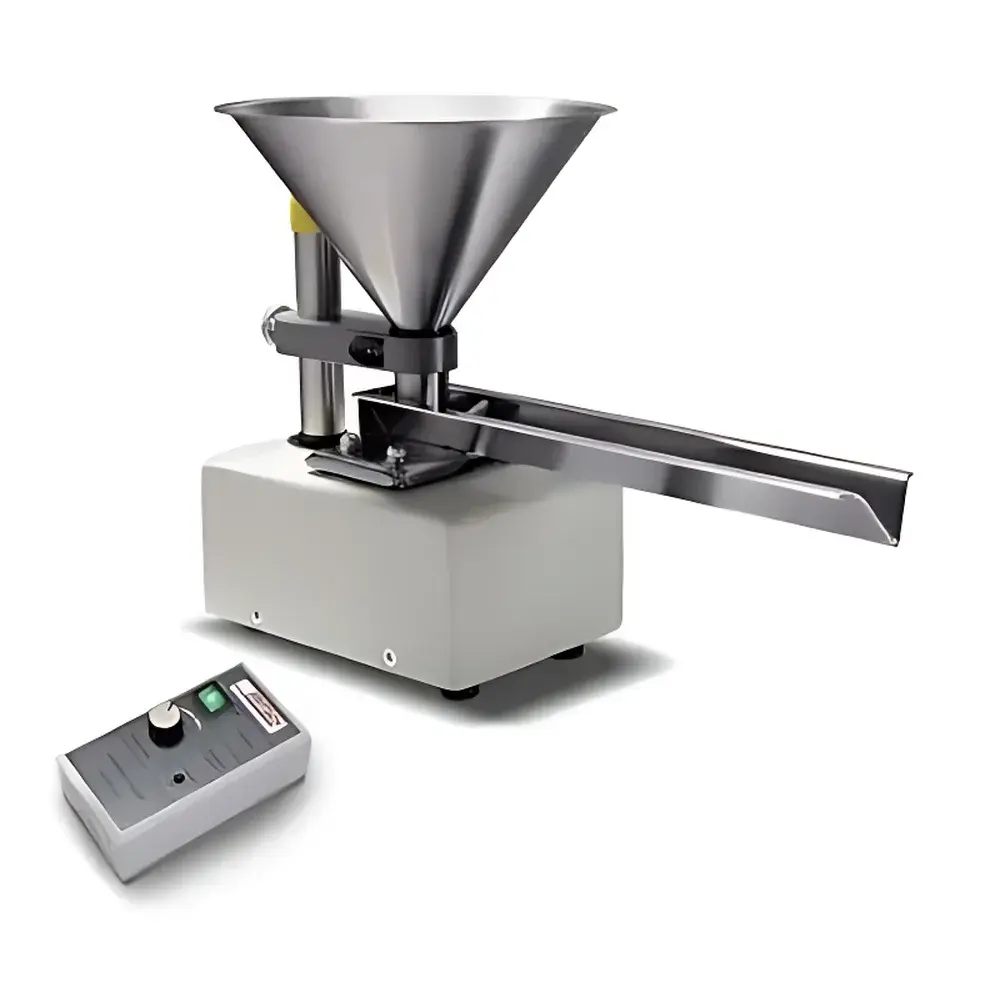
FRITSCH L-24 Vibratory Feeder & L-27 Rotary Sample Divider
| Brand | FRITSCH |
|---|---|
| Origin | Germany |
| Manufacturer Type | Original Equipment Manufacturer (OEM) |
| Product Origin | Imported |
| Models | L-24, L-27 |
| Price Range | USD 13,500 – 40,500 (FOB Hamburg) |
| Feeder Funnel Types | V-shaped and U-shaped |
| Feeder Funnel Length | 215 mm |
| Splitting Ratios (L-27) | 1:8, 1:10, 1:30 |
| Max. Feed Particle Size | 10 mm |
| Max. Feed Volume | 4,000 mL |
| Collection Vessel Capacities | 15 mL, 20 mL, 30 mL, 250 mL, 500 mL |
| Feeder Flow Control | Continuously Adjustable via Independent Speed Regulator |
| L-27 Rotational Speed | Up to 100 rpm |
| Max. Splitting Frequency | 3,000 splits per minute |
| Material Contact Surfaces | Electropolished AISI 316L Stainless Steel |
| Compliance | ISO 14687, ASTM D6938, EN 933-2, GLP-ready architecture |
Overview
The FRITSCH L-24 Vibratory Feeder and L-27 Rotary Sample Divider constitute a fully integrated, precision-engineered sample handling system designed for reproducible, bias-free material subdivision in analytical laboratories and industrial quality control environments. Operating on two distinct physical principles—controlled vibratory conveyance (L-24) and centrifugal dynamic splitting (L-27)—this dual-unit configuration ensures metrological traceability from bulk feedstock to representative sub-samples. The L-24 employs electromagnetic excitation to generate linear, sinusoidal oscillation at precisely regulated amplitude and frequency, enabling laminar, pulse-free flow of cohesive or free-flowing powders, granules, suspensions, emulsions, and low-viscosity liquids through an electropolished AISI 316L stainless steel channel. The L-27 utilizes rotational inertia and radial acceleration to distribute incoming material across eight, ten, or thirty equi-angular collection sectors—each defined by calibrated orifices and guided by gravity-fed geometry—thereby eliminating manual coning-and-quartering errors and ensuring statistically valid mass reduction per ISO 14687:2022 and EN 933-2:2020.
Key Features
- Electromagnetic drive system with zero mechanical wear: The L-24’s maintenance-free actuator delivers stable vibration profiles across its full speed range (0–100 Hz), independent of load mass or material density.
- Modular funnel interface: Interchangeable V- and U-profile funnels (215 mm length) accommodate varying flow rheology—V-type for coarse granules, U-type for fine powders and slurries.
- Programmable split ratio selection: L-27 offers three fixed geometric configurations (1:8, 1:10, 1:30) selected via mechanical indexing; no software calibration required—split fidelity is inherent to the machined rotor geometry.
- Full 360° radial distribution: Sample dispersion occurs uniformly across all collection ports; no preferential channeling or wall adhesion due to optimized surface finish (Ra ≤ 0.4 µm) and hydrophobic glassware options.
- GLP-compliant microprocessor controller: Integrated 8-bit MCU manages synchronized start/stop, dwell timing, and speed ramping; stores operational logs (date/time, total splits, selected ratio) for audit trail generation.
- Tool-free disassembly: All wetted parts—including feed chute, rotor cone, splitter head, and glass receivers—are accessible without wrenches or solvents, supporting rapid changeover between sample matrices.
Sample Compatibility & Compliance
The L-24/L-27 system accepts heterogeneous solids and liquids with maximum particle dimensions up to 10 mm and volumetric throughput up to 4 L per cycle. It is validated for use with pharmaceutical granules (USP ), cementitious blends (ASTM C187), mineral ores (ISO 8502), polymer pellets (ISO 18736), and food-grade particulates (Codex Alimentarius STAN 234). All contact surfaces meet FDA 21 CFR Part 11 requirements for material compatibility and cleanability. The system conforms to ISO/IEC 17025:2017 clause 7.7 (sampling) and supports documented evidence for GMP Annex 11 and EU GMP Chapter 4 compliance when deployed within validated laboratory workflows.
Software & Data Management
While the base L-24/L-27 operates as a standalone hardware platform, optional RS-232/USB interface enables integration with FRITSCH’s LabSolutions v4.2 software suite. This application provides remote parameter setting, real-time flow rate monitoring (via optional load cell feedback), automated batch logging (sample ID, timestamp, split count, ratio), and CSV export compatible with LIMS platforms including Thermo Fisher SampleManager and LabWare LIMS. Audit trails include electronic signatures, version-controlled firmware updates, and tamper-evident log encryption meeting 21 CFR Part 11 Subpart B requirements.
Applications
- Preparation of homogenized sub-samples for laser diffraction particle size analysis (e.g., FRITSCH ANALYSETTE 22, Malvern Mastersizer)
- Representative sampling prior to XRF, ICP-OES, or SEM-EDS elemental mapping
- Reduction of batch materials for stability testing under ICH Q5C guidelines
- Calibration verification of automatic powder feeders in tablet press validation protocols
- Statistical process control (SPC) sampling in additive manufacturing powder recycling loops
- Environmental soil/sediment subsampling per EPA Method 8081B and ISO 11464
FAQ
Can the L-24 feeder handle abrasive ceramics or metal powders without channel wear?
Yes—the L-24’s feed channel is fabricated from electropolished AISI 316L stainless steel with Rockwell hardness ≥ 220 HV; abrasion resistance is further enhanced by its non-contact electromagnetic drive mechanism.
Is the 1:30 split ratio suitable for regulatory submissions requiring ISO 13320-compliant sample mass?
Yes—when used with certified reference materials and validated receiver tare weights, the L-27 achieves RSD ≤ 1.8% across n = 10 replicate splits at 1:30, satisfying ISO 13320 Annex B precision criteria.
Does the system support hazardous area operation (ATEX Zone 22)?
Standard units are rated for general laboratory use (IEC 61000-6-3); ATEX-certified versions (II 3D Ex tc IIIC T100°C) are available upon request with modified motor windings and static-dissipative housings.
How often does the L-27 require recalibration?
None—the split ratio is mechanically fixed by precision-machined rotor geometry; annual verification using gravimetric balance checks (per ISO 14687 Annex C) is recommended but not mandatory.
Can glass receivers be replaced with conductive polymer vessels for electrostatic-sensitive powders?
Yes—FRITSCH offers antistatic polyether ether ketone (PEEK) receivers (catalog #L27-PEEK-250) with surface resistivity < 10⁶ Ω/sq, compliant with IEC 61340-5-1 ESD control standards.



