
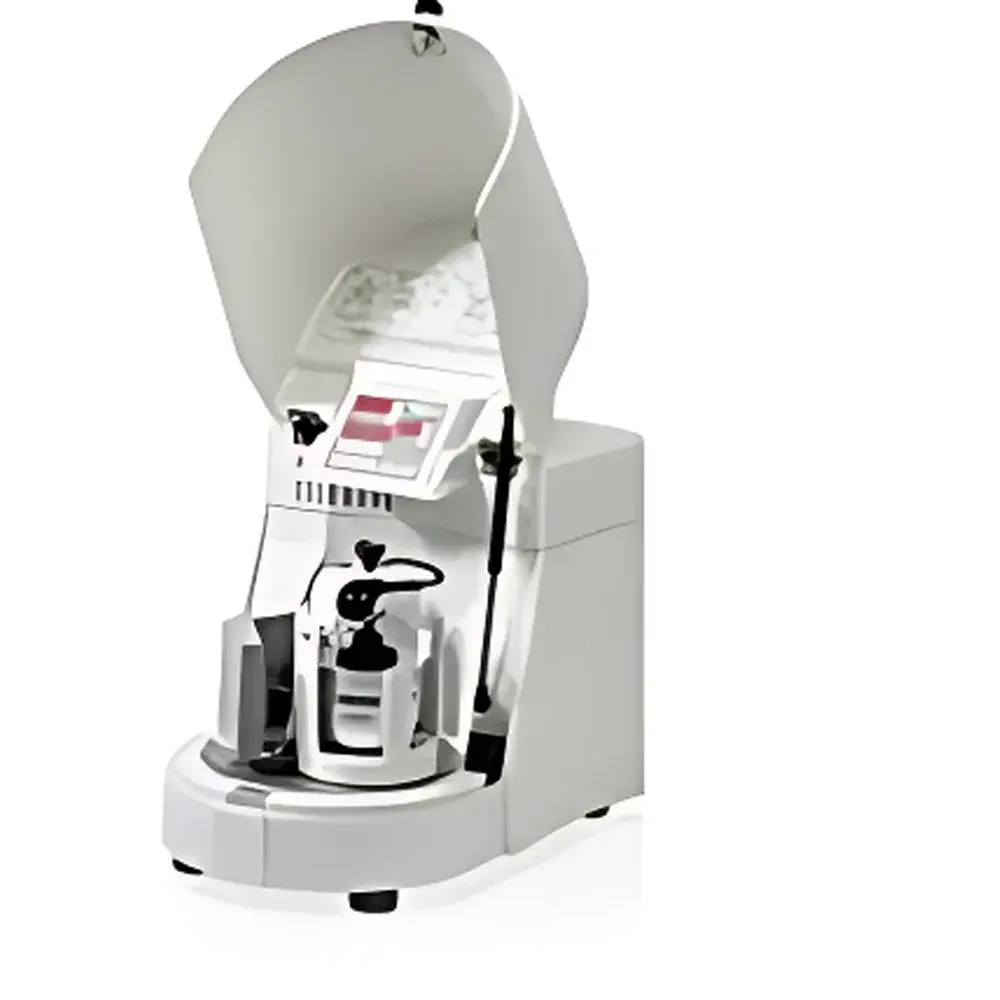
Fritsch P-6 Planetary Micro Mill
| Brand | Fritsch |
|---|---|
| Origin | Germany |
| Manufacturer | Fritsch GmbH |
| Product Type | Planetary Ball Mill |
| Model | P-6 |
| Sample Type | Hard to brittle solids & suspensions |
| Max. Feed Size | < 10 mm |
| Batch Volume | 225 mL |
| Final Particle Size | < 1 µm |
| Grinding Modes | Dry & Wet |
| Operating Environment | Ambient or inert gas (e.g., Ar, N₂) |
| Power Supply | 100–120 / 200–240 V, 1–phase, 50–60 Hz, 1100 W |
| Net Weight | 63 kg |
| Dimensions (W×H×D) | 37 × 53 × 50 cm |
| Compliance | CE, ISO 9001 certified manufacturing |
| Optional Integration | GTM Gas Temperature & Pressure Monitoring System |
Overview
The Fritsch P-6 Planetary Micro Mill is a high-energy, single-vial planetary ball mill engineered for reproducible ultrafine comminution of solid and suspension-based samples in research and quality control laboratories. Based on the fundamental principle of planetary motion—where the grinding bowl rotates around a central axis while simultaneously rotating on its own axis—the P-6 generates intense centrifugal acceleration (up to 65 g), enabling highly efficient particle size reduction through combined impact, shear, and friction forces. Developed by Fritsch GmbH, a German manufacturer with over six decades of expertise in sample preparation and particle characterization, the P-6 has been protected under European patent EP00297248 (1962) and remains a benchmark instrument for applications demanding sub-micron final fineness (< 1 µm) without thermal degradation or cross-contamination. Its robust cast-aluminum housing, precision-machined drive system, and vibration-damped base ensure operational stability even at maximum rotational frequencies.
Key Features
- High-energy planetary motion delivering up to 65 g centrifugal acceleration for rapid, homogeneous size reduction
- Precise digital control of grinding time (1 s–99 h 59 min), pause intervals, and rotational speed (100–650 rpm)
- Seven interchangeable grinding bowl volumes (80, 250, 500 mL) and seven grinding ball diameters (3–40 mm) for method optimization
- Material-flexible grinding components: agate, silicon nitride, aluminum oxide, zirconium oxide, stainless steel, tempered steel, and tungsten carbide—each meeting analytical-grade purity requirements
- Inert atmosphere compatibility via sealed bowl design and gas inlet port; supports argon, nitrogen, or other process gases per ASTM E2913 and ISO 8502-9 protocols
- Integrated cooling jacket option and programmable rest cycles to manage exothermic reactions during extended milling
- CE-marked and manufactured under ISO 9001-certified quality management systems; fully traceable component sourcing
Sample Compatibility & Compliance
The P-6 accommodates a broad spectrum of sample types—from hard, brittle materials (e.g., ceramics, minerals, alloys) to soft, fibrous, or temperature-sensitive substances (e.g., pharmaceutical actives, polymers, biological tissues). It is routinely employed in GLP-compliant laboratories for sample preparation prior to XRD, SEM-EDS, laser diffraction (ISO 13320), and BET surface area analysis (ISO 9277). The instrument meets mechanical safety requirements per EN 61000-6-2/6-4 (EMC Directive) and is compatible with GMP documentation workflows when paired with optional audit-trail-capable software modules. All grinding media and bowls are certified free of extractables and leachables per USP , ensuring suitability for pharmaceutical R&D and QC environments.
Software & Data Management
While the P-6 operates via an intuitive front-panel interface with real-time parameter display, it supports seamless integration with Fritsch’s proprietary MaS (Mill & Sieve) software suite for advanced method storage, remote operation, and electronic lab notebook (ELN) synchronization. When equipped with the GTM (Gas Temperature & Pressure Monitoring) system—the only commercially available solution capable of in-situ measurement of internal bowl gas conditions—the P-6 delivers time-resolved thermodynamic data critical for mechanochemical reaction monitoring (e.g., solid-state synthesis, catalytic activation). All operational logs—including speed profiles, duration, ambient temperature, and GTM traces—are exportable as CSV or PDF for 21 CFR Part 11–compliant archiving.
Applications
- Mechanical alloying and amorphization of metallic powders for additive manufacturing feedstock development
- Preparation of nanoscale catalysts and battery electrode materials (e.g., LiCoO₂, Si anodes)
- Homogenization of heterogeneous geological and mineralogical specimens for geochemical assay
- Particle size reduction of APIs and excipients in pharmaceutical formulation studies
- Production of ultrafine ceramic precursors for sintering and thin-film deposition
- Cell disruption and DNA/RNA extraction support in life science sample prep workflows
- Standardized sample conditioning for ISO/IEC 17025-accredited testing laboratories
FAQ
What is the maximum recommended batch volume for optimal energy transfer in the P-6?
The 225 mL nominal batch capacity refers to the total volume of sample + grinding balls + (if applicable) liquid medium. For dry grinding, optimal performance is achieved at 1/3 to 1/2 bowl fill level; for wet grinding, 2/3 fill is typical.
Can the P-6 be validated for regulated pharmaceutical use?
Yes—when operated with documented SOPs, calibrated speed/time settings, and qualified grinding media, the P-6 supports IQ/OQ/PQ protocols aligned with Annex 15 and ICH Q5C guidelines.
Is the GTM system compatible with all bowl sizes?
GTM integration is validated for 80 mL and 250 mL bowls; custom calibration is required for 500 mL configurations.
How does the P-6 prevent cross-contamination between runs?
All contact surfaces are accessible for manual cleaning; optional ultrasonic cleaning adapters and solvent-resistant seals further reduce carryover risk.
Does Fritsch provide application-specific method development support?
Yes—Fritsch Application Laboratories offer remote and on-site method optimization services, including DOE-based parameter screening and reproducibility assessment per ISO 5725.



