
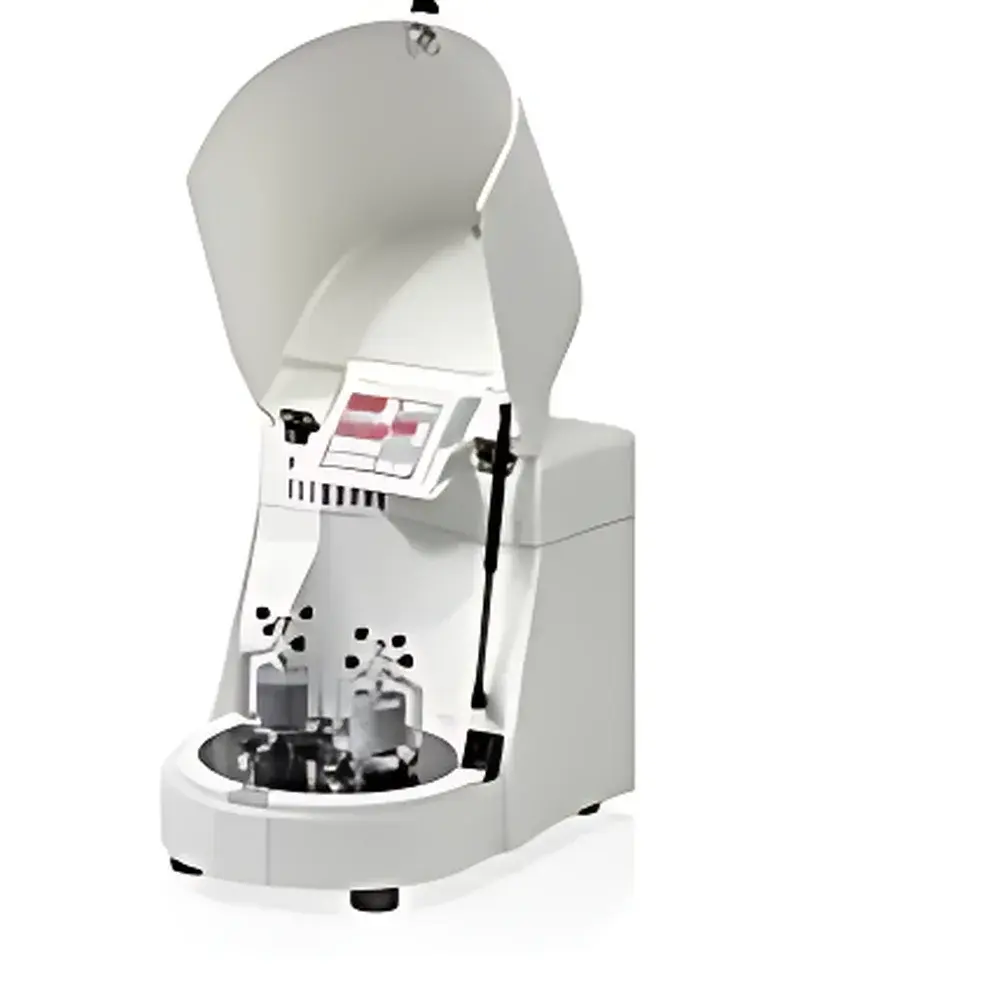
Fritsch P-7 Micro Planetary Ball Mill
| Brand | Fritsch |
|---|---|
| Origin | Germany |
| Manufacturer | Fritsch GmbH |
| Product Type | Planetary Ball Mill |
| Model | P-7 |
| Sample Type | Hard to brittle solids & suspensions |
| Feed Size | < 10 mm |
| Final Particle Size | < 1 µm |
| Batch Volume | 2 × 20 mL (max) |
| Grinding Bowl Options | 12 mL, 45 mL |
| Grinding Media Diameters | 3 mm, 5 mm, 10 mm, 15 mm |
| Grinding Modes | Dry & Wet |
| Power Supply | 100–120 V / 200–240 V, 1-phase, 50–60 Hz, 880 W |
| Net Weight | 35 kg |
| Dimensions (W×H×D) | 37 × 53 × 50 cm |
Overview
The Fritsch P-7 Micro Planetary Ball Mill is a high-energy laboratory grinding instrument engineered for precision particle size reduction in research and quality control environments. Based on the planetary ball milling principle—where grinding bowls rotate in one direction while simultaneously revolving around a central axis—the P-7 generates intense centrifugal and Coriolis forces that accelerate grinding balls to high velocities. This dual-motion mechanism delivers controlled impact energy and shear stress, enabling efficient comminution of hard, brittle, or fibrous materials down to submicron particle sizes (< 1 µm). Designed and manufactured in Idar-Oberstein, Germany, the P-7 conforms to DIN EN ISO 9001 quality management standards and meets essential safety requirements per IEC 61000-6-2/6-4 and CE directives. Its compact footprint and modular configuration make it suitable for regulated laboratories requiring reproducible sample preparation prior to XRD, SEM, laser diffraction, or elemental analysis.
Key Features
- High-precision programmable control with time resolution down to 1 second for both grinding duration and cooling intervals—critical for heat-sensitive samples and process repeatability.
- Two independent grinding stations (2 × 20 mL max capacity), allowing parallel processing of dissimilar samples under identical parameters to minimize inter-batch variability.
- Eight certified grinding material options—including agate, silicon nitride, alumina, yttria-stabilized zirconia, stainless steel, hardened steel, tungsten carbide, and disposable polypropylene bowls—ensuring chemical inertness and minimal contamination for trace-level analyses.
- Optimized bowl geometry and kinematic design deliver uniform energy distribution across the grinding zone, supporting high reproducibility (RSD < 3% for repeated runs under standardized conditions).
- Integrated thermal management system with configurable pause cycles mitigates temperature rise during extended operation—essential for preserving crystallinity, polymorphic form, or organic integrity in pharmaceutical and nanomaterial applications.
- Ergonomic access, tool-free bowl clamping, and smooth-surface components facilitate rapid cleaning and cross-contamination prevention in GLP/GMP-aligned workflows.
Sample Compatibility & Compliance
The P-7 accommodates a broad spectrum of inorganic and organic matrices: metallic alloys, oxides, ceramics, geological specimens (e.g., quartz, feldspar), pharmaceutical actives and excipients, polymers, and biological tissues (after lyophilization). It supports both dry grinding and wet dispersion using solvents such as ethanol, isopropanol, or aqueous surfactant solutions. All contact parts comply with USP Class VI biocompatibility standards where applicable; grinding media meet ASTM F1877 (ceramic biomaterials) and ISO 13356 (zirconia purity) specifications. The instrument is routinely validated for use in methods adhering to ASTM E11-22 (specifications for test sieves), ISO 13320:2020 (laser diffraction particle sizing), and USP <429> (particle size distribution for drug substances).
Software & Data Management
While the P-7 operates via an intuitive front-panel interface with non-volatile parameter memory, its operational logs—including start/stop timestamps, speed profiles, cycle counts, and error codes—are stored internally for audit trail generation. When integrated into networked lab infrastructures, these records can be exported via USB for inclusion in electronic lab notebooks (ELNs) or LIMS platforms compliant with FDA 21 CFR Part 11 (electronic signatures and record retention). Optional firmware updates ensure alignment with evolving regulatory expectations for instrument qualification (IQ/OQ/PQ) documentation and traceable calibration history.
Applications
- Preparation of homogeneous powders for X-ray fluorescence (XRF) and X-ray diffraction (XRD) analysis in geochemical and metallurgical QA/QC.
- Mechanical alloying of intermetallic compounds and amorphous phase synthesis in advanced materials R&D.
- Particle size engineering of active pharmaceutical ingredients (APIs) to enhance dissolution kinetics and bioavailability.
- Homogenization of catalyst precursors and battery electrode materials (e.g., LiCoO₂, Si anodes) prior to slurry formulation.
- Standardized sample comminution for ASTM D346/D7502 coal and mineral assay protocols.
- Generation of reference standards with certified particle size distributions for instrument calibration across analytical labs.
FAQ
What is the smallest achievable particle size with the P-7?
Under optimized conditions (e.g., zirconia media, wet grinding, multi-step protocols), the P-7 consistently achieves median particle sizes below 1 µm, with D90 values typically < 2 µm for brittle inorganic materials.
Can the P-7 be used for cryogenic grinding?
No—the P-7 does not incorporate liquid nitrogen cooling ports or low-temperature rated seals; however, intermittent cooling pauses and chilled solvents in wet mode provide effective thermal control for moderately thermolabile samples.
Is method transfer between P-7 units straightforward?
Yes—identical mechanical design, factory-calibrated speed governors, and standardized bowl/media geometries ensure high inter-unit reproducibility when operating parameters (rpm, time, ball-to-powder ratio) are rigorously documented.
How is contamination minimized during sequential runs?
By selecting chemically matched grinding media, implementing validated cleaning protocols (e.g., ultrasonic bath + solvent rinse), and utilizing single-use polypropylene bowls for ultra-trace applications.
Does Fritsch provide IQ/OQ documentation support?
Yes—comprehensive qualification templates, test protocols, and raw data worksheets are available upon request to support GxP-compliant installation and operational verification.



