
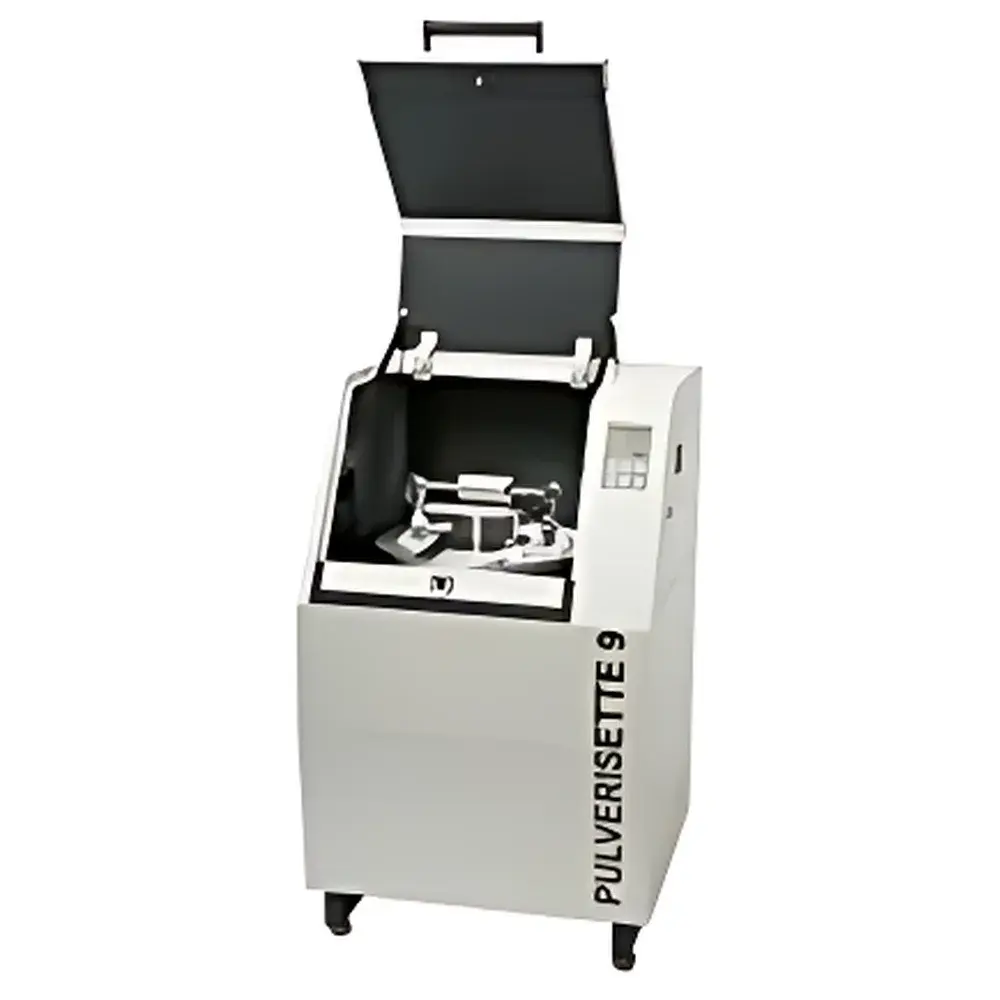
Fritsch P-9 Vibratory Cup Mill
| Brand | Fritsch |
|---|---|
| Origin | Germany |
| Manufacturer | FRITSCH GmbH |
| Model | P-9 |
| Instrument Type | Vibratory Disc Mill |
| Sample Applicability | Hard & Brittle Materials |
| Max. Feed Size | 12 mm |
| Batch Volume | 250 mL |
| Final Particle Size | 10–20 µm |
| Motor Speed | Up to 1500 rpm |
| Power Supply | 230–240 V, 1~ , 50–60 Hz, 1200 W |
| Motor Output | 1.1 kW (EN 60034 / VDE 0530) |
| Net Weight | 267 kg |
| Dimensions (W×H×D) | 77 × 76 × 116 cm |
| Noise Reduction | ISO 7779-compliant enclosed grinding chamber |
| Safety Lock | Spring-loaded centrifugal locking mechanism |
Overview
The Fritsch P-9 Vibratory Cup Mill is a high-energy, precision-engineered laboratory mill designed for the rapid and reproducible size reduction of hard, brittle, and tough materials—including metallurgical slags, cast iron, coal, ores, rocks, refractories, and ceramic raw materials. Operating on the principle of high-frequency vibrational energy transfer, the P-9 employs a horizontally oscillating grinding disc mounted on a spring-damped suspension system. As the disc rotates at speeds up to 1500 rpm, it imparts intense centrifugal acceleration and tumbling motion to grinding elements (e.g., hardened steel or tungsten carbide balls) contained within a sealed, interchangeable cup. This dual-mode mechanical action—impact and friction—ensures efficient comminution without thermal degradation or cross-contamination. Unlike conventional planetary or jaw mills, the P-9’s frequency-controlled vibratory drive delivers consistent energy input across batch sizes, making it uniquely suited for analytical sample preparation where particle size distribution, homogeneity, and chemical integrity are critical—especially prior to XRF, XRD, ICP-OES, or fusion bead analysis.
Key Features
- Frequency-regulated vibratory drive—world’s only commercially available vibratory cup mill with adjustable oscillation frequency for optimized energy delivery per material class.
- Centrifugal safety lock system: spring-actuated mechanical interlock prevents accidental cup opening during operation, complying with EN 61000-6-4 (EMC) and EN ISO 12100 (machine safety).
- Hermetically sealed grinding chamber with acoustic insulation—meets ISO 7779 noise emission standards (<72 dB(A) at 1 m), enabling safe integration into shared laboratory environments.
- Modular cup system: interchangeable grinding cups (50 mL, 100 mL, 250 mL) fabricated from wear-resistant materials (stainless steel, tungsten carbide, agate, or zirconia) to match sample reactivity and contamination requirements.
- High-torque, brushless motor (1.1 kW output, EN 60034 certified) with integrated thermal protection and voltage stabilization for stable performance under variable grid conditions (230–240 V, 50–60 Hz).
- No-loss grinding architecture: fully enclosed path minimizes sample loss and airborne dust—critical for trace-element analysis and regulatory compliance (e.g., EPA Method 6010D, ISO 18227).
Sample Compatibility & Compliance
The P-9 accommodates dry or wet grinding of samples with Mohs hardness up to 9 (e.g., corundum, silicon carbide) and compressive strength exceeding 200 MPa. It is routinely employed in accredited laboratories preparing reference materials for ISO/IEC 17025 audits and fulfilling method validation requirements per ASTM E29, ISO 13320 (laser diffraction), and USP . Its closed-cup design supports GLP-compliant workflows by eliminating operator exposure and ensuring full sample accountability. All wet-grinding configurations comply with FDA 21 CFR Part 11 data integrity guidelines when paired with Fritsch’s optional digital control module (P-9 DigiControl), which logs timestamped operational parameters and cup identification.
Software & Data Management
While the base P-9 operates via analog controls, the optional P-9 DigiControl interface provides programmable protocols (speed ramping, dwell time, pause intervals), real-time RPM monitoring, and automatic shutdown upon torque overload or temperature threshold breach. Exportable CSV logs include cycle count, total operating time, and thermal history—supporting 21 CFR Part 11 audit trails and laboratory information management system (LIMS) integration. Firmware updates are delivered via USB and validated per IEC 62304 software lifecycle standards.
Applications
- Preparation of homogeneous powders for X-ray fluorescence (XRF) and X-ray diffraction (XRD) analysis in geological surveys and mining QA/QC labs.
- Routine pulverization of sintered slag, blast furnace residues, and ferroalloy samples for elemental assay by ICP-MS or AAS.
- Production of sub-20 µm feedstock for fused bead preparation in silicate and oxide matrix analysis (ISO 12677).
- Grinding of pharmaceutical excipients and ceramic precursors where amorphization must be avoided—validated via DSC and Raman spectroscopy.
- Ecological soil and sediment sample homogenization per ISO 11464 and EPA SW-846 Method 3050B.
FAQ
What materials are incompatible with the P-9?
Highly ductile metals (e.g., pure copper, aluminum), elastomers, and fibrous organics are not recommended due to insufficient brittleness for effective impact comminution.
Can the P-9 achieve sub-10 µm particle size?
Yes—with extended processing time, cryogenic cooling (optional liquid nitrogen jacket), and tungsten carbide cups; however, final fineness is material-dependent and should be verified by laser diffraction (ISO 13320) or SEM.
Is cleaning validated for multi-sample workflows?
Fritsch supplies cup-specific cleaning protocols—including ultrasonic treatment, solvent rinsing, and blank-run verification—aligned with ISO 17025 clause 7.7 on contamination control.
Does the P-9 support GMP documentation requirements?
When equipped with DigiControl and connected to a compliant LIMS, it satisfies Annex 11 and EU GMP Chapter 4 data integrity expectations for equipment qualification (IQ/OQ/PQ).
What maintenance intervals are recommended?
Biannual inspection of spring damping elements, cup sealing gaskets, and motor bearings is advised; full service kits and OEM-certified calibration are available directly from FRITSCH GmbH (Idar-Oberstein, Germany).



