
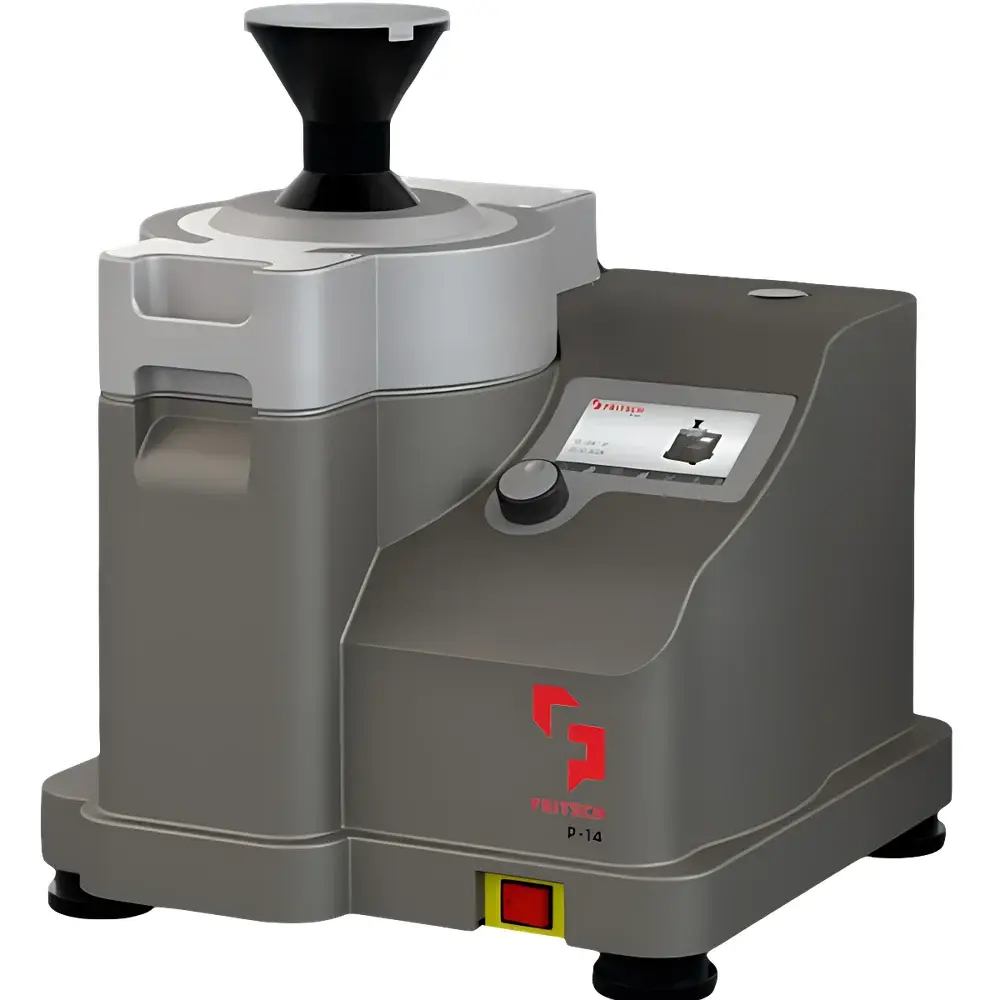
FRITSCH PULVERISETTE 14 Premium High-Speed Rotational Crusher
| Brand | FRITSCH |
|---|---|
| Origin | Germany |
| Manufacturer | FRITSCH GmbH |
| Product Type | Rotational Crusher |
| Model | PULVERISETTE 14 |
| Sample Type | Soft to medium-hard, fibrous, temperature-sensitive materials |
| Max. Feed Size | <15 mm |
| Throughput | ≥15 L/h |
| Final Particle Size | <40 µm |
| Adjustable Speed Range | 6,000–24,000 rpm |
| Motor Power | 1.5 kW (bearing motor per VDE 0530 / EN 60034), 2.5 kW total electrical input |
| Cooling | Forced-air convection with high-volume airflow |
| Safety | Automatic chamber locking, interlocked lid sensor, integrated safety control logic |
| Compliance | CE, RoHS-compliant grinding components available (titanium, tungsten carbide) |
| Dimensions (W×H×D) | 55×63×52 cm |
| Net Weight | 44 kg |
Overview
The FRITSCH PULVERISETTE 14 Premium is a high-speed rotational crusher engineered for rapid, reproducible size reduction of soft, fibrous, and thermally sensitive laboratory samples. Operating on the principle of high-velocity impact combined with controlled shear and compression between a rotating rotor and a fixed sieve ring, it delivers consistent particle size distributions without significant thermal degradation. Unlike conventional jaw or disc mills, the PULVERISETTE 14 employs a dynamically balanced, precision-machined stainless steel rotor spinning at up to 24,000 rpm—corresponding to a peripheral speed of 437 km/h—enabling efficient comminution through kinetic energy transfer rather than static pressure alone. Its forced-air cooling system maintains stable operating temperatures during extended runs, critical for polymers, pharmaceuticals, botanicals, and other heat-labile matrices. Designed and manufactured in Idar-Oberstein, Germany, the instrument meets stringent EU machinery directive (2006/42/EC) and electromagnetic compatibility (2014/30/EU) requirements, with full traceability under ISO 9001-certified production.
Key Features
- Variable-speed digital control (6,000–24,000 rpm) enabling precise optimization of impact energy for diverse material classes—from elastomeric polymers to dried plant tissue.
- Automatic locking mechanism for the grinding chamber ensures mechanical interlock verification prior to operation; the system only initiates when all components—including lid, sieve ring, and rotor—are correctly seated and secured.
- Integrated safety logic compliant with EN 61508 (functional safety of electrical systems), including real-time monitoring of motor load, temperature thresholds, and lid position status.
- High-volume axial airflow path engineered to dissipate heat generated during high-speed operation, minimizing sample oxidation and thermal artifact formation.
- Modular grinding assembly with interchangeable sieve rings (standard aperture range: 0.08–6 mm) and optional rotor materials—including pure titanium and tungsten carbide—for RoHS-conformant, metal-free processing of regulatory-critical samples (e.g., electronics waste, pharmaceutical excipients).
- Ergonomic design with tool-free disassembly, smooth-surface stainless steel housing, and minimal crevice geometry to support GLP-aligned cleaning validation and cross-contamination mitigation.
Sample Compatibility & Compliance
The PULVERISETTE 14 is validated for use with soft to medium-hard organic and inorganic materials, including but not limited to: polypropylene (PP), polyvinyl chloride (PVC), polyethylene (PE), cellulose-based fibers, dried herbs and roots, coated tablets, granulated fertilizers, animal feed, lignocellulosic biomass, leather shavings, and synthetic resins. It is routinely employed in compliance-driven workflows aligned with RoHS Directive 2011/65/EU, WEEE, and REACH substance screening protocols where contamination control and elemental integrity are paramount. Optional titanium or tungsten carbide rotors eliminate ferrous and heavy-metal leaching—essential for ICP-MS or XRF sample preparation. The instrument supports audit-ready documentation per ISO/IEC 17025:2017 and FDA 21 CFR Part 11 when paired with FRITSCH’s optional data logging software (PULVERISETTE Control Suite v3.2+).
Software & Data Management
When connected via RS-232 or optional USB interface, the PULVERISETTE 14 integrates with FRITSCH’s PULVERISETTE Control Suite—a validated Windows-based application supporting parameter archiving, user-level access control (administrator/operator roles), electronic signature capture, and automated report generation (PDF/CSV). All operational events—including speed setpoint, runtime, lid-open cycles, and fault codes—are timestamped and stored with immutable audit trails. The software complies with ALCOA+ principles and facilitates 21 CFR Part 11 compliance through configurable electronic signatures, role-based permissions, and secure data export. For high-throughput labs, optional integration with Fritsch L-24 vibratory feeders and cyclone separators enables unattended batch processing with full mass balance tracking.
Applications
This crusher serves as a primary size-reduction step in analytical workflows across environmental testing (soil, sediment, compost), polymer recycling analysis (plastic sorting and homogenization), pharmaceutical QA/QC (tablet content uniformity sampling), agrochemical R&D (fertilizer granule characterization), and food safety (mycotoxin extraction from cereal grains). Its ability to achieve sub-40 µm final fineness—without cryogenic assistance—makes it suitable for preparing representative subsamples prior to laser diffraction particle sizing (ISO 13320), XRD phase analysis, or SEM-EDS morphology assessment. In regulated environments, its deterministic performance and documented traceability support method validation per USP , ASTM D5630, and ISO 10423.
FAQ
What types of materials are unsuitable for the PULVERISETTE 14?
Hard, brittle, or highly abrasive materials such as quartz, silicon carbide, or hardened steel are not recommended due to excessive wear on standard stainless steel components and potential rotor imbalance.
Can the instrument be used for cryogenic grinding?
No—the PULVERISETTE 14 is not designed for liquid nitrogen integration; its forced-air cooling system operates within ambient temperature ranges (15–30 °C). For cryo-applications, FRITSCH recommends the PULVERISETTE 19 cryo-mill.
Is the 15 L/h throughput rate achievable across all sample types?
Throughput is material-dependent: values ≥15 L/h apply to low-density, fibrous, or soft polymers under optimal feed conditions (pre-sieved <15 mm, continuous feeding via L-24). Denser or moisture-rich samples may require reduced feed rates to maintain final fineness and thermal stability.
How is calibration and performance verification performed?
FRITSCH provides factory calibration certificates for speed accuracy (±0.5% full scale) and motor torque response. Users perform routine verification using certified reference materials (e.g., NIST-traceable glass microspheres) and sieve analysis per ISO 9276-2.
Does the system support GMP documentation requirements?
Yes—when configured with PULVERISETTE Control Suite, full electronic records—including operator ID, timestamped parameters, and event logs—are retained for minimum 10 years and exportable in 21 CFR Part 11–compliant formats.



