
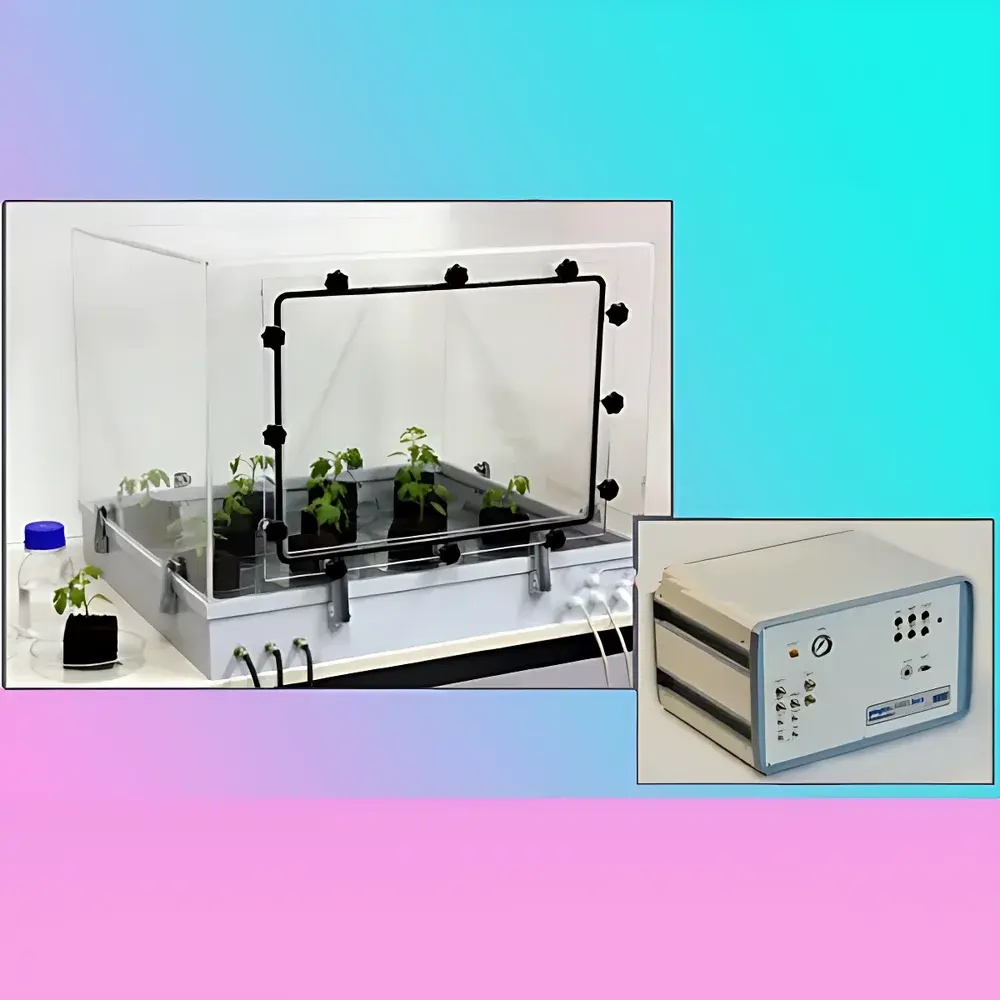
German ECH phytolabelbox C13 Stable Isotope (¹³C) Gas Labeling Plant Growth System
| Origin | Germany |
|---|---|
| Manufacturer Type | Authorized Distributor |
| Import Status | Imported |
| Model | C13 |
| Pricing | Available Upon Request |
Overview
The German ECH phytolabelbox C13 is a purpose-built, compact stable isotope gas labeling system engineered for non-invasive, real-time ¹³CO₂ pulse-chase experiments in controlled plant growth environments. It operates on the principle of dynamic isotopic labeling—introducing precisely metered concentrations of ¹³C-enriched carbon dioxide into a sealed or semi-closed cultivation chamber to trace carbon assimilation, allocation, and turnover kinetics across tissues and developmental stages. Unlike open-flow IRGA-based systems, the phytolabelbox C13 integrates gas dosing, environmental control (temperature, humidity), and automated sampling logic within a single robust enclosure—enabling reproducible labeling under defined physiological conditions without external gas cabinets, mass flow controllers, or third-party data loggers. Designed for laboratory- and greenhouse-based phenotyping workflows, it supports both short-term gas exchange studies (e.g., photosynthetic induction, stomatal response) and multi-hour metabolic tracing protocols compliant with ISO 17025-accredited plant physiology labs.
Key Features
- Integrated ¹³CO₂ delivery module with calibrated solenoid valves and pressure-regulated gas manifold—ensuring repeatable label pulses between 5.0–69.9 µmol·mol⁻¹ (ppm) concentration range
- Thermostatically controlled internal environment: adjustable setpoint from ambient +8 °C to 60 °C, maintaining ±0.5 °C stability during labeling cycles
- High-speed sequential measurement capability: full-cycle gas sampling and concentration readout completed within ≤2 seconds per sample—enabling high-temporal-resolution kinetic profiling
- Self-contained operation: no external peripherals required; powered by standard AC 100 W (50/60 Hz); zero warm-up time—operational immediately after power-on
- Dual-output interface: RS-232C serial port for direct connection to PC-based acquisition software or LIMS, plus built-in thermal printer for immediate hard-copy documentation
- Onboard non-volatile memory (≥10,000 data points) with timestamping and sample ID tagging—supports GLP-compliant audit trails when used with validated software
- Compact footprint (370 × 345 × 160 mm) and lightweight aluminum-alloy chassis—designed for benchtop use, mobile field deployment, or integration into multi-sensor phenotyping racks
Sample Compatibility & Compliance
The phytolabelbox C13 accommodates whole plants (up to 30 cm height), detached leaves, seedlings, or excised tissue segments placed inside its standardized 1.2 L labeling chamber. Chamber seals meet DIN EN 17101 leak-rate specifications (<5 × 10⁻⁴ mbar·L/s), ensuring minimal isotopic dilution during pulse application. The system complies with IUPAC guidelines for stable isotope tracer methodology and supports experimental designs aligned with ASTM E2915–22 (Standard Practice for Quantitative Isotopic Analysis of Biological Materials). All electrical components conform to CE/EMC Directive 2014/30/EU and RoHS 2011/65/EU. For regulated environments (e.g., contract research organizations conducting OECD TG 208 or EPA OPPTS 850.4400 studies), the device’s deterministic timing, fixed calibration intervals, and traceable firmware versioning support 21 CFR Part 11 readiness when paired with validated data management software.
Software & Data Management
Data acquisition and protocol scheduling are managed via optional ECH ControlSuite v3.2 (Windows 10/11 compatible), which provides ISO/IEC 17025-aligned features including user role-based access control, electronic signatures, change history logging, and PDF report generation with embedded metadata (operator ID, timestamp, chamber temperature, CO₂ concentration, pulse duration). Raw output includes ASCII-delimited files (.csv) containing time-stamped ¹³CO₂ concentration values, chamber temperature, and status flags—directly importable into MATLAB, R, or Python for kinetic modeling (e.g., compartmental analysis using COPASI or GNU MCSim). Internal storage retains all measurements with millisecond-level precision; printouts include QR-coded batch identifiers for cross-referencing with physical sample logs.
Applications
- Quantification of carbon fixation rates and photorespiratory flux under varying light intensities or spectral quality (blue LED illumination supports concurrent photobiological stimulation)
- In vivo assessment of source–sink dynamics during fruit development, tuber initiation, or grain filling in cereals and legumes
- Evaluation of stress-induced shifts in carbon partitioning (e.g., drought, salinity, nutrient deficiency) using time-resolved ¹³C distribution profiles
- Validation of genome-edited lines for altered Rubisco kinetics or stomatal conductance via comparative labeling efficiency metrics
- Calibration of non-invasive imaging modalities (e.g., hyperspectral reflectance, fluorescence lifetime imaging) against ground-truth isotopic incorporation data
FAQ
Does the phytolabelbox C13 require external CO₂ analyzers or IRGA units?
No—the system incorporates a factory-calibrated NDIR sensor optimized for ¹³CO₂ detection within the specified concentration range; no external gas analyzers are needed.
Can multiple samples be labeled sequentially without manual intervention?
Yes—up to ten pre-loaded samples can be processed in fully automated sequence with programmable inter-pulse intervals and individual chamber conditioning cycles.
Is firmware upgradable, and are calibration certificates provided?
Firmware updates are distributed via ECH’s secure portal with version-controlled release notes; each unit ships with a traceable calibration certificate valid for 12 months from date of dispatch.
What safety mechanisms prevent over-pressurization or gas leakage during operation?
A redundant pressure relief valve (set at 1.2 bar g), continuous chamber pressure monitoring, and automatic shutdown upon seal integrity failure ensure Class II biosafety compliance per EN 14122-3.
Is the blue LED illumination spectrally characterized, and can its intensity be modulated?
The 450 nm ±10 nm LED array delivers 120 µmol·m⁻²·s⁻¹ PAR at chamber floor level; intensity is fixed to maintain consistent photophysiological conditions across replicates—no dimming function is implemented to preserve measurement reproducibility.
Related Products





