
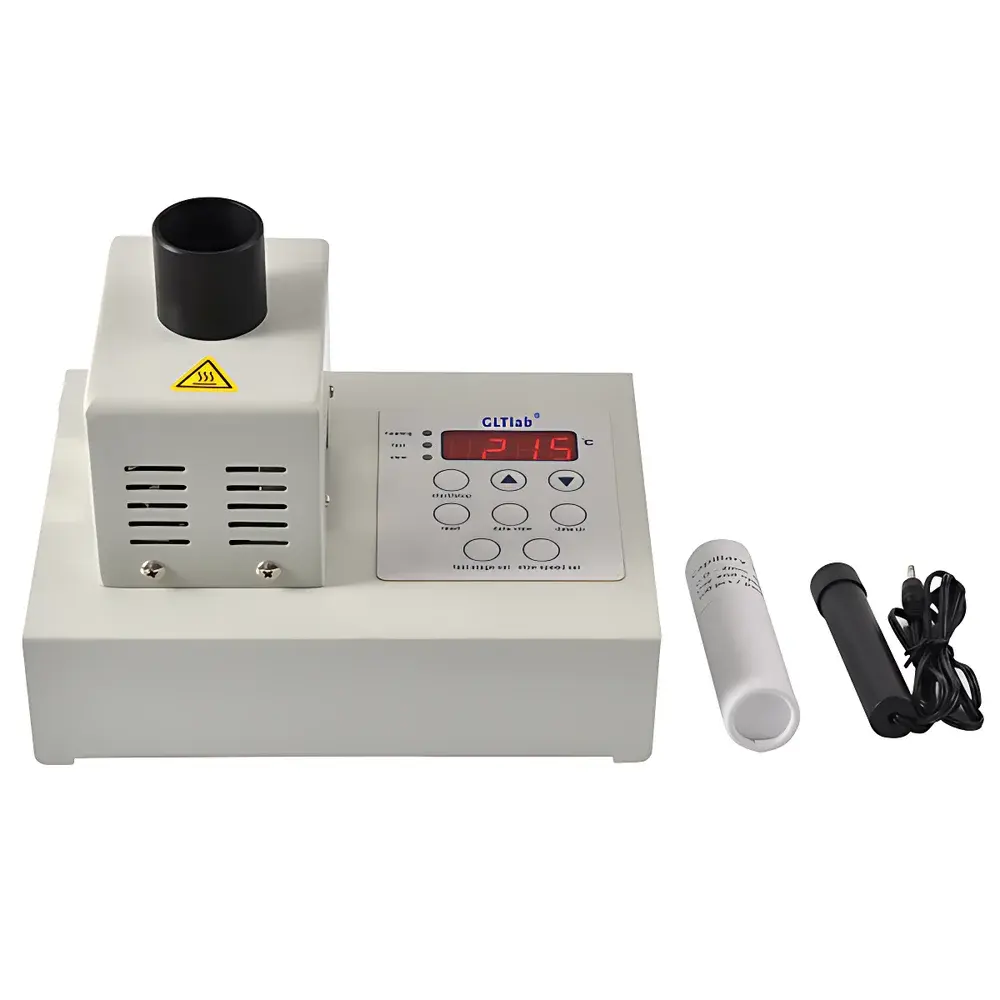
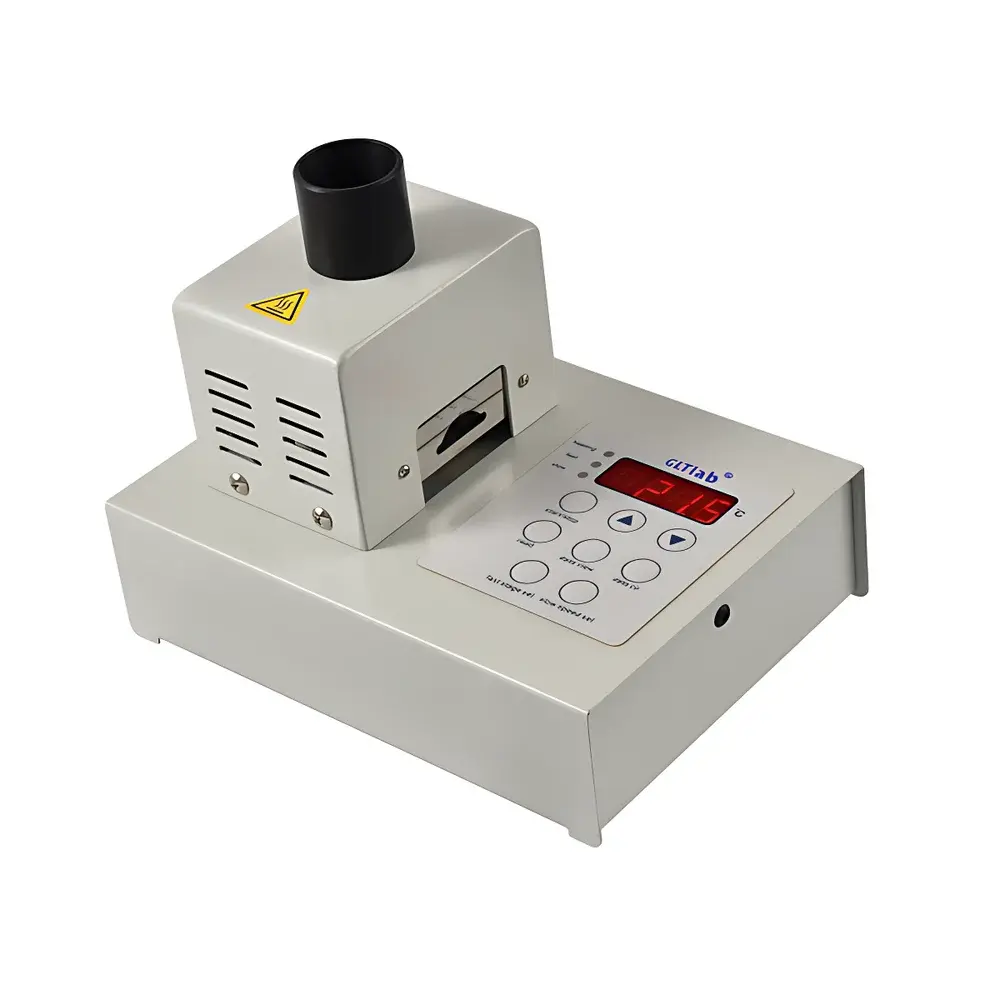
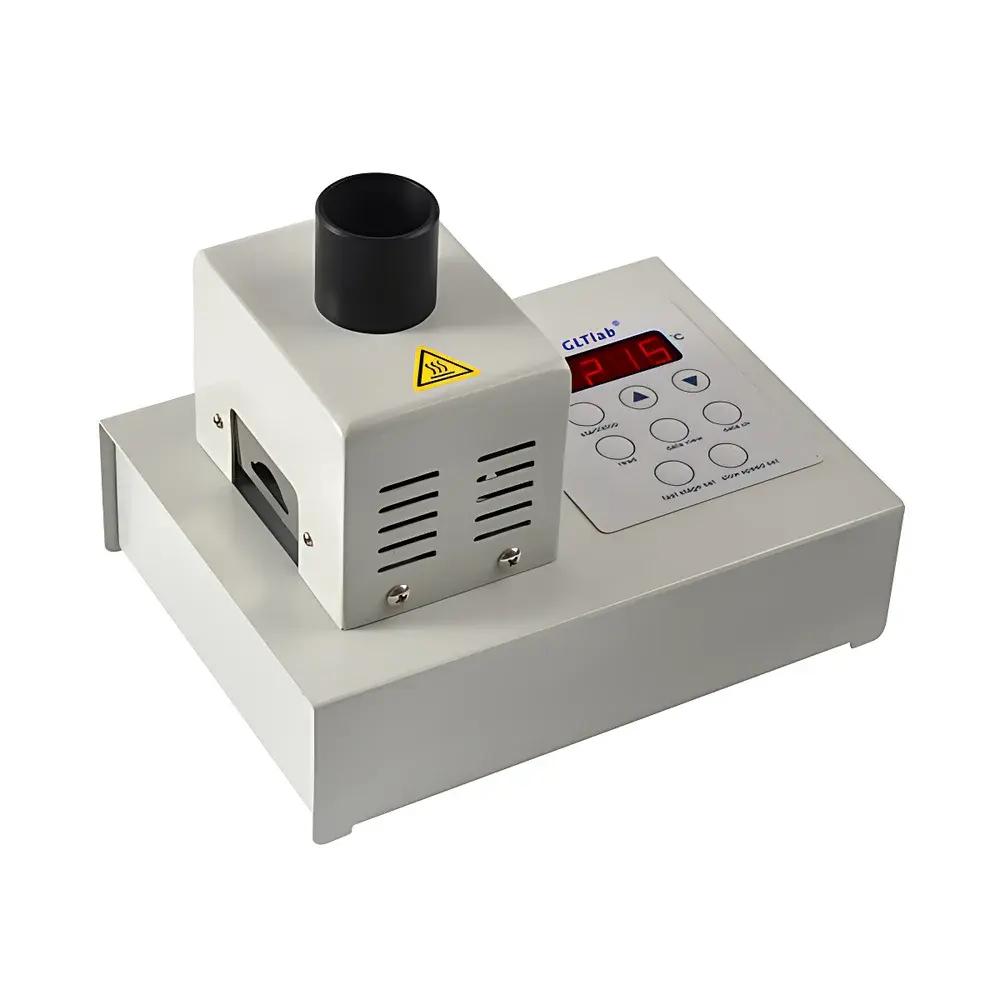
GLTlab MPD-03 Digital Visual Melting Point Apparatus with Internal Eyepiece Observation
| Brand | GLTlab |
|---|---|
| Origin | Guangdong, China |
| Manufacturer Type | Direct Manufacturer |
| Country of Origin | China |
| Model | MPD-03 |
| Temperature Range | Ambient to 400 °C |
| Heating Rate | 20 °C/min |
| Temperature Repeatability | ±0.5 °C |
| Temperature Accuracy | ±0.1 °C |
| Capillary Diameter | 2 mm |
| Sample Capacity | 3 samples |
| Temperature Resolution | 0.1 °C |
| Display | 4-digit LED |
| Calibration Function | Yes |
| Hold Temperature Function | Yes |
| Dimensions (W×D×H) | 160 × 220 × 170 mm |
| Net Weight | 2 kg |
| Power Supply | 120/230 V AC, 50 Hz, 75 W |
Overview
The GLTlab MPD-03 Digital Visual Melting Point Apparatus is a precision thermal analysis instrument engineered for reliable, operator-controlled determination of solid-phase transition temperatures in crystalline organic and pharmaceutical compounds. Utilizing the classical capillary tube method—standardized in pharmacopoeial guidelines including USP , EP 2.2.14, and JP 2.60—the MPD-03 employs a calibrated Peltier-heated aluminum block and high-stability temperature control circuitry to deliver reproducible melt onset and clear point detection. Its integrated internal eyepiece optical system enables direct visual observation of sample morphology changes during heating, eliminating reliance on external microscopes or video modules. Designed for routine QC laboratories, academic teaching labs, and R&D settings where regulatory traceability and method robustness are essential, the MPD-03 operates within a validated temperature range from ambient to 400 °C with a resolution of 0.1 °C and certified accuracy of ±0.1 °C against NIST-traceable references.
Key Features
- Triple-sample capability: Simultaneous independent melting point determination of up to three capillary-loaded specimens—enhancing throughput without compromising measurement integrity.
- Internal optical viewing path: Fixed-focus eyepiece aligned coaxially with the heating block, optimized for real-time visual assessment of meniscus formation, sintering, and collapse under consistent illumination.
- High-fidelity thermal control: Microprocessor-regulated heating ramp with selectable fixed-rate mode (20 °C/min standard) and precise dwell functionality for isothermal hold at user-defined temperatures.
- Calibration-ready architecture: Supports two-point calibration using certified reference standards (e.g., pure caffeine, acetanilide, indomethacin), ensuring long-term drift compensation per ISO/IEC 17025 laboratory requirements.
- Compact benchtop footprint: Space-efficient design (160 × 220 × 170 mm) and low power consumption (75 W) suitable for shared instrumentation spaces and mobile lab configurations.
- LED-based digital interface: Four-digit display with intuitive navigation buttons for temperature setpoint entry, ramp activation, and hold initiation—no software dependency required for basic operation.
Sample Compatibility & Compliance
The MPD-03 accommodates standard 1–2 mm outer diameter glass capillaries (2 mm specified), compatible with both manual and semi-automated sample packing tools. It supports common pharmaceutical actives, polymers, fine chemicals, and natural product isolates requiring melt characterization per pharmacopeial monographs. Instrument performance aligns with ASTM E324–22 (Standard Test Methods for Softening Point of Solid Materials by Ring-and-Ball Apparatus) for comparative thermal behavior assessment and meets baseline requirements for GLP-compliant documentation when paired with external logbooks or LIMS-integrated reporting. While the MPD-03 does not include built-in audit trail or electronic signature functions, its deterministic analog-digital hybrid control architecture ensures full repeatability for 21 CFR Part 11–aligned validation protocols when operated within documented SOPs.
Software & Data Management
The MPD-03 is a standalone, hardware-centric instrument with no embedded data logging or USB/RS-232 connectivity. All measurements are recorded manually via operator notation or external documentation systems. This design prioritizes operational simplicity, electromagnetic immunity, and long-term serviceability—particularly advantageous in environments with high RF noise or limited IT infrastructure. For laboratories requiring electronic data capture, the MPD-03 can be integrated into broader QA workflows via time-synchronized manual entry into validated ELN platforms or LIMS interfaces. Calibration records, maintenance logs, and daily verification checks (e.g., using USP-certified reference materials) are maintained externally per ISO 9001 and ICH Q7 Annex 19 expectations.
Applications
- Pharmaceutical quality control: Identity confirmation and purity assessment of active pharmaceutical ingredients (APIs) and excipients per USP/EP compendial methods.
- Academic instruction: Teaching fundamental principles of phase transitions, eutectic behavior, and thermal stability in undergraduate chemistry and materials science curricula.
- Polymer characterization: Preliminary screening of crystallinity, degradation onset, and batch-to-batch consistency in thermoplastics and copolymers.
- Natural products analysis: Verification of botanical extract authenticity and detection of adulteration through comparative melting profile analysis.
- Regulatory submission support: Generation of raw observational data for inclusion in ANDA, DMF, or CMC sections where instrumental qualification is documented per ICH Q2(R2).
FAQ
Does the MPD-03 support automated video capture or image storage?
No. The MPD-03 features an internal optical eyepiece only; it does not include a camera module, SD card slot, or digital imaging interface.
Can the heating rate be adjusted below 20 °C/min?
No. The MPD-03 provides a fixed 20 °C/min ramp rate as a factory-set parameter to ensure thermal uniformity across the block and minimize overshoot artifacts.
Is the instrument supplied with calibration standards?
No. Certified reference materials (e.g., USP Melting Point Standards) must be procured separately and stored under controlled conditions per manufacturer specifications.
What capillary types are compatible with the MPD-03?
Standard thin-walled glass capillaries with 1.0–2.0 mm outer diameter and 0.1–0.2 mm wall thickness are recommended; quartz capillaries are not supported due to differential thermal expansion characteristics.
Does the MPD-03 comply with FDA 21 CFR Part 11?
The device itself is not Part 11–compliant out-of-the-box, but it may be deployed within a Part 11–compliant environment when procedural controls (e.g., dual-operator verification, handwritten logbooks with timestamps) are implemented and validated.



