
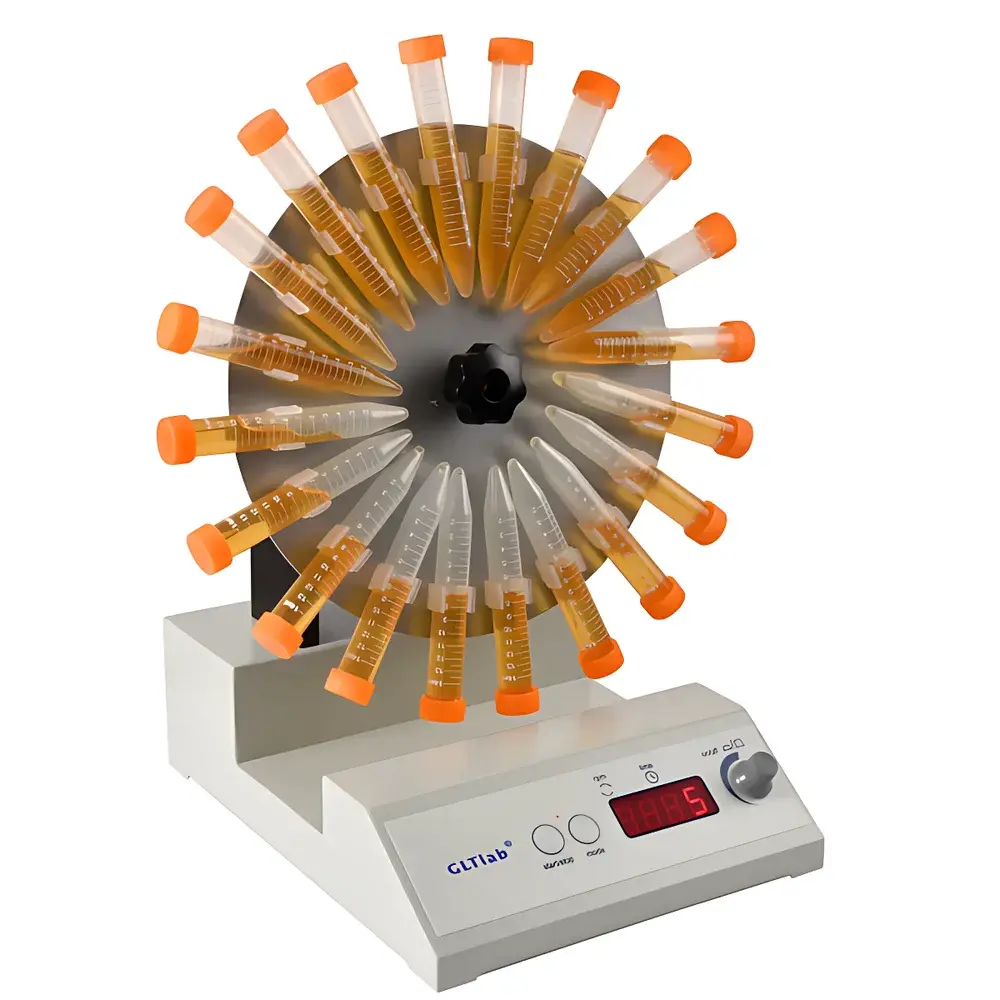
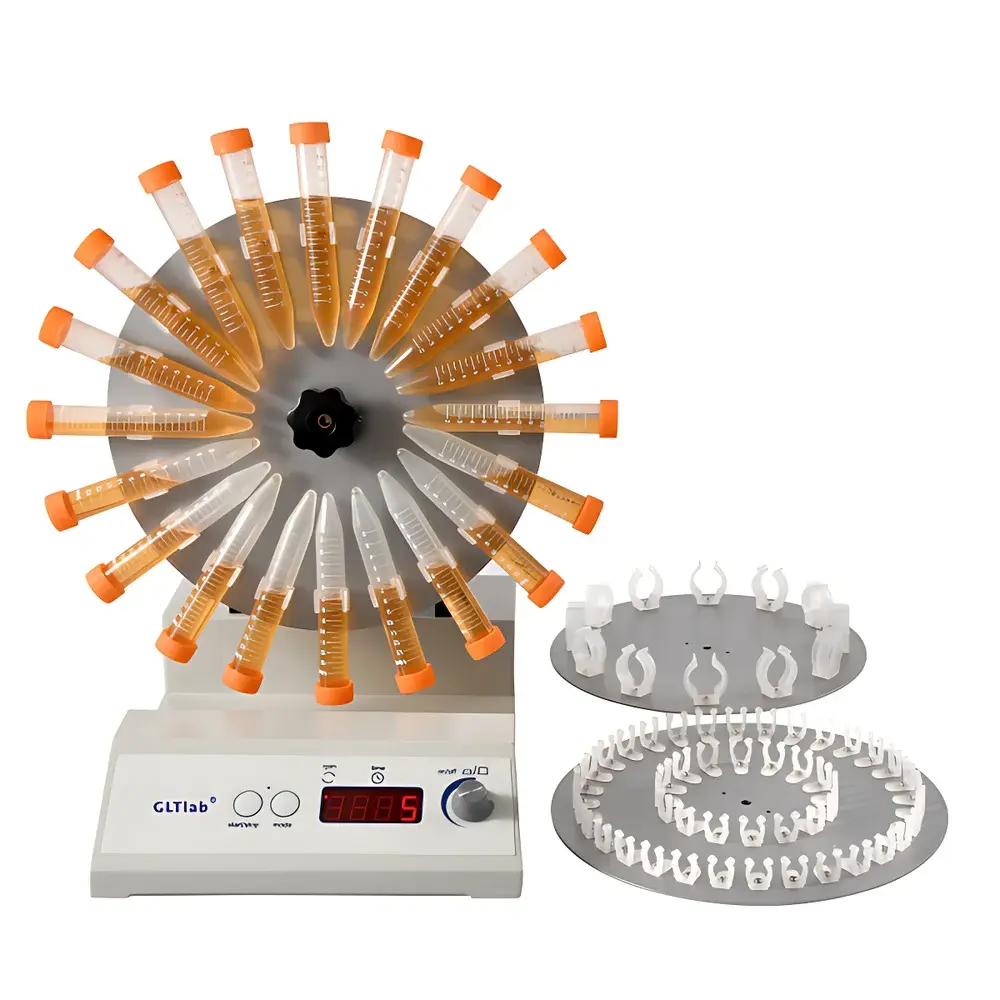
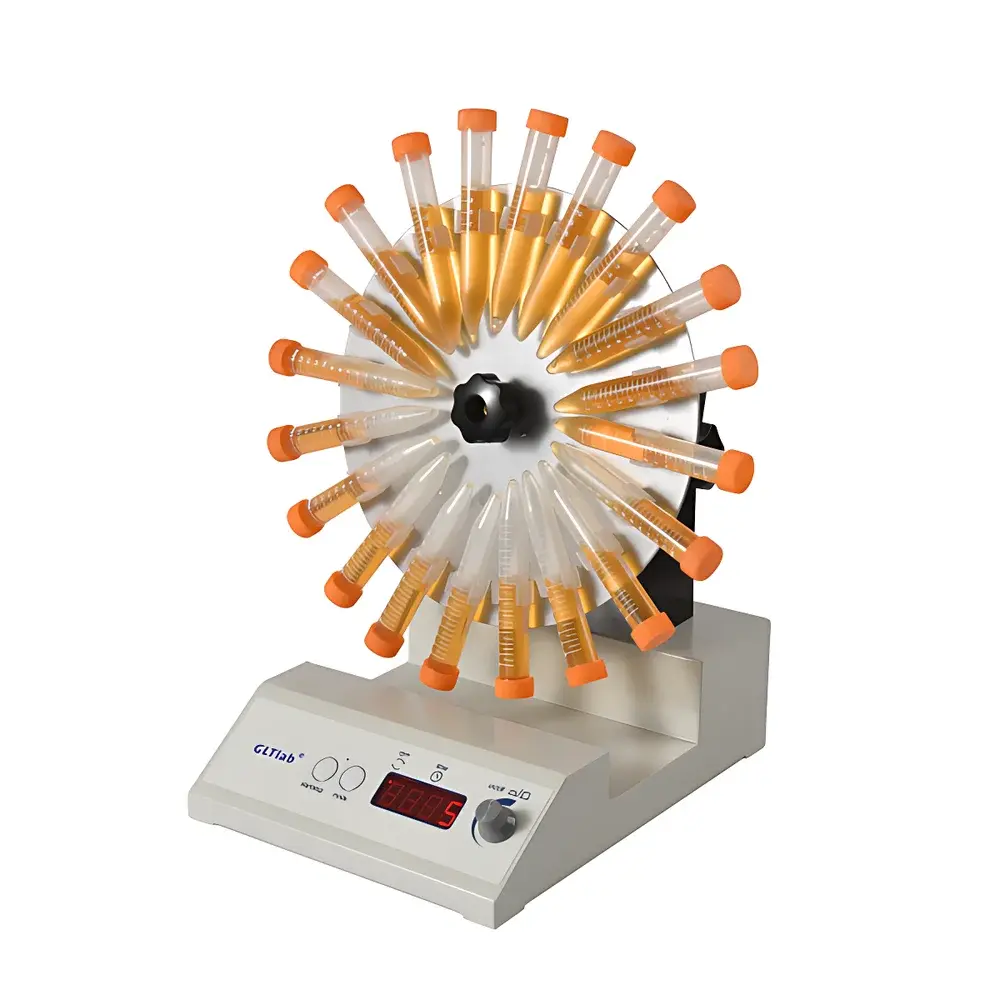
GLTlab RM-02 Digital Vortex Mixer
| Brand | GLTlab |
|---|---|
| Origin | Guangdong, China |
| Manufacturer | GLTlab (Guoli Tian Co., Ltd.) |
| Model | RM-02 |
| Speed Range | 1–70 rpm |
| Operating Mode | Continuous Unidirectional Rotation |
| Motion Type | Single-Axis 360° Rotational Oscillation |
| Display | LED Digital Speed & Timer |
| Timer Range | 0.1–540 min (9 h) |
| Speed Resolution | 1 rpm |
| Construction | Anodized Aluminum Housing with Corrosion-Resistant Coating |
| Motor Type | Precision Stepper Motor |
| Power Input | 100–230 V AC, 50–60 Hz, 20 W |
| Dimensions (W × L × H) | 200 × 270 × 230 mm |
| Net Weight | 2.6 kg |
| Safety Features | Overload Detection, Stall Protection, Auto-Shutdown with Error Alert |
Overview
The GLTlab RM-02 Digital Vortex Mixer is an engineered solution for gentle yet effective sample homogenization in life science, clinical diagnostics, and analytical laboratories. Unlike traditional vortex mixers that rely on orbital shaking or eccentric motion, the RM-02 employs controlled single-axis rotational oscillation—rotating the platform through a precise 360° arc at user-defined angular velocity. This motion generates two complementary mixing mechanisms: vertical displacement (when tubes are placed radially—parallel to the platform surface) and circumferential shear (when tubes are oriented axially—perpendicular to the platform). The result is reproducible, low-shear agitation ideal for fragile biological matrices such as whole blood, cell suspensions, serum, plasma, and enzymatic reaction mixtures where mechanical lysis or foaming must be avoided. Its stepper motor architecture ensures stable speed output across variable line voltage conditions, eliminating drift commonly observed in brushed DC motor-based units.
Key Features
- Precision stepper motor delivering consistent 1–70 rpm operation with 1-rpm incremental adjustment—enabling fine-tuned optimization for sensitive protocols.
- LED digital display showing real-time speed and countdown timer (0.1–540 minutes), supporting extended incubation-mixing workflows without manual intervention.
- Anodized aluminum housing with corrosion-resistant coating ensures long-term durability in humid or reagent-exposed environments, including biosafety cabinets and cold rooms.
- Intelligent safety system monitors motor load and rotational integrity; automatically halts operation and displays error code upon stall or overload—preventing sample loss and hardware damage.
- Compact footprint (200 × 270 × 230 mm) and low power consumption (20 W) make it suitable for benchtop deployment in high-density lab layouts or mobile diagnostic units.
- Unidirectional continuous rotation mode optimized for applications requiring uniform directional torque—such as sediment resuspension, ligand binding assays, and immunoassay plate preparation.
Sample Compatibility & Compliance
The RM-02 accommodates a broad range of tube formats via interchangeable accessories—including 48-position microtube racks (10–14 mm), 20-position test tube holders (15–20 mm), and 12-position 50 mL conical tube stands (25–35 mm). All fixtures are designed to secure samples during rotation without clamping or adhesives, minimizing cross-contamination risk. While the RM-02 itself does not carry CE or UL certification out-of-box, its electrical design complies with IEC 61010-1:2010 requirements for laboratory equipment safety. When used with validated accessories and documented SOPs, the system supports GLP-compliant workflows. It meets typical internal QA criteria for mixing consistency per ASTM D5295-18 (Standard Practice for Evaluation of Mixing Efficiency in Laboratory Equipment) and aligns with USP guidance on analytical instrument qualification for mixing devices.
Software & Data Management
The RM-02 operates as a standalone instrument with no embedded firmware or network connectivity. All operational parameters—speed, duration, and start/stop—are configured directly via front-panel membrane keys and displayed on the integrated LED screen. No software installation, driver dependencies, or cloud synchronization is required. This architecture eliminates cybersecurity vulnerabilities, simplifies 21 CFR Part 11 compliance for regulated labs (no electronic records generated), and ensures uninterrupted functionality in offline or air-gapped environments. For audit readiness, users may log settings manually or integrate timing data into LIMS via external clock-synced timestamps. Calibration verification is performed using traceable tachometers per ISO/IEC 17025 Annex A.3 guidelines.
Applications
- Resuspension of lyophilized reagents and pelletized cells without shearing membranes or denaturing proteins.
- Homogenization of whole blood samples prior to centrifugation—maintaining erythrocyte integrity for hematocrit analysis or flow cytometry prep.
- Equilibration of immunoassay plates during ELISA development and validation studies.
- Preparation of standard curves in molecular diagnostics where uniform dilution matrix dispersion is critical.
- Low-force mixing of viscous polymer solutions, hydrogels, and nanoparticle colloids where turbulent vortexing would induce aggregation.
- Supporting ISO 15189-accredited clinical labs in achieving repeatable pre-analytical sample handling per CLSI GP45-A4 recommendations.
FAQ
What is the minimum controllable speed?
The RM-02 achieves stable rotational output starting at 1 rpm, verified across input voltages from 100–230 V AC.
Does the unit support bidirectional rotation?
No—the RM-02 operates exclusively in unidirectional continuous rotation mode. For reversible or oscillatory motion, consider the RM-03 variant.
Can the timer be paused or reset mid-cycle?
Yes—pressing the “Timer” button during operation pauses the countdown; pressing again resumes from the remaining time.
Is the aluminum housing compatible with alcohol-based disinfectants?
Yes—the anodized and coated surface resists degradation from 70% ethanol, isopropanol, and common quaternary ammonium solutions when wiped per manufacturer-recommended protocols.
How is speed accuracy validated during routine maintenance?
Users should verify rotational speed annually using a NIST-traceable optical tachometer; deviation exceeding ±2 rpm at any setpoint warrants recalibration or service.



