
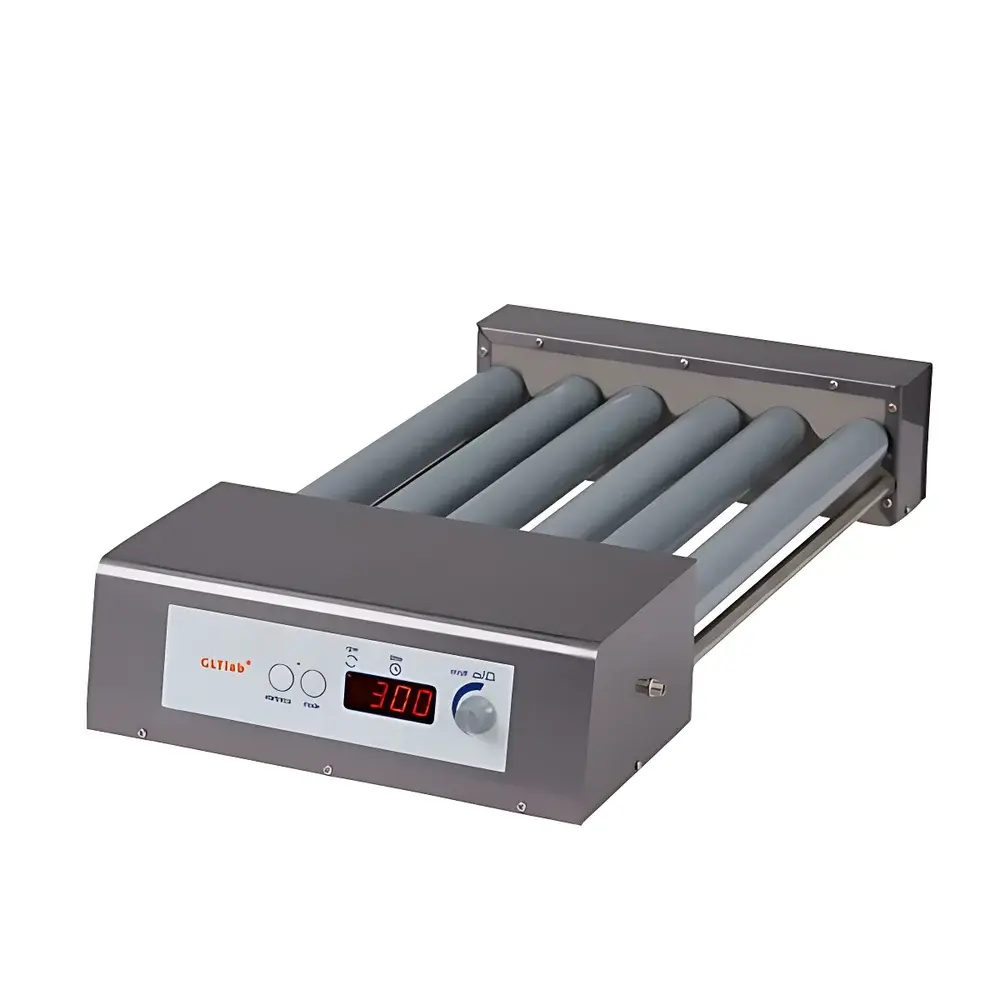
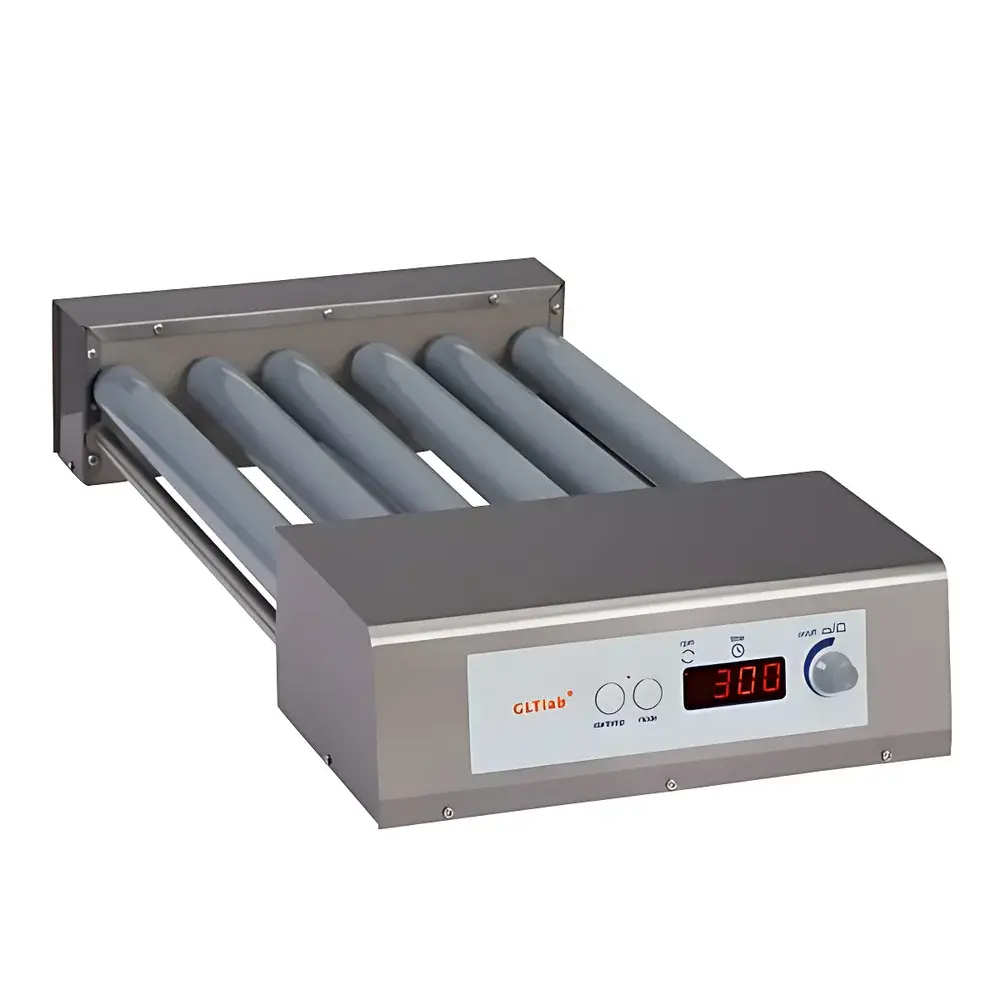
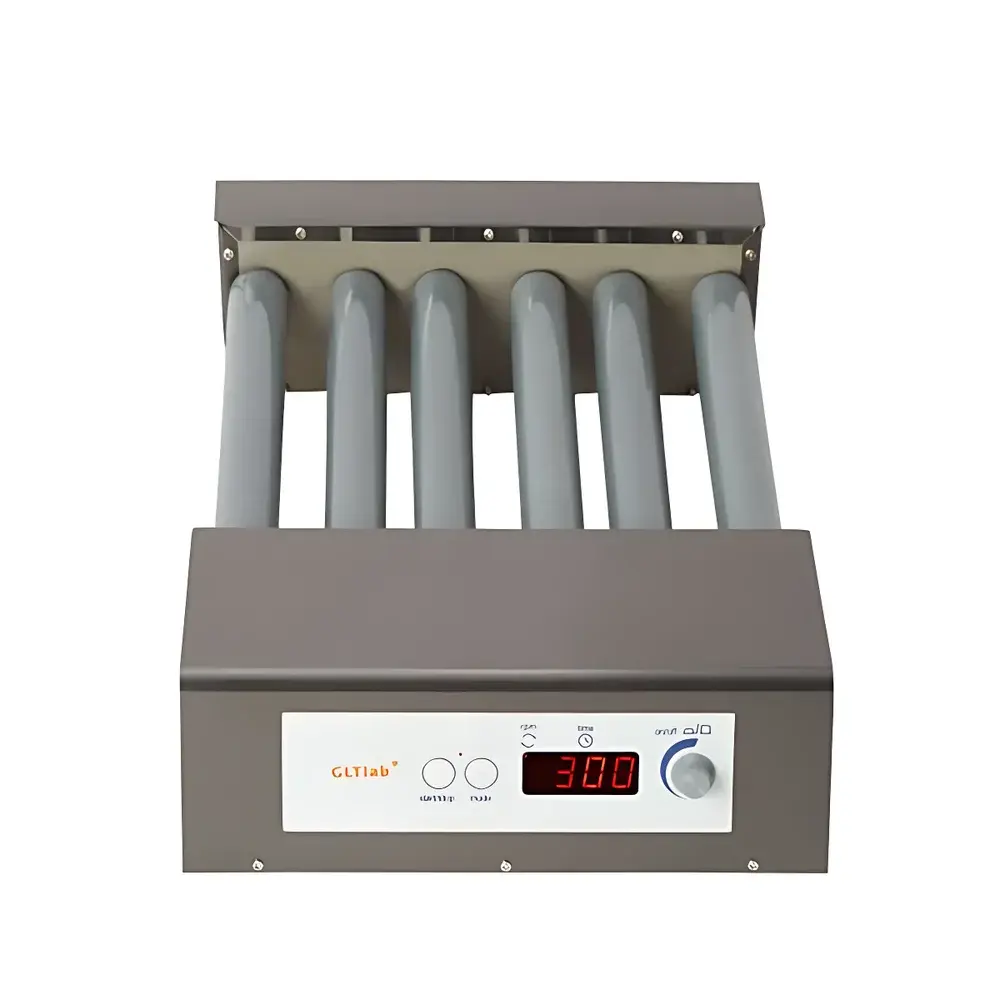
GLTLab TR-6B 6-Axis CNC-Controlled Roller Mixer
| Brand | GLTLab |
|---|---|
| Origin | Guangdong, China |
| Manufacturer Type | Direct Manufacturer |
| Product Category | Domestic (China-Made) |
| Model | TR-6B |
| Price | USD 420 (FOB Guangdong) |
| Control System | Microprocessor-Based Digital Controller |
| Drive Mechanism | High-Torque Brushless DC Motor with Precision Planetary Gearbox |
| Construction Material | Full 304 Stainless Steel Frame and Housing |
| Operating Environment | pH 1–14, 5–40 °C, ≤80% RH (non-condensing) |
| Rotation Mode | Bidirectional Reversing (programmable interval & direction change) |
| Speed Range | 5–300 rpm (adjustable in 1-rpm increments) |
| Load Capacity | 10 kg max (uniformly distributed) |
| Timer Range | 1 second to 200 hours (with auto-stop & memory retention) |
| Roller Dimensions | 340 × 30 mm (L × Ø), Grey-Anodized Aluminum Alloy Surface |
| Roller Count | 6 |
| External Dimensions | 556 × 286 × 98 mm (W × D × H) |
| Weight | 12.8 kg |
| Power Supply | 100–240 VAC, 50/60 Hz, 60 W |
Overview
The GLTLab TR-6B is a precision-engineered 6-axis CNC-controlled roller mixer designed for rigorous industrial and R&D applications requiring reproducible, low-shear, continuous agitation of heterogeneous mixtures. Unlike orbital shakers or vortex mixers, the TR-6B employs synchronized multi-axis rolling kinematics—six independently mounted rollers rotating at identical or differential speeds—to generate gentle yet effective tumbling motion. This mechanical principle ensures uniform material displacement without foaming, phase separation, or thermal degradation—critical for sensitive battery slurry formulations, polymer composites, and high-viscosity pharmaceutical suspensions. Its fully stainless steel (AISI 304) construction eliminates galvanic corrosion in acidic or alkaline process environments, directly addressing long-term reliability failures observed in legacy carbon-steel units after 3–4 years of operation.
Key Features
- Full 304 stainless steel chassis, housing, and mounting hardware—certified for continuous exposure to pH 1–14 solutions and humid industrial settings
- Brushless DC motor coupled with a planetary gearbox delivering consistent torque across full speed range (5–300 rpm), with <±0.5 rpm speed stability under load
- CNC-programmable bidirectional rotation: users define reversal intervals (1 s–200 h), dwell time, and directional sequence via intuitive front-panel interface
- Grey-anodized aluminum alloy rollers (340 × 30 mm) offering high surface hardness (HV 350+), wear resistance, and non-stick characteristics for residue-free cleaning
- Dual-mode operation: timer-based (1 s–200 h) or continuous run mode with power-loss recovery and last-setting memory
- Integrated thermal protection, overcurrent cutoff, and anti-vibration rubber feet compliant with ISO 10816-3 vibration severity thresholds
Sample Compatibility & Compliance
The TR-6B accommodates standard laboratory and pilot-scale containers—including glass vials (10–50 mL), HDPE bottles (100–500 mL), stainless steel mixing cans (up to 2 L), and custom-shaped battery slurry jars—without clamping fixtures. Its low-frequency rolling action (<300 rpm) avoids particle attrition in fragile cathode/anode slurries (e.g., NMC, LFP, Si/C composites) and preserves rheological integrity of shear-thinning binders (e.g., CMC, SBR, PVDF). The unit meets CE marking requirements per Directive 2014/30/EU (EMC) and 2014/35/EU (LVD), and conforms to ISO 9001:2015 manufacturing protocols. While not intrinsically rated for ATEX Zone 1, it is routinely deployed in GMP-aligned battery electrode coating lines under controlled ventilation per IEC 60079-0 guidelines.
Software & Data Management
The TR-6B operates via an embedded microcontroller with real-time clock and non-volatile parameter storage. No external PC software is required; however, optional RS-232/USB-C serial interface enables integration into centralized lab automation systems (e.g., LabVantage, Thermo Fisher SampleManager) for audit-trail logging. All runtime events—including start/stop timestamps, speed changes, direction reversals, and fault codes—are timestamped and retained for ≥10,000 cycles. When paired with validated third-party data acquisition platforms, the device supports 21 CFR Part 11-compliant electronic records when used in regulated QC/QA workflows.
Applications
- Battery Manufacturing: Homogenization of cathode (LiCoO₂, NMC811) and anode (graphite, silicon oxide) slurries prior to coating; additive dispersion (CNTs, conductive carbon) in aqueous or NMP-based media
- Chemical Processing: Blending of viscous resins (epoxy, polyurethane), pigment pastes, catalyst slurries, and silicone gels where laminar flow prevents air entrapment
- Materials Science: Dry powder mixing of metal-organic frameworks (MOFs), ceramic precursors, and nanocomposite feedstocks without agglomeration
- Life Sciences: Gentle re-suspension of cryopreserved cell pellets, antibody-conjugated magnetic beads, and tissue homogenates in diagnostic assay development
FAQ
What is the maximum recommended viscosity range for optimal mixing performance?
The TR-6B is validated for Newtonian fluids up to 50,000 mPa·s and non-Newtonian shear-thinning systems (e.g., battery slurries) with apparent viscosities up to 120,000 mPa·s at 10 s⁻¹, provided container geometry permits free tumbling.
Can the TR-6B be integrated into a cleanroom environment (ISO Class 7)?
Yes—the stainless steel enclosure, absence of lubricant-exposed gears, and smooth, crevice-free surfaces support ISO 14644-1 compliant cleaning protocols using IPA/water or hydrogen peroxide vapor.
Does the unit support GLP-compliant operation?
When operated with enabled event logging and paired with a validated electronic record system, the TR-6B satisfies core GLP requirements for instrument traceability, parameter control, and data integrity per OECD Principles of GLP.
Is calibration required before first use or periodically?
No routine calibration is mandated; however, users may verify rotational speed accuracy annually using a certified optical tachometer traceable to NIST standards.
What maintenance schedule is recommended for extended service life?
Inspect roller alignment and motor mount fasteners every 6 months; clean rollers with neutral detergent and dry lint-free cloth; no grease or oil application is necessary due to sealed gearbox and stainless components.
Related Products



