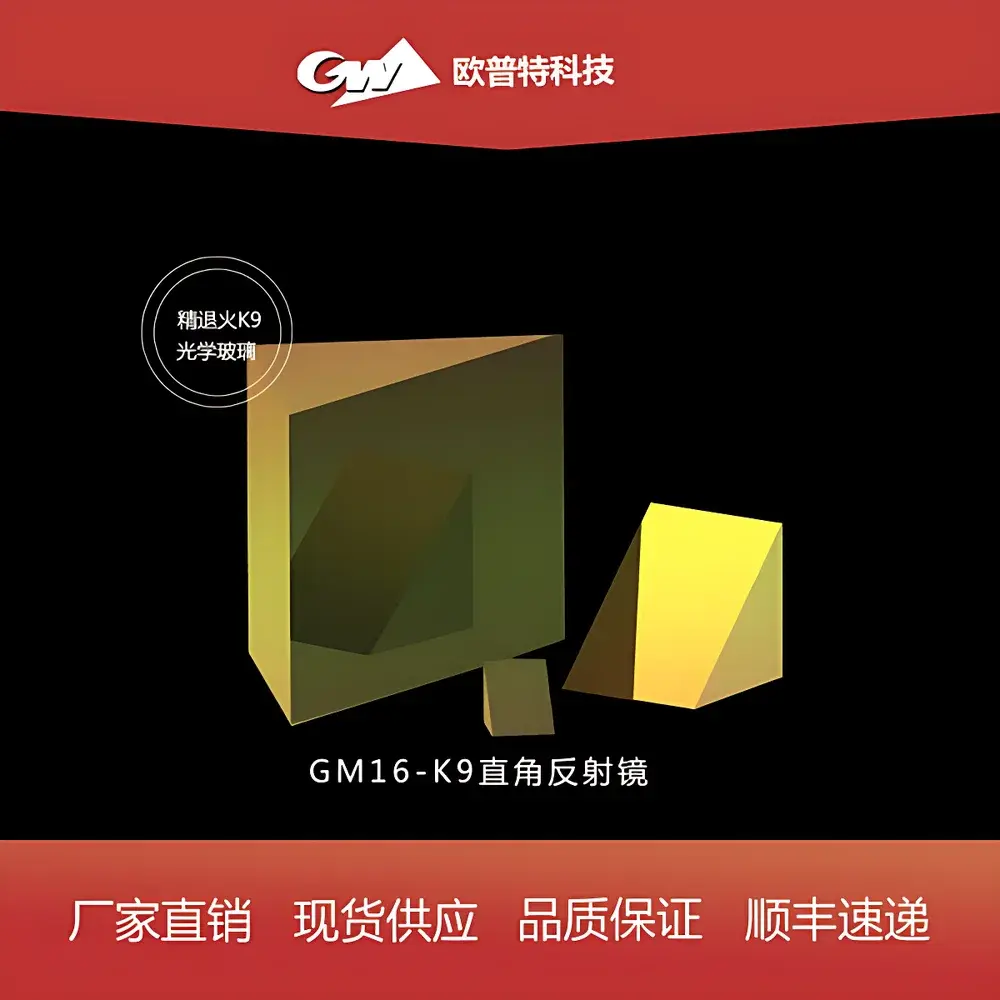
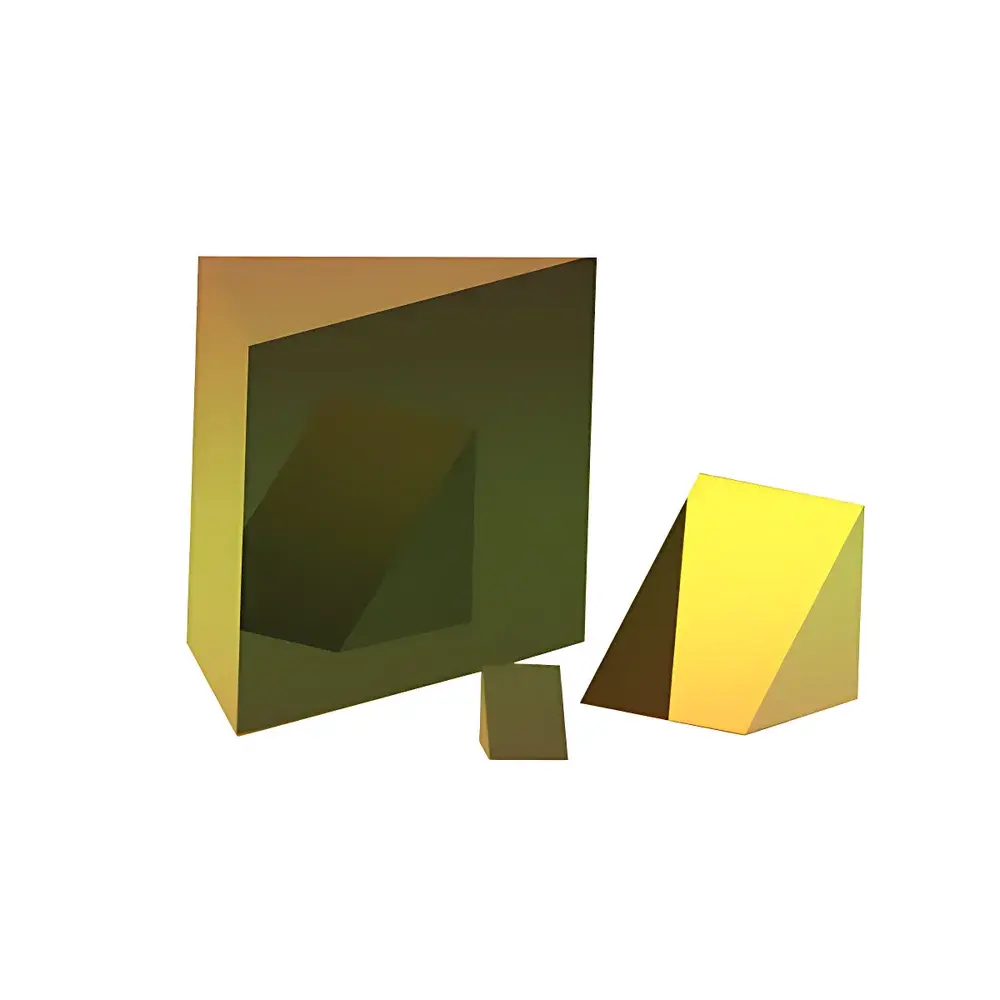
GM16-K9 Right-Angle Prism Mirror

| Material | Precision-Annealed K9 Optical Glass |
|---|---|
| Dimensional Tolerance | ±0.1 mm |
| Surface Flatness | λ/4 @ 633 nm |
| Surface Quality | 3–4 Scratch-Dig |
| Angular Accuracy | ±30 arcseconds |
| Beam Deviation (Tower Error) | <10 arcminutes |
| Edge Bevel | ±0.5 mm |
| Coating Options | Protected Aluminum, UV-Enhanced Aluminum, Protected Silver, Protected Gold, Dielectric HR (D02: 400–800 nm), Dielectric HR (D03: 750–1250 nm) |
| Available Sizes | 5×5×5 mm to 30×30×30 mm |
Ask about pricing, availability and specifications.
Overview
The GM16-K9 Right-Angle Prism Mirror is a precision optical component engineered for high-fidelity 90° beam deviation and image path folding in demanding laboratory, metrology, and industrial optical systems. Constructed from optically homogeneous, precision-annealed K9 borosilicate crown glass, this solid prism mirror operates on total internal reflection (TIR) principles at the hypotenuse face—eliminating reliance on metallic or dielectric coatings for the primary reflection surface. Unlike mirror-mounted right-angle prisms that depend on external coatings, the GM16-K9 leverages the intrinsic refractive index of K9 (n ≈ 1.517 @ 587.6 nm) to achieve >99.9% theoretical reflectivity at the internal interface when properly oriented, ensuring minimal wavefront distortion and long-term stability under thermal and mechanical stress. Its monolithic design avoids adhesive layers or mounting-induced stress birefringence, making it suitable for interferometric applications, laser cavity alignment, beam steering in ultrafast systems, and polarization-sensitive setups where phase preservation is critical.
Key Features
- Precision-annealed K9 optical glass substrate with low bubble/inclusion content per ISO 10110-2 Class 3
- Surface flatness specified at λ/4 (158 nm PV) referenced to 633 nm HeNe wavelength, verified via phase-shifting interferometry
- Surface quality compliant with MIL-PRF-13830B Scratch-Dig 3–4, ensuring minimal scatter for low-noise imaging and laser applications
- Angular accuracy of ±30 arcseconds (±0.0083°) between entrance and exit faces, enabling sub-milliradian beam pointing stability
- Tower error (beam deviation due to prism apex imperfection) controlled to <10 arcminutes, supporting alignment-critical multi-prism assemblies
- Consistent edge bevel of ±0.5 mm applied to all three edges to prevent chipping and facilitate safe handling and mounting
- Optional dielectric or metal-dielectric hybrid coatings deposited via ion-assisted e-beam evaporation for enhanced spectral performance across UV-VIS-NIR bands
Sample Compatibility & Compliance
The GM16-K9 is compatible with standard kinematic mounts, prism tables, and lens tubes used in optical breadboard systems (e.g., Thorlabs, Newport). It meets dimensional and surface specifications aligned with ISO 10110-3 (surface form tolerances) and ISO 10110-7 (surface imperfections). While not certified to a specific regulatory framework as a standalone component, its material traceability (K9 batch certification available upon request), coating durability (adhesion tested per MIL-C-48497A), and manufacturing consistency support integration into FDA-regulated optical subsystems (e.g., ophthalmic diagnostic devices) and ISO/IEC 17025-accredited calibration labs. All coated variants undergo environmental testing per ISO 9211-4 for humidity, abrasion, and temperature cycling.
Software & Data Management
As a passive optical component, the GM16-K9 requires no embedded firmware or software drivers. However, its geometric and optical parameters are fully integrated into industry-standard optical design platforms including Zemax OpticStudio (ZOS), Synopsys Code V, and Lambda Research TracePro. Standard .zmx and .seq files—including full coating dispersion models for D02 and D03 dielectric stacks—are available for download from the manufacturer’s technical portal. For traceable metrology workflows, calibrated interferometric measurement reports (including Zernike decomposition and PV/RMS wavefront error maps) can be supplied with each batch, supporting GLP-compliant documentation requirements.
Applications
- Laser cavity folding and Q-switch beam routing in DPSS and fiber laser systems
- Beam combining/splitting in Mach-Zehnder and Michelson interferometers
- Optical path shortening in compact spectrometers and portable Raman analyzers
- Image erecting and relay optics in endoscopic and borescope systems
- Alignment reference in coordinate measuring machines (CMMs) and laser tracker setups
- UV-VIS-NIR broadband illumination routing in fluorescence microscopy and hyperspectral imaging platforms
FAQ
What distinguishes a right-angle prism mirror from a front-surface mirror mounted at 45°?
A right-angle prism mirror uses total internal reflection at the hypotenuse, eliminating substrate absorption and coating-related phase shifts; a front-surface mirror introduces additional air-glass interfaces and coating dispersion effects.
Can the GM16-K9 be used with ultrashort pulses (e.g., <100 fs)?
Yes—when uncoated or with broadband dielectric coatings (D02/D03), it exhibits negligible group delay dispersion (GDD) across common Ti:sapphire and Yb:fiber spectral ranges.
Is custom coating or size available beyond the standard catalog options?
Yes—custom dimensions up to 50×50×50 mm and non-standard coatings (e.g., AOI-specific HR, polarizing beamsplitter variants) are available under NRE-supported engineering agreements.
How is angular accuracy verified during production?
Each unit undergoes autocollimation testing using a high-resolution electronic autocollimator (resolution ≤ 0.1 arcsecond) referenced to NIST-traceable angle standards.
Does the K9 substrate comply with RoHS and REACH directives?
Yes—K9 glass composition excludes restricted substances per Annex II of Directive 2011/65/EU and meets SVHC thresholds defined in EC 1907/2006.