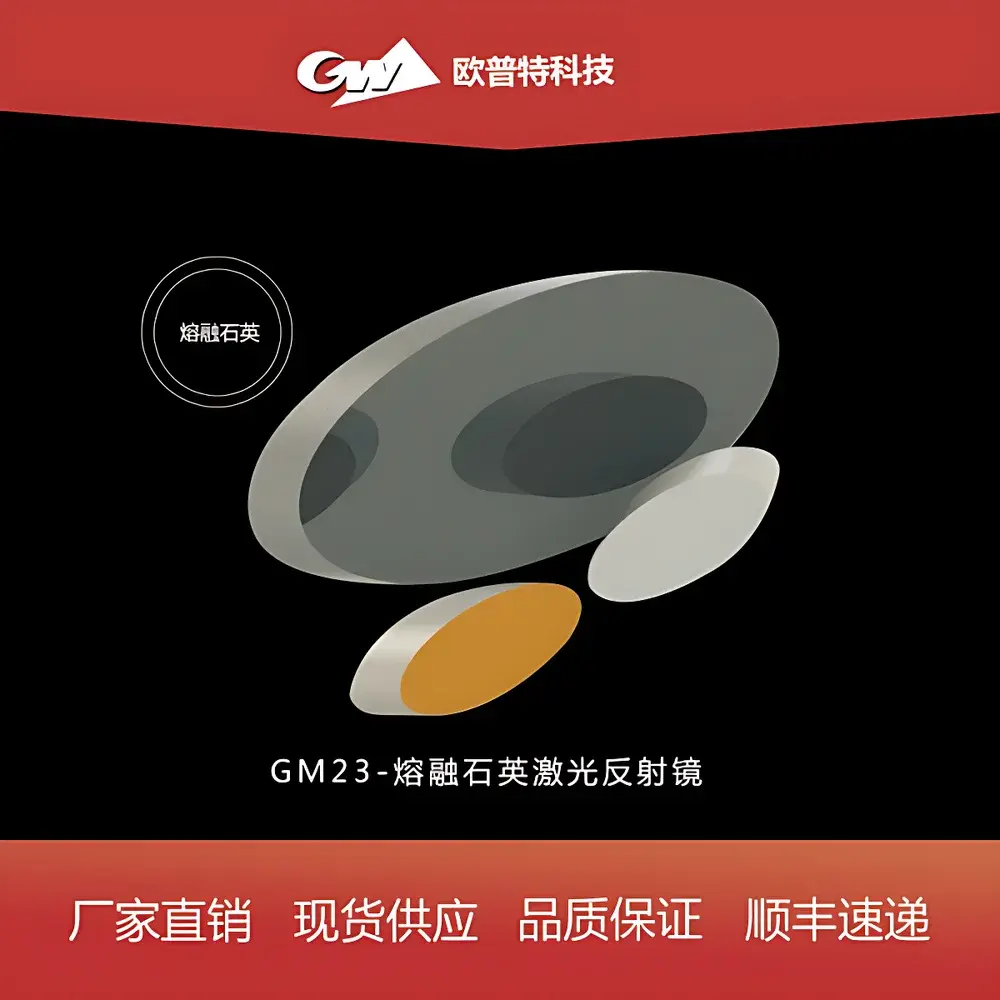
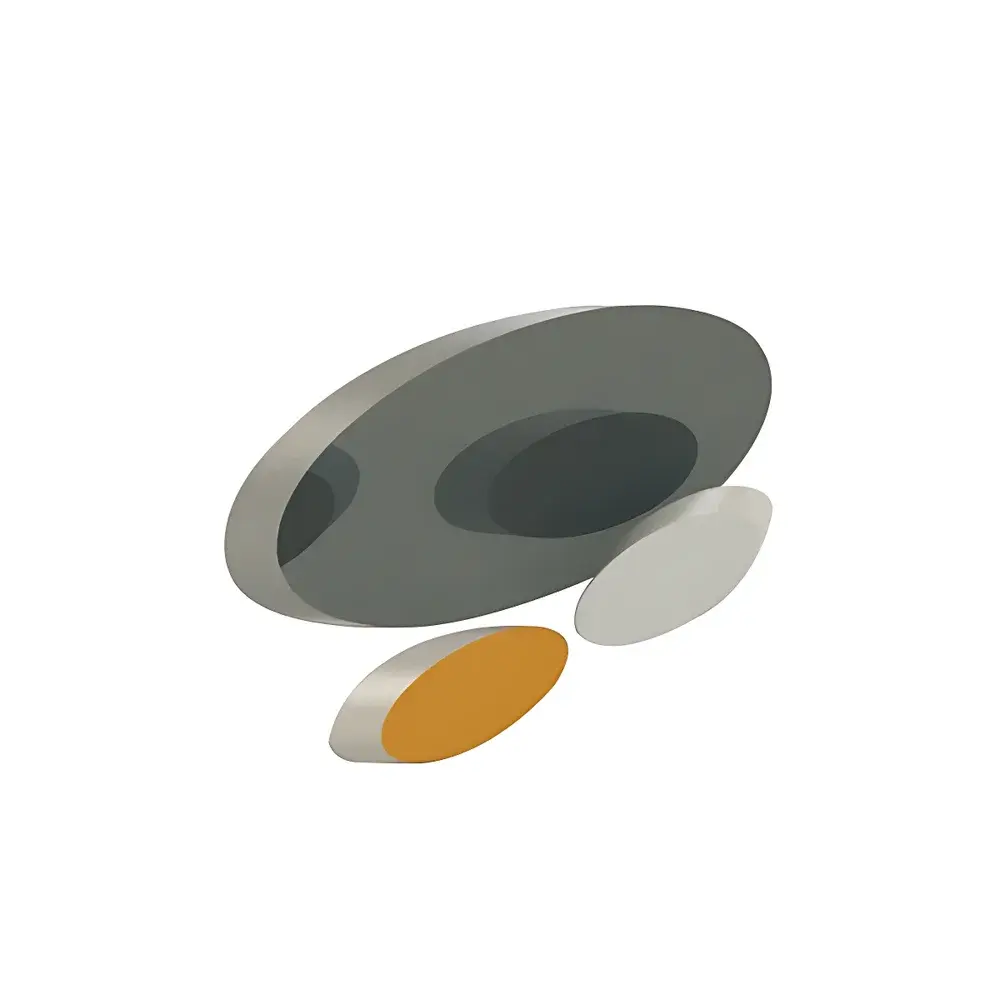
GM23 Fused Silica High-Reflectivity Laser Mirrors

| Origin | Beijing, China |
|---|---|
| Manufacturer Type | Distributor |
| Product Origin | Domestic (China) |
| Model | GM23 |
| Price Range | USD 0.15–75.00 (per unit) |
| Component Category | Optical Element |
| Substrate Material | Fused Silica |
| Coating Type | Dielectric High-Reflectivity (HR) |
| Available Configurations | 0° and 45° incidence |
| Wavelength Ranges | 244–257 nm, 300–308 nm, 351–364 nm, 458–528 nm, 266 nm, 355 nm, 532 nm, 1064 nm |
| Avg. Reflectivity | >99.5% (Rₐᵥg) |
| Laser Damage Threshold | >1 kW/cm² (CW, 10 ns pulse) |
| Diameter Options | 12.5 mm, 25.0 mm, 50.0 mm |
| Thickness Options | 6.0 mm, 10.0 mm |
Ask about pricing, availability and specifications.
Overview
The GM23 series consists of precision-engineered fused silica high-reflectivity (HR) laser mirrors designed for demanding ultraviolet (UV), visible, and near-infrared (NIR) laser applications. Constructed from synthetic fused silica (SiO₂) with ultra-low thermal expansion (α ≈ 0.55 × 10⁻⁶ /°C), these mirrors provide exceptional dimensional stability under thermal load and minimal wavefront distortion. The dielectric multilayer coating is optimized using ion-assisted electron-beam evaporation to achieve broadband or narrowband reflectance exceeding 99.5% (Ravg) across specified wavelength bands—including excimer (244–257 nm), frequency-tripled and quadrupled Nd:YAG (266 nm, 355 nm), argon-ion lines (458–528 nm), and fundamental harmonics (532 nm, 1064 nm). Each mirror is characterized by low absorption (<0.05%), high polarization insensitivity at designated angles, and compliance with ISO 10110-7 surface quality standards (scratch-dig ≤ 10-5).
Key Features
- Fused silica substrate with <1 ppm hydroxyl content, ensuring deep-UV transmission down to 185 nm and negligible solarization under prolonged UV exposure
- Dual-angle configuration: zero-degree (normal incidence) and 45-degree variants for flexible optical path integration in resonators, beam steering, and interferometric setups
- High laser-induced damage threshold (LIDT): >3 J/cm² for nanosecond pulses (10 ns, 20 Hz, 1064 nm) and >1 kW/cm² for continuous-wave operation—validated per ISO 21254-1
- Low residual stress coating architecture minimizing figure error (PV < λ/10 @ 633 nm) and enabling diffraction-limited performance in high-finesse cavities
- Customizable mounting compatibility: uncoated rear surface (optional AR coating) and edge-polished geometry for kinematic or flexure-based mounts
Sample Compatibility & Compliance
The GM23 mirrors are compatible with pulsed and CW solid-state lasers (Nd:YAG, Nd:YVO₄, Ti:sapphire), excimer lasers (KrF, ArF), and gas lasers (Ar⁺, Kr⁺). Their fused silica base meets MIL-O-13830A surface quality requirements and is certified RoHS-compliant. Coating durability adheres to ASTM F1625-19 adhesion testing (tape peel, thermal cycling −40°C to +80°C, 100 cycles). For regulated environments—including ISO 13485-certified medical laser systems and FDA-cleared analytical instrumentation—the mirrors support full traceability via batch-specific test reports (including spectral reflectance curves, LIDT verification logs, and surface roughness AFM scans).
Software & Data Management
While the GM23 is a passive optical component, its performance integration is supported through standardized calibration documentation delivered with each shipment. Spectral reflectance data (200–1100 nm, ±0.3 nm resolution) is provided in ASCII-compatible .csv format compliant with Zemax OpticStudio, CODE V, and FRED import protocols. Optional NIST-traceable spectral certification (NIST SRM 2036 reference) and custom coating design files (layer stack thickness, material indices) are available upon request for OEM system validation and GLP/GMP audit readiness.
Applications
- Ultrafast laser oscillators and amplifiers requiring low-dispersion, high-damage-threshold cavity optics
- UV lithography alignment subsystems operating at 248 nm and 193 nm (with appropriate grade selection)
- Confocal microscopy illumination paths where polarization preservation and minimal thermal lensing are critical
- Atomic physics experiments involving magneto-optical traps (MOTs) and optical lattices using 355 nm or 532 nm beams
- Industrial laser processing heads (cutting, welding, ablation) requiring long-term power stability under multi-kW average power loads
FAQ
Are GM23 mirrors suitable for ultrafast femtosecond lasers?
Yes—when specified with low-group-delay dispersion (GDD) coating designs (available as custom option), GM23 mirrors maintain sub-10 fs pulse fidelity at 800 nm and 1030 nm. Standard versions are optimized for picosecond-to-nanosecond regimes.
Can I specify a custom wavelength band or angle of incidence?
Absolutely. Custom HR coatings (e.g., 322 nm, 488 nm, or dual-band 532/1064 nm) and non-standard angles (e.g., 30°, 60°) are manufacturable with lead times of 4–6 weeks and MOQ of 5 units.
Do you provide mounting hardware or kinematic adapters?
Standard mounts (SM1-threaded kinematic cells, Ø12.7 mm post holders) are available separately; OEM mechanical drawings for direct integration are supplied upon NDA.
Is environmental testing data (humidity, vibration) available?
Yes—accelerated aging reports per IEC 60068-2-30 (damp heat cyclic) and MIL-STD-810H vibration profiles (5–500 Hz, 7.7 g RMS) are included in the full qualification package.