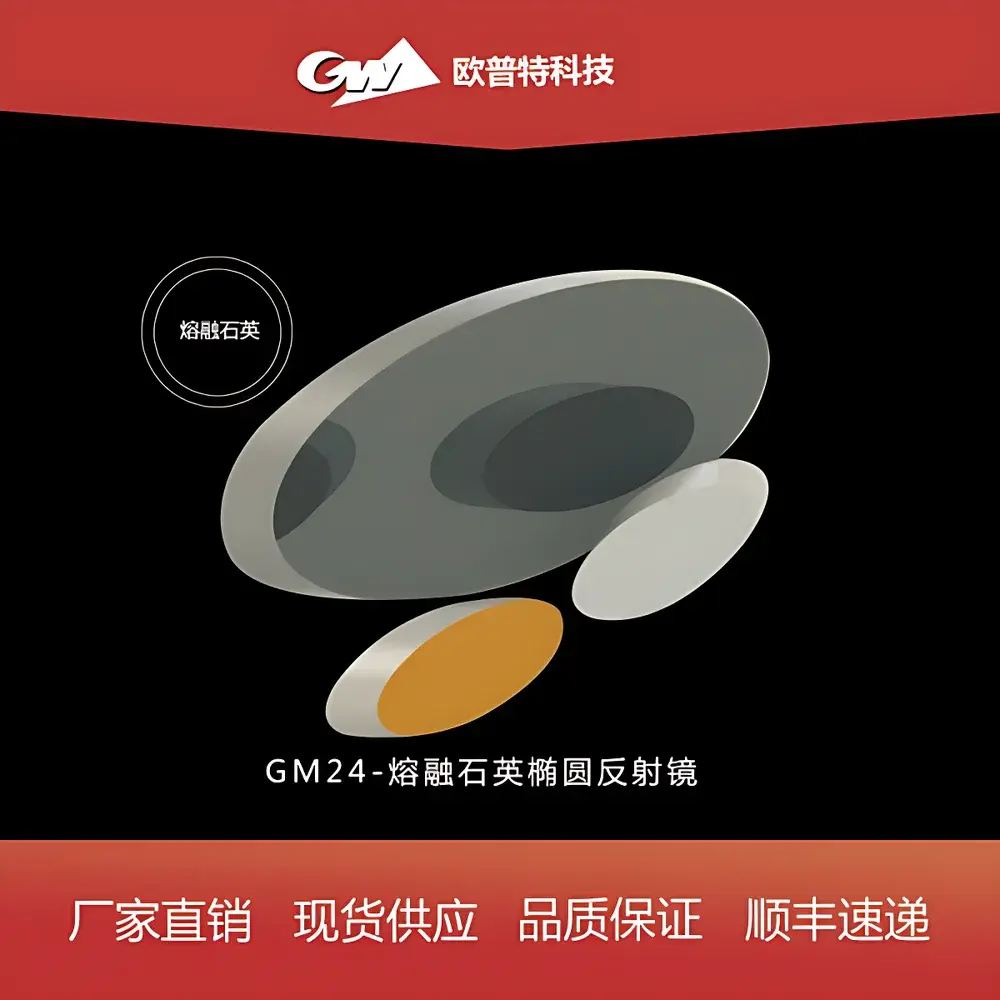
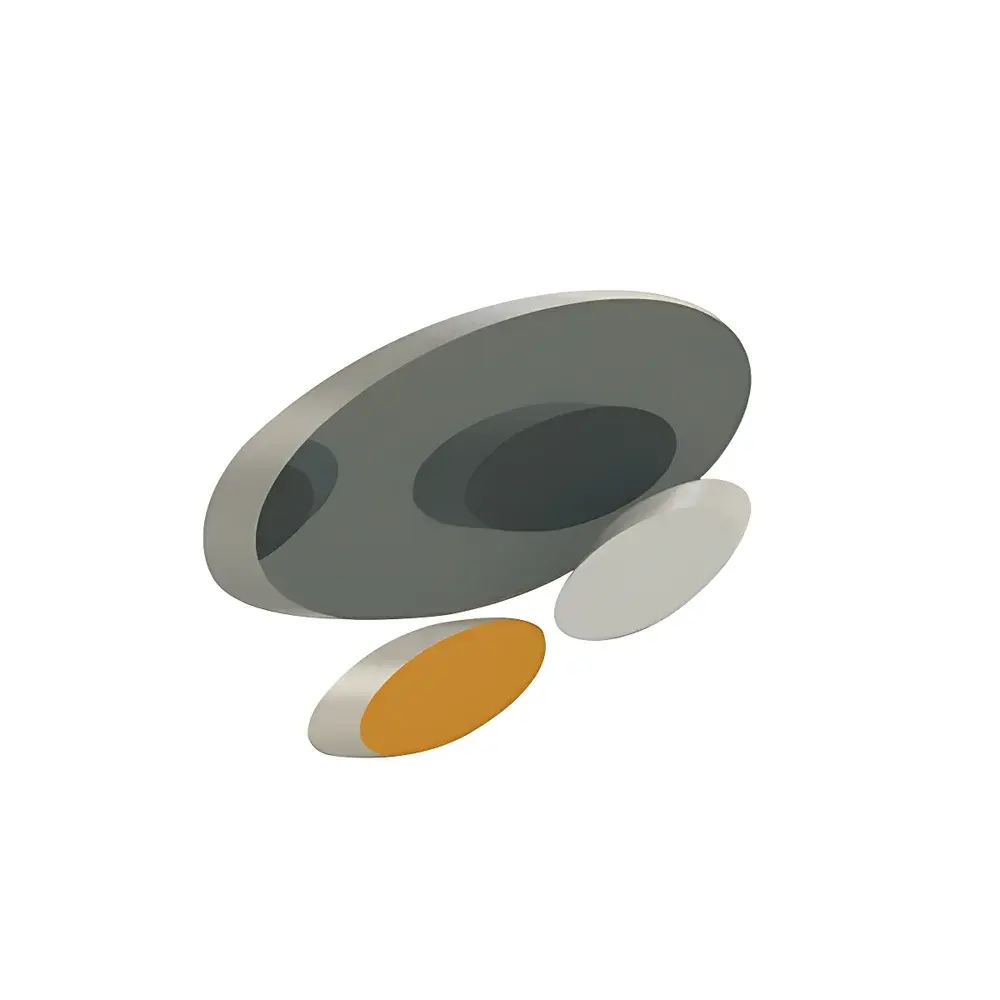
GM24 Fused Silica Elliptical Mirror

| Origin | Beijing, China |
|---|---|
| Manufacturer Type | Distributor |
| Model | GM24 |
| Unit Price Range | USD 0.15–75.00 (varies by size/coating) |
| Component Category | Optical Element |
| Short Axis A (mm) | 12.50 / 25.00 / 50.00 |
| Long Axis B (mm) | 17.68 / 35.36 / 70.72 |
| Thickness (mm) | 6.0 / 6.0 / 12.5 |
| Coating Options | D02 (High-Reflectance Dielectric, 400–800 nm, 45° AOI), D03 (High-Reflectance Dielectric, 750–1250 nm, 45° AOI) |
| Substrate Material | Synthetic Fused Silica (SiO₂), OH⁻ < 1 ppm, λ/10 surface flatness, scratch-dig 10–5, UV-grade transmission |
Ask about pricing, availability and specifications.
Overview
The GM24 Fused Silica Elliptical Mirror is a precision optical component engineered for high-fidelity beam steering and focusing in demanding ellipsoidal optical configurations. Designed according to classical geometric optics principles, the elliptical geometry enables precise conjugation of two focal points—ideal for applications requiring efficient light collection from one focus and redirection to the second, such as in laser cavity coupling, spectroscopic sample illumination, or vacuum ultraviolet (VUV) and near-infrared (NIR) optical train alignment. Constructed from synthetic fused silica (Corning 7980 or equivalent), the substrate exhibits exceptional homogeneity, low thermal expansion (α ≈ 0.55 × 10⁻⁶ /°C), deep-UV transparency down to 185 nm, and intrinsic resistance to solarization under prolonged UV exposure. Each mirror is diamond-turned and polished to λ/10 surface accuracy (RMS) and conforms to MIL-O-13830A scratch-dig 10–5 specifications.
Key Features
- Fused silica substrate with certified UV-grade transmission and minimal hydroxyl (OH⁻) content (<1 ppm), ensuring high throughput in both deep-UV and NIR spectral regions
- Precision elliptical geometry with controlled eccentricity—short axis (A) options: 12.5 mm, 25.0 mm, and 50.0 mm; corresponding long axis (B) values maintain constant aspect ratio (B/A ≈ 1.414, i.e., √2), preserving optical conjugacy across sizes
- Two standard high-reflectance dielectric coating variants: D02 (R > 99.5% @ 400–800 nm, 45° angle of incidence) and D03 (R > 99.3% @ 750–1250 nm, 45° AOI), both deposited via ion-assisted e-beam evaporation for environmental stability and laser damage threshold >5 J/cm² (1064 nm, 10 ns)
- Optimized mechanical thickness (6.0 mm for smaller apertures; 12.5 mm for 50 mm variant) to minimize flexure under mounting stress while maintaining rigidity for kinematic alignment
- Validated wavefront error < λ/8 PV over clear aperture at 633 nm, verified via phase-shifting interferometry (PSI) per ISO 10110-5
Sample Compatibility & Compliance
The GM24 mirror is compatible with standard kinematic mounts (e.g., Thorlabs KM100, Newport UMB1) and vacuum-compatible flange interfaces (CF-35, KF-25). All coated variants meet ISO 9022-3 (Environmental Testing – Optical Components) for humidity, thermal cycling (−40°C to +70°C), and adhesion (ASTM D3359 Tape Test, Class 5A). The fused silica base material complies with ASTM F799 (Standard Specification for Fused Silica Optical Materials) and is suitable for Class 100 cleanroom handling. No RoHS-restricted substances are used in substrate fabrication or coating processes; full material declarations and coating spectral reflectance curves (measured per ISO/DIS 9211-4) are supplied with each shipment.
Software & Data Management
While the GM24 is a passive optical element, its integration into system-level optical design workflows is supported through standardized metadata packaging. Each unit ships with a digital calibration certificate (PDF + XML) containing measured surface figure (Zernike coefficients up to 37th order), spectral reflectance data (200–1600 nm, 1 nm resolution), and coating durability test reports. Reflectance datasets are formatted for direct import into Zemax OpticStudio (ZOS), CODE V, and FRED optical simulation environments. Traceability aligns with ISO/IEC 17025 requirements for measurement uncertainty reporting (k = 2), including uncertainty budgets for radius-of-curvature verification and coating uniformity mapping.
Applications
- Laser-induced fluorescence (LIF) and cavity ring-down spectroscopy (CRDS) systems requiring broadband, low-birefringence beam folding between excitation and detection paths
- Ellipsometric metrology setups where polarization-preserving reflection at fixed AOI is critical for accurate Ψ/Δ determination
- Space-qualified instrumentation optical benches (e.g., Earth observation spectrometers), leveraging fused silica’s radiation hardness and zero outgassing (per ECSS-Q-ST-70-02C)
- Ultrafast amplifier pump combiners using D02-coated variants to maintain group delay dispersion (GDD) stability across octave-spanning spectra
- Microscopy illumination arms in confocal and multiphoton platforms, where elliptical symmetry enables uniform field flattening without additional relay optics
FAQ
What is the maximum incident power density this mirror can withstand without coating degradation?
For continuous-wave (CW) operation at 532 nm, the D02 and D03 coatings are rated for ≤500 W/cm² (unfocused, natural convection cooling). For pulsed lasers (10 ns, 10 Hz), the damage threshold is ≥5 J/cm²—verified per ISO 21254-1.
Can custom coatings be applied to the GM24 substrate?
Yes. Custom dielectric stacks—including ultra-low-loss HR coatings (R > 99.99%), polarizing beamsplitters, or V-coatings for single-wavelength optimization—are available upon request with lead time extension (typically 6–8 weeks).
Is the substrate polished on both sides?
Only the reflective elliptical surface is polished to λ/10 specification. The rear surface is fine-ground (Ra < 0.4 µm) and optionally available with broadband antireflection (BBAR) coating upon specification.
Do you provide mounting fixtures or kinematic adapters for the GM24 series?
Standard SM1-threaded (1.035″-40) and M25×0.75 metric adapters are available as optional accessories. Custom CNC-machined kinematic cells (e.g., three-point flexure mounts) can be quoted separately.
Are measurement certificates NIST-traceable?
Surface figure and reflectance measurements are performed using NIST-traceable interferometers (ZYGO Verifire™) and spectrophotometers (PerkinElmer Lambda 1050+), with full traceability documented in the calibration report.