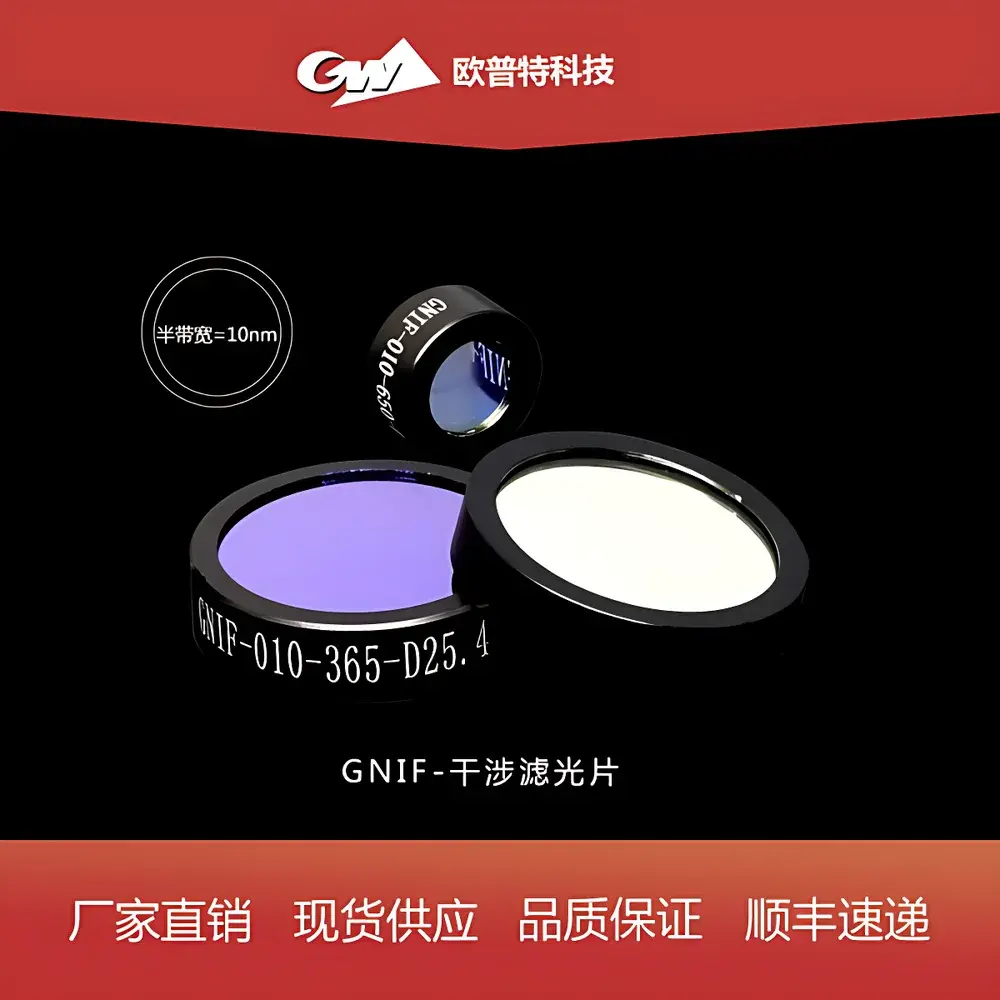
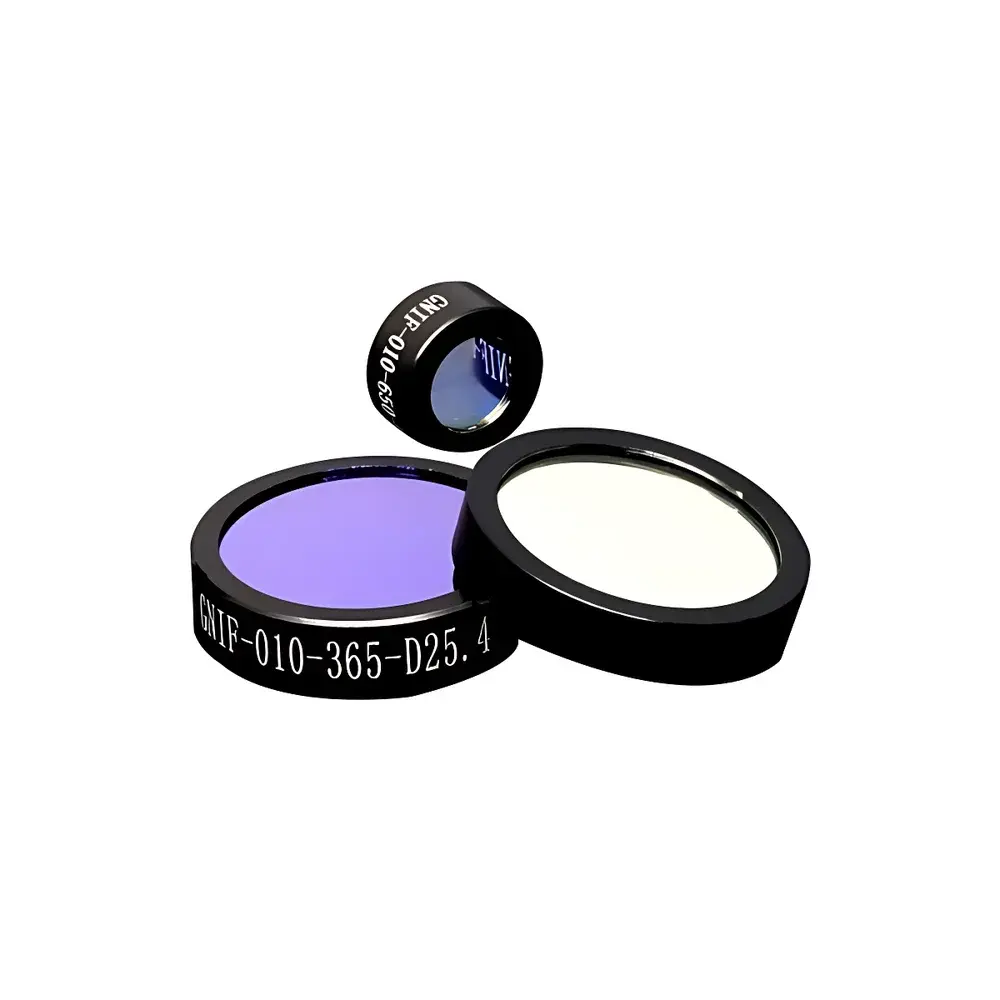
GNIF Interference Filter (FWHM = 10 nm)

| Origin | Beijing, China |
|---|---|
| Manufacturer Type | Authorized Distributor |
| Product Origin | Domestic (China) |
| Model | GNIF |
| Component Category | Optical Element |
| Center Wavelength Range | 420–636 nm |
| FWHM | 10 nm |
| Minimum Peak Transmittance | 45–75% (varies by wavelength and grade) |
| Available Diameters | 12.7 mm (0.5") and 25.4 mm (1.0") |
| High-Transmission Variant Designation | "-H" suffix |
Ask about pricing, availability and specifications.
Overview
The GNIF Interference Filter is a precision optical bandpass filter engineered for high spectral selectivity in laboratory and industrial optical systems. Based on multi-layer dielectric thin-film interference principles, it transmits a narrow, well-defined spectral band centered at a specified wavelength while suppressing adjacent spectral regions with high optical density (OD > 4 typical outside passband). With a fixed full width at half maximum (FWHM) of 10 nm across its operational range—from 420 nm (violet) to 636 nm (red)—the GNIF series supports applications requiring stable, repeatable wavelength isolation without mechanical tuning. Its design adheres to fundamental thin-film interference theory, where constructive and destructive interference of reflected and transmitted light waves within alternating high- and low-refractive-index layers determines the spectral response. This physics-based architecture ensures long-term stability under controlled environmental conditions and compatibility with standard optomechanical mounts.
Key Features
- Precisely controlled 10 nm FWHM bandwidth across 420–636 nm center wavelength options, enabling consistent spectral resolution in spectroscopic and fluorescence setups.
- Two transmission performance grades: standard (≥45–50% peak transmittance) and high-transmission (≥70–75% peak transmittance, denoted by “-H” suffix), optimized for low-light or quantum-efficiency-critical applications.
- Available in two industry-standard clear apertures: Ø12.7 mm (0.5 inch) and Ø25.4 mm (1.0 inch), both with parallel, λ/4 surface flatness and <0.2 arcmin wedge tolerance for minimal beam deviation.
- Hard-coated, ion-assisted deposition (IAD) multilayer dielectric stack ensuring environmental durability, resistance to humidity (per MIL-C-48497A), and compatibility with cleaning protocols using spectroscopic-grade solvents.
- Custom mounting-ready design: unmounted filters with laser-etched part numbers (e.g., GNIF-010-532-H-D25) and optional black anodized aluminum retention rings for kinematic alignment in cage systems or lens tubes.
Sample Compatibility & Compliance
The GNIF series is compatible with collimated or near-collimated beams incident at 0° ± 2° angle of incidence (AOI), maintaining nominal spectral characteristics within specification. It is routinely deployed in conjunction with halogen, LED, and laser light sources—including common gas lasers (e.g., 488 nm Ar⁺, 532 nm DPSS, 632.8 nm HeNe) and diode lasers—where precise excitation or emission filtering is required. All filters meet ISO 10110-7 surface quality standards (scratch-dig 60–40), and coating adhesion complies with ASTM F394-22 (tape test). While not certified to ISO/IEC 17025 as a calibrated measurement device, GNIF filters are supplied with individual spectral transmittance data sheets traceable to NIM (National Institute of Metrology, China) reference spectrophotometers. They support GLP-compliant optical system validation when integrated into documented instrument qualification protocols.
Software & Data Management
Each GNIF filter is shipped with a digital spectral transmittance report (CSV and PDF) containing measured data at 0.5 nm resolution from 350–750 nm, acquired using a calibrated UV-VIS-NIR spectrophotometer (PerkinElmer Lambda 1050+ with 150 mm integrating sphere). The report includes peak wavelength (CWL), FWHM, peak transmittance (%T), blocking range (OD ≥ 4.0 from 200–1200 nm), and edge steepness (50%–10% transition width). These files are structured for direct import into optical design software such as Zemax OpticStudio and CODE V, as well as analysis platforms including MATLAB, Python (via NumPy/Pandas), and LabVIEW. No proprietary software or license is required; spectral data conforms to the ISO 17025-aligned reporting format used by accredited calibration labs.
Applications
- Fluorescence Microscopy: Excitation and emission filtering in widefield and confocal systems—e.g., pairing GNIF-010-488-H-D25 with GFP imaging or GNIF-010-532-H-D25 for FITC detection.
- Spectroscopic Instrumentation: Wavelength selection in monochromator output paths, compact spectrometer modules, and OEM optical engines for chemical sensing.
- Laser Line Cleanup: Suppression of amplified spontaneous emission (ASE) and plasma lines in DPSS and fiber laser systems operating at 532 nm, 561 nm, or 632.8 nm.
- Environmental & Industrial Sensing: Gas detection (e.g., NO₂ at 450 nm, O₃ at 254 nm—requires custom variant), colorimetric assay readers, and machine vision lighting control.
- Educational Optics Labs: Demonstrating wave interference, spectral resolution limits, and Beer-Lambert law applications in undergraduate physics and engineering curricula.
FAQ
What does the “-H” suffix indicate in part numbers like GNIF-010-532-H-D25?
The “-H” denotes the high-transmission variant, achieved via optimized layer count and material index matching. It delivers ≥75% peak transmittance at 532 nm versus ≥50% for the standard version—critical for photon-starved applications such as single-molecule fluorescence or low-power portable sensors.
Can GNIF filters be used at non-normal incidence?
Performance degrades predictably with increasing AOI: CWL shifts to shorter wavelengths (~0.3 nm per degree), and FWHM broadens slightly. For AOI > 2°, custom designs with tilted incidence compensation are recommended—contact technical support for ray-trace modeling.
Are these filters suitable for high-power laser applications?
GNIF filters are rated for continuous-wave (CW) power densities up to 5 W/cm² at 532 nm (uncooled, 10 mm beam diameter). For pulsed lasers (ns–ps), LIDT is ~0.5 J/cm² @ 1064 nm, 10 ns, 10 Hz; consult the detailed LIDT report included with each batch.
Do you provide mounting hardware or custom substrate materials?
Standard unmounted filters ship with optional black anodized aluminum retaining rings (SM1- or SM2-threaded). Custom substrates (e.g., fused silica for UV extension, CaF₂ for deep-UV, or IR-grade Ge/Si) and AR-coated substrates are available upon request with minimum order quantities.
Is spectral data traceable to international standards?
Yes—each filter’s transmittance curve is measured against NIM-traceable reference standards, and uncertainty budgets follow GUM (Guide to the Expression of Uncertainty in Measurement) principles. Full calibration certificates compliant with ISO/IEC 17025 can be provided for qualified orders.