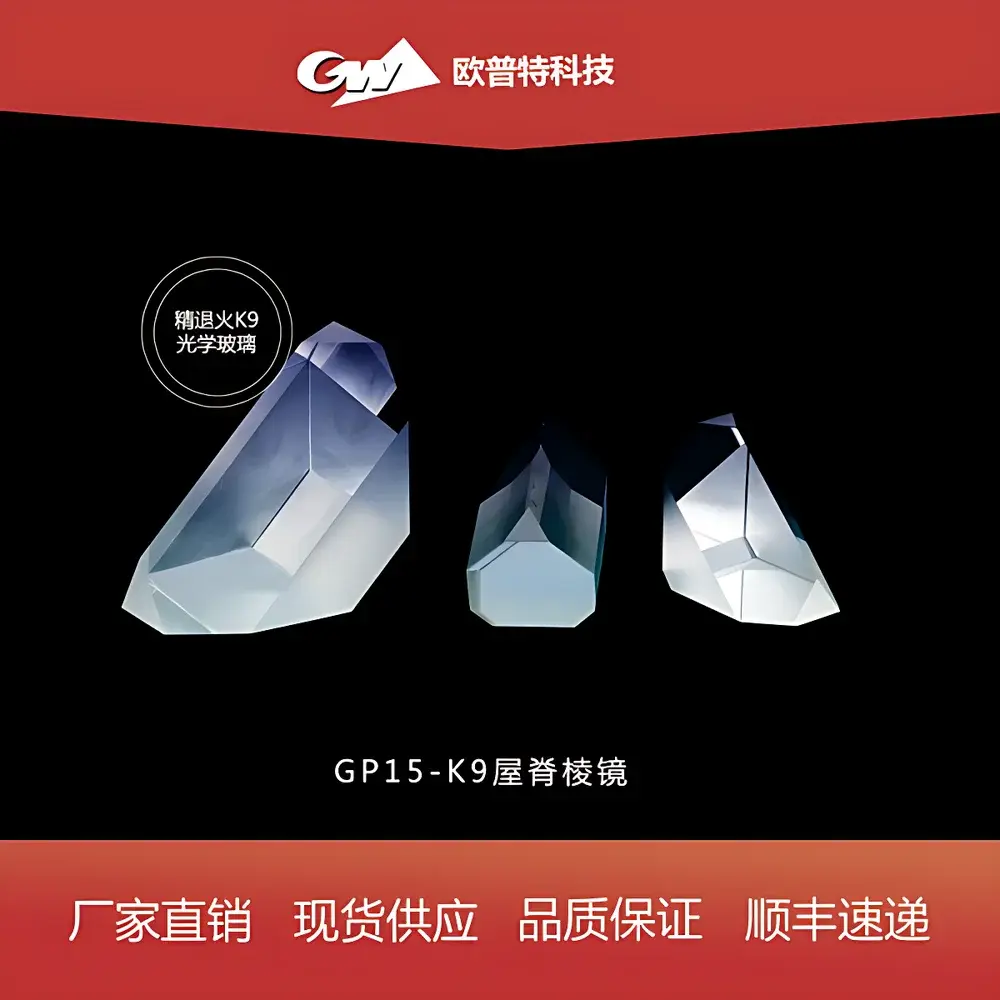
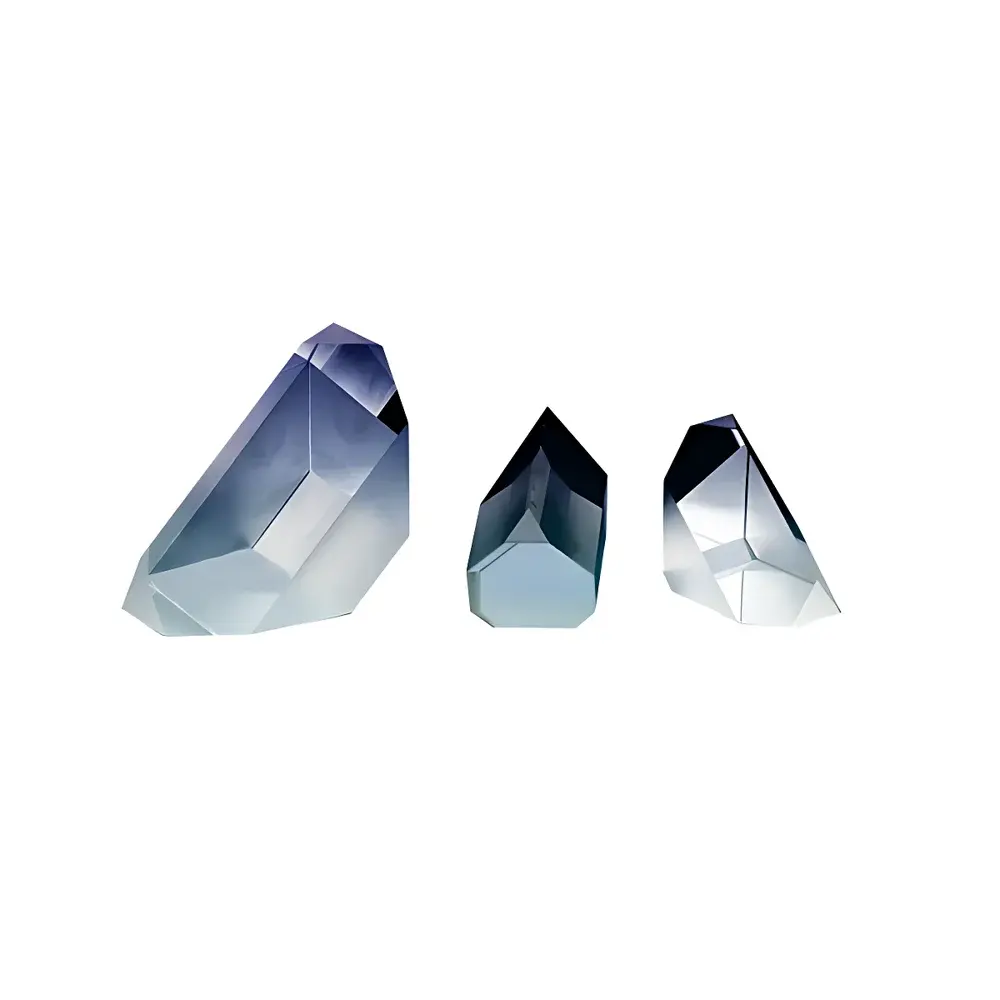
GP15-K9 Roof Prism (Uncoated)

| Material | K9 precision-annealed optical glass |
|---|---|
| Dimensions tolerance | +0.0 / −0.1 mm |
| Surface figure | λ/10 @ 632.8 nm |
| Surface quality | 3–4 scratch-dig |
| Roof angle accuracy | ±3 arcseconds |
| Other angular tolerances | ±3 arcminutes |
| Edge chamfer | < 0.25 mm × 45° |
| Coating | Uncoated |
| Clear aperture | Φ9 mm to Φ29 mm (model-dependent) |
Ask about pricing, availability and specifications.
Overview
The GP15-K9 Roof Prism is a high-precision, uncoated optical component engineered for applications requiring image inversion and 90° beam deviation with maintained handedness. Based on the roof prism principle—two mutually perpendicular reflecting faces meeting along a “roof” edge—it operates via total internal reflection (TIR) to reverse both vertical and horizontal image orientation while preserving chirality. Unlike standard right-angle prisms, the roof configuration ensures that the output image is rotated 180° about the optical axis without lateral inversion, making it indispensable in binoculars, terrestrial telescopes, rangefinders, and alignment systems where correct visual orientation is critical. Manufactured from Schott-grade K9 borosilicate crown glass (equivalent to BK7), the prism exhibits excellent transmission across the visible spectrum (350–2000 nm), low bubble/inclusion content, and homogeneity suitable for demanding imaging and metrology tasks.
Key Features
- Precision-ground and polished roof edge with angular tolerance of ±3 arcseconds—ensuring minimal wavefront distortion and high image fidelity.
- Surface figure accuracy of λ/10 at HeNe wavelength (632.8 nm), verified via interferometric testing per ISO 10110-5 standards.
- Surface quality rated 3–4 scratch-dig (per MIL-PRF-13830B), minimizing scatter and supporting diffraction-limited performance in collimated or near-collimated beams.
- Dimensional tolerances held to +0.0 / −0.1 mm on all critical edges, enabling reliable mechanical integration into OEM optical mounts and instrument housings.
- Uncoated design preserves native broadband transmission (~91.5% per surface at 550 nm); optional anti-reflection coatings (e.g., MgF₂, BBAR) available upon request for specific spectral bands.
- Controlled edge chamfer (< 0.25 mm × 45°) prevents chipping during handling and mounting while maintaining full clear aperture integrity.
Sample Compatibility & Compliance
The GP15 series accommodates four standardized sizes (GP15-010 through GP15-030), each defined by orthogonal leg dimensions (A, B, C) and corresponding clear aperture (Φ9–Φ29 mm). All variants comply with ISO 10110-1 (optical drawing notation), ISO 10110-7 (surface imperfection specification), and DIN 3140 (prism angle classification). The K9 substrate meets ASTM F264-22 requirements for optical glass used in laboratory and industrial instrumentation. No hazardous substances are introduced during manufacturing; RoHS 3 (2015/863/EU) and REACH SVHC compliance are certified. As an uncoated passive component, it requires no electrical safety certification but is compatible with Class 1 laser systems per IEC 60825-1 when integrated into properly engineered optical paths.
Software & Data Management
As a passive optical element, the GP15-K9 Roof Prism does not incorporate embedded firmware, sensors, or digital interfaces. Its performance parameters—including effective focal shift, polarization-dependent phase retardation, and TIR efficiency—are fully characterizable using standard optical design software such as Zemax OpticStudio, CODE V, or FRED. Manufacturer-provided STEP and ZMX files (available upon request) include accurate surface geometry, material dispersion data (Schott K9 catalog values), and realistic surface error models for Monte Carlo tolerance analysis. Traceable metrology reports (including interferograms and coordinate measuring machine [CMM] validation data) are supplied with each batch for GLP-compliant documentation and QA record retention.
Applications
- Image erecting systems in astronomical and terrestrial refracting telescopes.
- Optical path folding in compact spectrometers, interferometers, and laser cavity alignment tools.
- Beam steering and orientation correction in machine vision inspection platforms and automated optical inspection (AOI) systems.
- Core component in dual-channel stereo imaging modules requiring matched pupil conjugation and identical ray path lengths.
- Calibration reference in angular metrology setups, including autocollimator verification and goniometer alignment fixtures.
- Integration into FDA-regulated medical endoscopic imaging assemblies where biocompatible glass substrates and absence of outgassing coatings are required.
FAQ
What is the typical transmission efficiency of the uncoated GP15-K9 roof prism in the visible range?
Uncoated K9 glass delivers ~91.5% transmission per surface at 550 nm; total system throughput (after two TIR bounces) exceeds 84% under ideal incidence conditions.
Can this prism be used with pulsed lasers?
Yes—K9’s high laser-induced damage threshold (LIDT > 500 MW/cm² for 10 ns pulses at 1064 nm, tested per ISO 21254-1) supports integration into nanosecond-pulsed Nd:YAG and Ti:sapphire systems.
Is the roof angle tolerance sufficient for interferometric applications?
With ±3 arcsecond roof angle control, the GP15 series meets requirements for moderate-coherence white-light interferometry and aligns with ISO 10110-19 specifications for prism-based null testing configurations.
Do you provide custom coating options?
Yes—single-layer MgF₂, V-coats (450–650 nm), and broadband AR coatings (400–700 nm or 700–1100 nm) can be applied post-manufacture; lead time and minimum order quantities apply.
How is thermal stability characterized for this prism?
K9 exhibits a coefficient of thermal expansion (CTE) of 7.1 × 10⁻⁶ /°C and dn/dT of +2.7 × 10⁻⁶ /°C, ensuring stable optical performance across −10°C to +60°C ambient operating ranges.