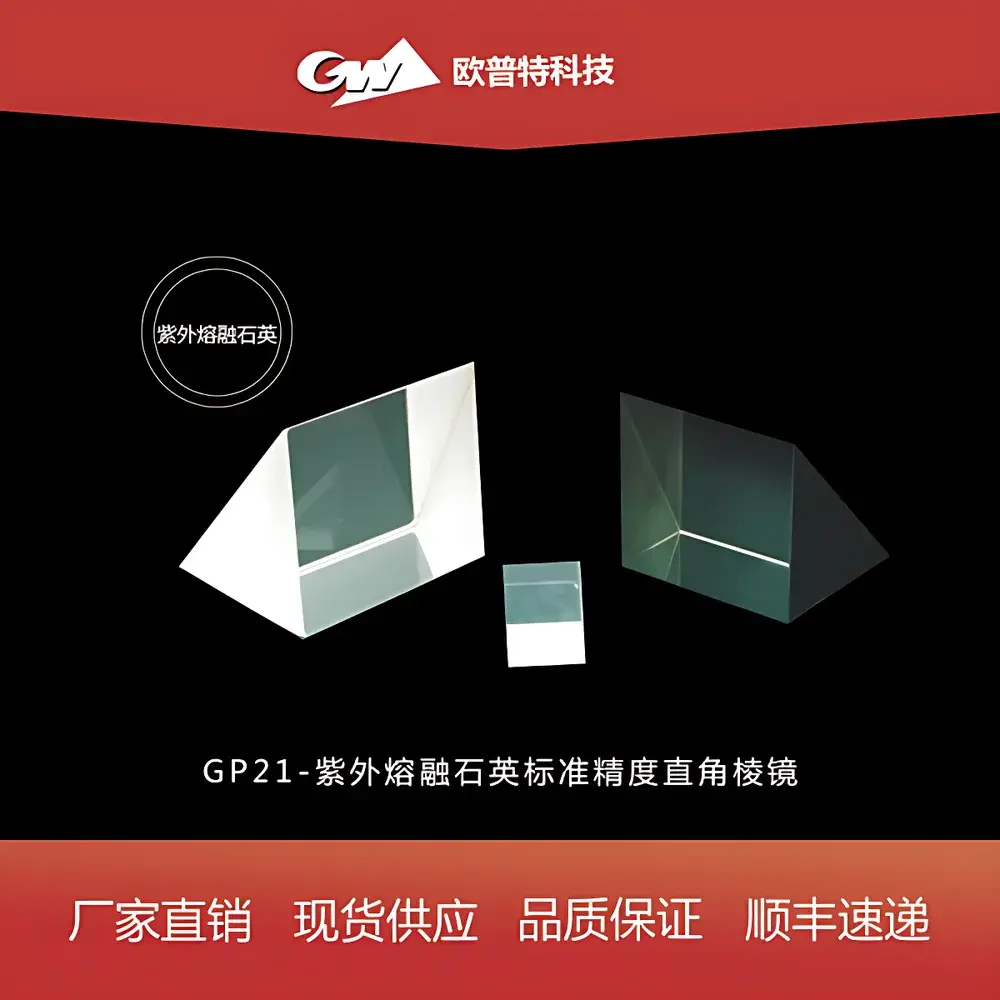
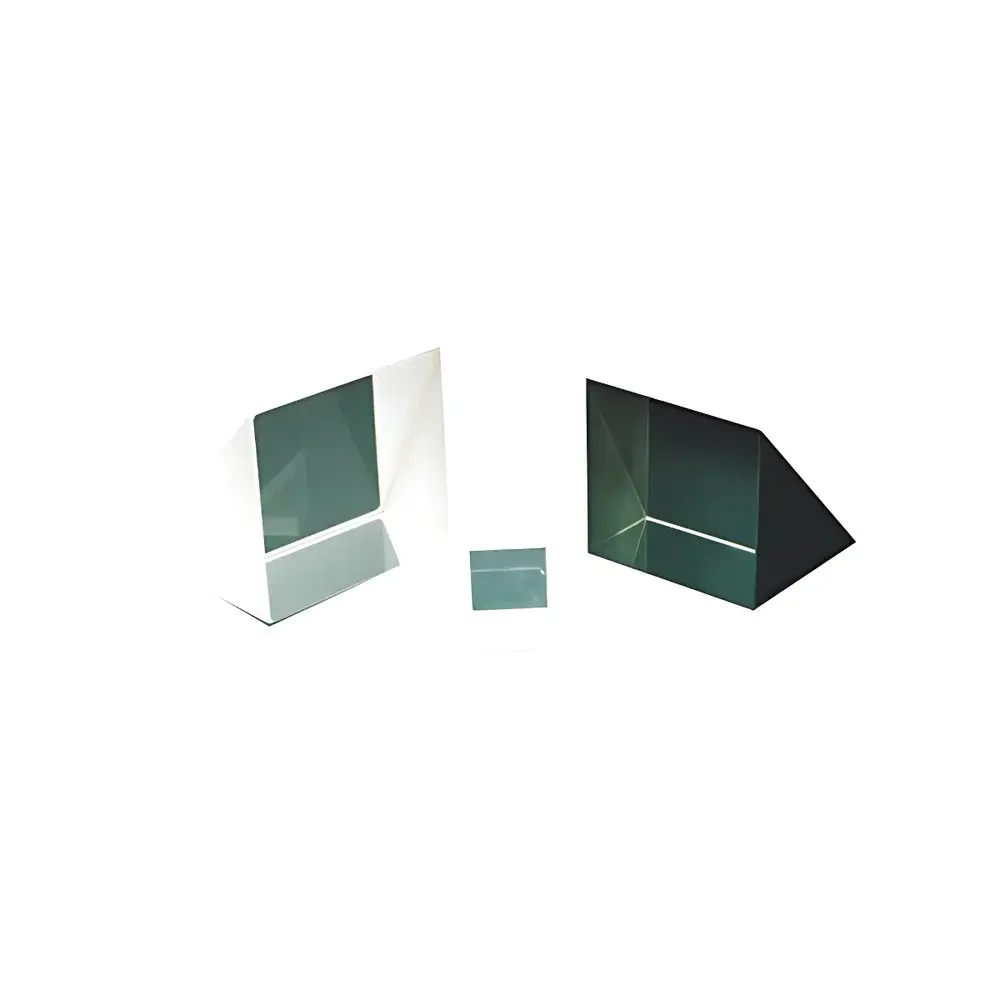
GP21 UV-Grade Fused Silica Right-Angle Prism

| Material | UV-grade fused silica |
|---|---|
| Dimensions tolerance | +0.0 / –0.2 mm |
| Surface flatness | λ/4 @ 633 nm |
| Angular accuracy | ±3 arcmin |
| Beam deviation (prism tilt error) | <10 arcmin |
| Edge chamfer | 0.2–0.5 mm × 45° |
| Surface quality | 3–4 scratch-dig |
| Coating options | Uncoated, UV-enhanced AR (250–400 nm), or Al+dielectric protected front-surface mirror (on hypotenuse) |
Ask about pricing, availability and specifications.
Overview
The GP21 UV-grade fused silica right-angle prism is a precision optical component engineered for high-stability beam steering, image reflection, and optical path folding in ultraviolet through visible spectral ranges (250–700 nm). Fabricated from synthetic fused silica with exceptional UV transmission (>85% at 254 nm), low thermal expansion (α ≈ 0.55 × 10⁻⁶ /°C), and intrinsic homogeneity, this prism operates on total internal reflection (TIR) when light enters the entrance face and reflects off the hypotenuse—enabling 90° beam deviation with minimal wavefront distortion. Its λ/4 surface flatness (measured at 633 nm HeNe wavelength) and angular accuracy of ±3 arcmin ensure sub-milliradian pointing stability critical for interferometric alignment, laser cavity design, and UV lithography support optics. Designed for integration into OEM instrumentation, spectroscopic systems, and metrology platforms, the GP21 complies with ISO 10110-3 (surface form tolerances) and ISO 10110-7 (surface imperfections), supporting traceable calibration workflows under GLP-compliant laboratory environments.
Key Features
- Optical substrate: High-purity UV-grade fused silica (e.g., Suprasil® 300 or equivalent), certified for <0.5 ppm metallic impurities and OH-content <1 ppm to minimize UV absorption and solarization effects
- Precision geometry: Equilateral right-angle configuration (A = B = C) with tight dimensional tolerance of +0.0 / –0.2 mm per side, enabling repeatable mechanical mounting in kinematic fixtures
- Surface metrology: λ/4 peak-to-valley flatness referenced to 633 nm, verified via phase-shifting interferometry (PSI) with NIST-traceable calibration; surface roughness <5 Å RMS (measured by AFM)
- Angular fidelity: Hypotenuse-to-leg angle deviation controlled to ±3 arcmin (±0.05°), with total beam deviation error <10 arcmin after assembly—critical for multi-prism arrays and polarization-sensitive setups
- Edge preparation: Consistent 0.2–0.5 mm × 45° protective chamfer applied to all three edges per ISO 10110-12, reducing chipping risk during handling and cleaning
- Coating flexibility: Available uncoated for TIR applications, or with custom thin-film coatings including UV-optimized anti-reflection (250–400 nm, R 95% reflectance at large incidence angles
Sample Compatibility & Compliance
The GP21 prism is compatible with standard optomechanical mounts (e.g., SM1-threaded cage systems, kinematic mirror mounts with adjustable tip/tilt), and supports vacuum-compatible integration (outgassing rate <1×10⁻⁹ Pa·m³/s per ASTM E595). All batches undergo full lot traceability per ISO 9001:2015, with material certificates specifying refractive index (n = 1.468 at 254 nm, n = 1.458 at 587.6 nm), dn/dT (≈ 1.0 × 10⁻⁶ /°C), and birefringence <5 nm/cm. Surface quality conforms to MIL-PRF-13830B Scratch-Dig 3–4 specification. No RoHS-restricted substances are used in substrate fabrication or coating processes.
Software & Data Management
While the GP21 is a passive optical element, its performance specifications are fully embeddable in optical design software environments including Zemax OpticStudio (ZOS), CODE V, and FRED via user-defined surface files (.ZBF, .DAT). Each shipped unit includes a digital Certificate of Conformance (CoC) with interferometric surface maps (Zernike coefficients up to 37th order), angular deviation test reports, and spectral transmittance/reflectance curves (measured on PerkinElmer Lambda 950 or equivalent). Raw metrology data is archived for 10 years and available upon request for FDA 21 CFR Part 11–compliant audit trails.
Applications
- Laser beam redirection in UV photolithography steppers and mask aligners
- Image erecting and relay optics in endoscopic and borescope systems
- Reference elements in Michelson and Twyman-Green interferometers
- Hypotenuse-mirrored variants for p-polarized beam combiners in ultrafast amplifier cavities
- Stable fold mirrors in vacuum UV (VUV) monochromators (e.g., 121–200 nm range)
- Calibration standards for angular metrology systems using autocollimators or electronic theodolites
FAQ
What is the maximum CW laser power density this prism can withstand without damage?
For uncoated UV fused silica at 266 nm, the typical LIDT is ≥5 J/cm² (10 ns pulse, 10 Hz); for CW operation, bulk absorption limits safe irradiance to ≤1 MW/cm² at 355 nm and lower at shorter wavelengths. Actual threshold depends on beam profile, cooling, and mounting.
Can the GP21 be customized with wedge correction for collimated beam recombination?
Yes—wedge-compensated variants (e.g., Δθ < 2 arcsec between legs) are available under custom order with extended lead time and interferometric verification.
Is the surface quality verified per ISO 10110-5 or MIL-PRF-13830B?
Both: Scratch-dig rating is certified per MIL-PRF-13830B (3–4), while surface roughness and subsurface damage depth are characterized per ISO 10110-5 Annex A using white-light interferometry and Nomarski DIC microscopy.
Do you provide mounting adapters or kinematic bases for the GP21 series?
Standard SM1-threaded prism mounts (e.g., PRM1Z8) and low-profile kinematic bases (KCB1) are recommended; full mechanical drawings and tolerance stacks are available upon NDA.
Are coated versions compliant with NASA outgassing requirements (SP-R-0022A)?
UV-AR coated units meet SP-R-0022A Class A criteria (CVCM < 0.1%, TML < 1.0%) when deposited via ion-assisted e-beam evaporation; certification reports available per lot.