
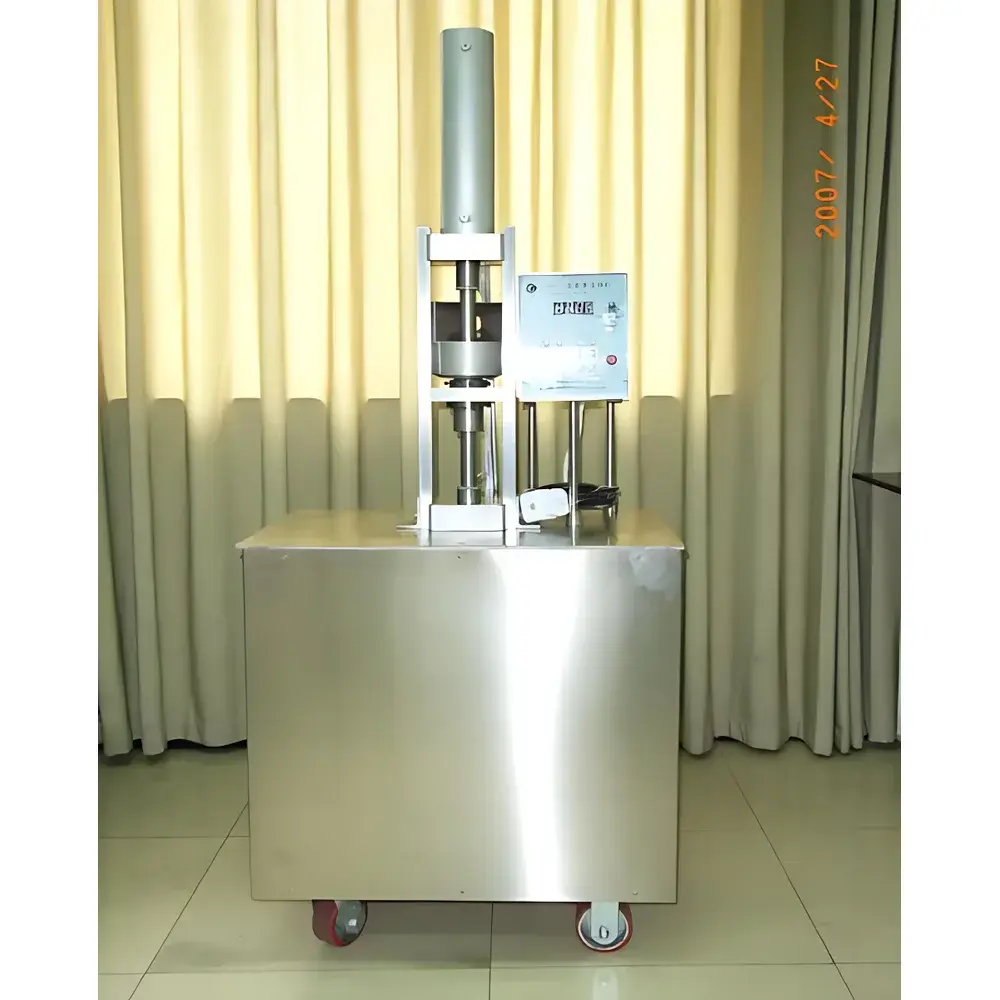
GY-TBY-70 Carbon Black Compressor
| Origin | China |
|---|---|
| Manufacturer Type | Authorized Distributor |
| Model | GY-TBY-70 |
| Pricing | Upon Request |
| Operating Temperature Range | −40 °C to +60 °C |
| Power Supply | 380 V ±10%, 50 Hz (3-phase AC) |
| Cylinder Internal Pressure | 16.07 MPa |
| Maximum Adjustable Control Pressure Setpoint | 0–40 MPa |
| Effective Axial Contact Pressure (Column End-to-Load Base) | Up to 200 MPa |
| Cylinder Stroke | 160 mm |
| Piston Advancing Speed | 4.2 mm/s |
| Hydraulic Reservoir Volume | 10 L |
| Hydraulic Fluid | ISO VG 46 Anti-Wear Hydraulic Oil |
| Motor-Pump Unit | 1.1 kW, 1500 rpm, 1.25 mL/r |
| System Rated Hydraulic Pressure | 16.70 MPa |
| Control Voltage (Solenoid Valve) | DC 220 V |
| Patent No. | ZL2005 2 0033701.1 |
Overview
The GY-TBY-70 Carbon Black Compressor is a precision-engineered, semi-automated mechanical compression instrument designed in strict compliance with GB/T 3780.4—China’s national standard for the determination of carbon black bulk density and compressibility. It operates on a direct-force hydraulic compression principle, where controlled axial loading is applied via a vertically actuated piston-cylinder assembly to consolidate standardized carbon black samples within a defined die cavity. Unlike manually operated or single-direction compression systems, the GY-TBY-70 implements bidirectional pressure control (compression and decompression) through closed-loop feedback from a calibrated pressure transducer, enabling repeatable, traceable, and operator-independent consolidation cycles. Its architecture integrates electromechanical actuation, digital pressure monitoring, and programmable setpoint logic—making it suitable not only for routine quality control of furnace-black and channel-black grades but also for comparative densification studies of other free-flowing, non-cohesive powders used in rubber compounding, battery electrode formulation, and pigment processing.
Key Features
- Semi-automatic bidirectional operation: simultaneous compression and controlled depressurization via solenoid-driven hydraulic circuitry
- Digital real-time pressure display (0–40 MPa range) with user-configurable setpoints via membrane keypad interface
- Programmable compression cycle counter with automatic increment/decrement logic and on-screen retention
- High-force axial loading capability: column end-to-base contact pressure up to 200 MPa achievable via mechanical leverage amplification
- Hydraulic system rated at 16.70 MPa with ISO VG 46 anti-wear fluid, ensuring long-term stability under cyclic load conditions
- Integrated piston speed regulation (4.2 mm/s nominal advancing velocity) for consistent strain-rate application during consolidation
- Robust cast-iron frame and hardened steel load train components engineered for >100,000 compression cycles without performance drift
Sample Compatibility & Compliance
The GY-TBY-70 is validated for use with ASTM D1765-22 (Standard Classification for Rubber Compounding Materials—Carbon Black), ISO 11249:2021 (Rubber—Determination of bulk density of carbon black), and GB/T 3780.4–2019. It accommodates standard cylindrical dies (Ø25.4 mm × H30 mm) per GB/T 3780.4 Annex A. While optimized for carbon black (N110–N990 series), the instrument supports compression testing of other dry, granular, or agglomerated powders—including silica fume, graphite flakes, metal oxides (e.g., ZnO, TiO₂), and lithium iron phosphate (LiFePO₄) cathode precursors—provided particle size distribution falls within 0.1–100 µm and moisture content remains below 0.5 wt%. All mechanical and electrical subsystems conform to IEC 61000-6-2 (immunity) and IEC 61000-6-4 (emission) standards. CE marking documentation is available upon request for EU-market deployment under Machinery Directive 2006/42/EC.
Software & Data Management
The GY-TBY-70 operates via embedded firmware without external PC dependency; however, optional RS-232/USB data export enables integration with laboratory information management systems (LIMS). Pressure vs. time profiles, cycle count logs, and setpoint timestamps are stored in non-volatile memory (1000-cycle capacity) and retrievable via serial query commands. For GLP/GMP environments, the optional Data Logging Module (DLM-70) provides audit-trail functionality compliant with FDA 21 CFR Part 11 requirements—including electronic signatures, user access levels (Operator/Supervisor/Admin), and immutable event logging with UTC timestamps. Calibration records—including transducer verification against NIST-traceable dead-weight testers—and maintenance history can be archived and exported as CSV or PDF.
Applications
- Routine QC of carbon black bulk density and compressibility index (CBI) per GB/T 3780.4 and ISO 11249
- Development and validation of high-loading rubber compounds requiring precise filler packing density control
- Comparative study of powder flowability and interparticle friction under confined compression
- Pre-compression conditioning of electrode slurries for lithium-ion battery manufacturing
- Research into pressure-induced phase transitions in nanocarbon aggregates
- Calibration support for online density monitors in carbon black production lines
FAQ
What standards does the GY-TBY-70 comply with?
It is fully aligned with GB/T 3780.4–2019, ISO 11249:2021, and ASTM D1765-22 for carbon black compression testing.
Can the instrument be used for non-carbon-black materials?
Yes—provided the material is dry, free-flowing, and exhibits no cohesive adhesion under low-moisture conditions (≤0.5 wt% H₂O). Validation per ISO 13321 is recommended for new matrix types.
Is hydraulic oil included with shipment?
No—the unit ships dry; users must fill with 10 L of ISO VG 46 anti-wear hydraulic oil prior to first operation.
What is the expected service life of the pressure transducer?
Under normal usage (≤5 cycles/day), the OEM-calibrated transducer maintains ±0.5% FS accuracy for ≥3 years or 50,000 cycles, whichever occurs first.
Does the system support remote diagnostics?
With the optional DLM-70 module installed, real-time status monitoring and error-code retrieval are possible via Modbus RTU over RS-485.






