
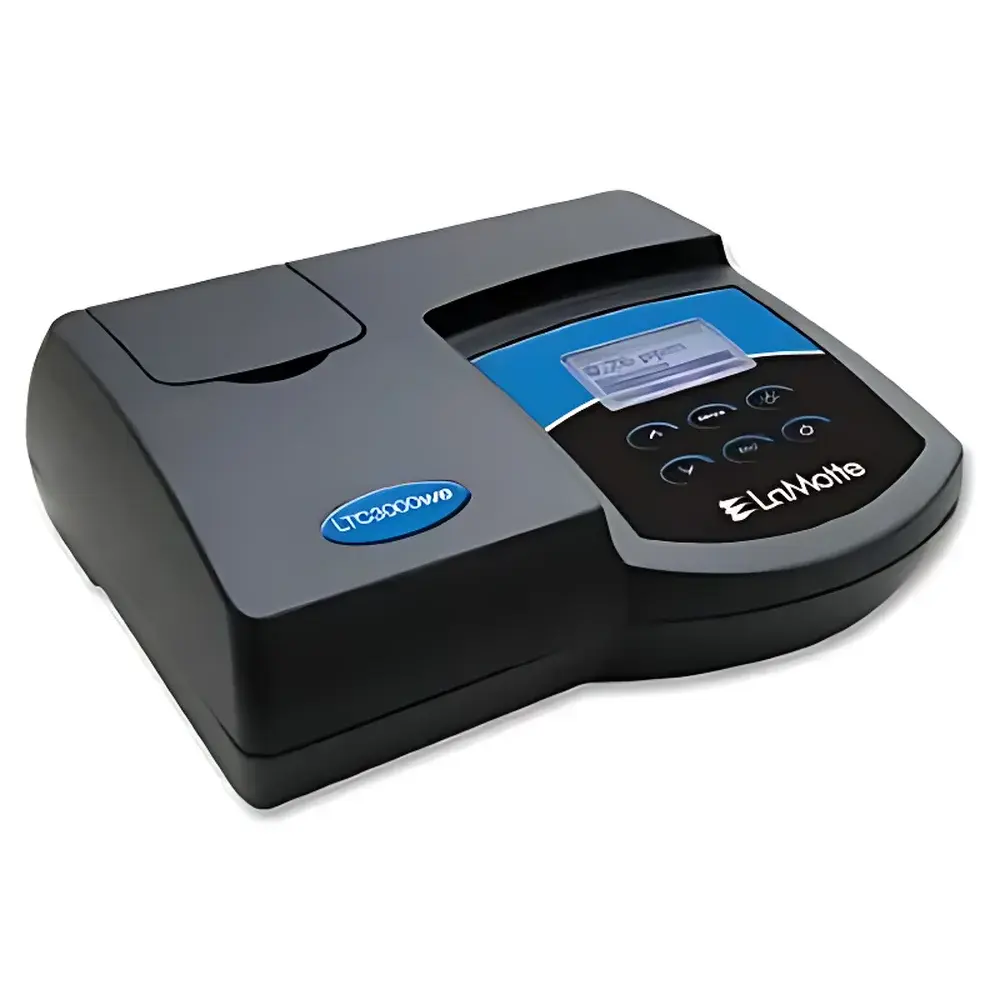
Hach LTC3000we Benchtop Turbidity and Chlorine Analyzer
| Origin | USA |
|---|---|
| Manufacturer Type | Authorized Distributor |
| Origin Category | Imported |
| Model | LTC3000we |
| Price | Upon Request |
| Turbidity Range | 0–4,000 NTU (also supports FNU, AU, FAU, ASBC, EBC) |
| Chlorine Range | 0–10 ppm (free & total chlorine) |
| Detection Limit | 0.05 NTU (turbidity), 0.03 ppm (chlorine) |
| Compliance | EPA Method 180.1 (turbidity), EPA Method 330.5 (chlorine), ISO 7027, Standard Methods 2120 B (color), 4500-Cl-G |
| Data Storage | 500 measurements |
| Light Sources | Tungsten lamp (EPA mode), 860 nm LED (ISO mode), 525 nm LED (chlorine), 428 nm LED (color) |
| Power Options | USB-powered, AC adapter, or rechargeable Li-ion battery (3.7 V) |
Overview
The Hach LTC3000we is a benchtop turbidity and chlorine analyzer engineered for precision, regulatory compliance, and operational flexibility in environmental and water quality laboratories. It integrates three critical water quality parameters—turbidity, free/total chlorine, and color—into a single, compact platform using standardized optical measurement principles. Turbidity is measured via nephelometry (90° light scatter) in accordance with EPA Method 180.1 and ISO 7027, employing either a tungsten lamp (for EPA-compliant measurements) or an 860 nm LED (for ISO-compliant measurements). Chlorine quantification follows the DPD (N,N-diethyl-p-phenylenediamine) colorimetric method per EPA Method 330.5, utilizing a 525 nm LED for photometric detection of oxidized DPD chromophore. Color is determined spectrophotometrically at 428 nm per Standard Methods 2120 B. The instrument’s dual-mode optical architecture ensures traceable, repeatable results across diverse regulatory frameworks—including U.S. EPA, ISO, and APHA Standard Methods—without requiring hardware modification.
Key Features
- Triple-parameter capability: simultaneous or independent measurement of turbidity (NTU/FNU/AU/FAU/ASBC/EBC), free and total chlorine (ppm), and platinum-cobalt color (CU)
- Regulatory-grade optics: selectable light sources—tungsten lamp (EPA 180.1), 860 nm LED (ISO 7027), 525 nm LED (chlorine), and 428 nm LED (color)—each calibrated to method-specific spectral requirements
- High-resolution detection: 0.01 NTU/FNU resolution in low-range turbidity (0.00–10.99), with ±0.05 NTU accuracy below 2.5 NTU and ±2% from 2.5–100 NTU
- Chlorine detection limit of 0.03 ppm with <2-second reaction time; DPD tablet and liquid reagent compatibility supported
- Integrated data management: 500-point internal memory with timestamp, sample ID, and operator fields; export via USB to CSV-compatible software
- Flexible power architecture: operable via USB host connection, AC adapter (100–240 V), or field-deployable rechargeable Li-ion battery (3.7 V, 2.5″ × 0.75″, 1.7 oz)
- Multi-language interface: English, French, Spanish, Japanese, Italian, Portuguese, and Simplified Chinese—configurable without firmware update
Sample Compatibility & Compliance
The LTC3000we accommodates standard 25-mm round glass vials (included) and accepts both DPD tablets (100 tablets each for free and total chlorine) and liquid reagents. Its turbidity measurement conforms to EPA 180.1 for drinking water and wastewater applications, and to ISO 7027 for international reporting. Chlorine analysis meets EPA 330.5 performance criteria for oxidant residual determination in potable water, distribution systems, and disinfection validation studies. Color measurement adheres to Standard Methods 2120 B, enabling comparison against historical CU scales used in regulatory reporting and treatment optimization. All calibration standards—including 0, 1, and 10 NTU formazin equivalents—are NIST-traceable and supplied with the system. The instrument supports GLP/GMP-aligned workflows through user-defined ID entry, automatic timestamping, and audit-ready data export.
Software & Data Management
Data generated by the LTC3000we is stored internally with full metadata: date/time stamp, measurement type, range mode, operator ID (user-definable), and sample identifier. Export occurs via USB cable to standard spreadsheet applications or LIMS-compatible platforms; no proprietary software installation is required. The instrument does not implement FDA 21 CFR Part 11 electronic signature functionality but provides raw, unaltered data files suitable for manual audit trails in regulated environments. Signal averaging (2-, 5-, or 10-point) reduces noise in low-turbidity or low-chlorine samples, improving reproducibility without compromising response time. Auto-shutdown options (5, 10, or 30 seconds) conserve battery life during intermittent use.
Applications
This analyzer serves municipal water utilities, environmental testing labs, wastewater treatment facilities, and academic research groups conducting routine or method-validated water quality assessments. Typical use cases include: verification of filtration efficiency via turbidity breakthrough monitoring; chlorine decay profiling in distribution networks; disinfection byproduct precursor screening through color correlation; validation of point-of-use treatment devices; and compliance reporting for NPDES permits, Safe Drinking Water Act (SDWA) requirements, and ISO 17025-accredited testing. Its portability and battery operation also support mobile lab deployments and field-to-lab continuity in emergency response scenarios.
FAQ
Does the LTC3000we meet U.S. EPA certification requirements for regulatory reporting?
Yes—it is designed and validated to comply with EPA Methods 180.1 (turbidity) and 330.5 (chlorine), and its optical configuration satisfies the spectral and geometric specifications outlined in those methods.
Can the instrument switch between EPA and ISO turbidity modes without recalibration?
Yes—mode selection is software-based and automatically adjusts wavelength, detector gain, and unit scaling; factory calibration remains valid across both configurations.
What is the recommended maintenance interval for optical components?
No scheduled optical maintenance is required; the sealed optical path and LED/tungsten sources are rated for >10,000 hours of operation. Routine cleaning of the sample cell compartment and cuvette surfaces with lint-free wipes and deionized water is advised after each use.
Is the instrument compatible with LIMS integration?
It exports ASCII-formatted CSV files via USB, which can be ingested directly into most LIMS platforms via batch import or custom scripting; no API or HL7 support is provided.
How is traceability ensured for calibration standards?
The included 0, 1, and 10 NTU formazin standards are certified reference materials traceable to NIST SRM 2102; lot-specific certificates of analysis are supplied with each kit.







