
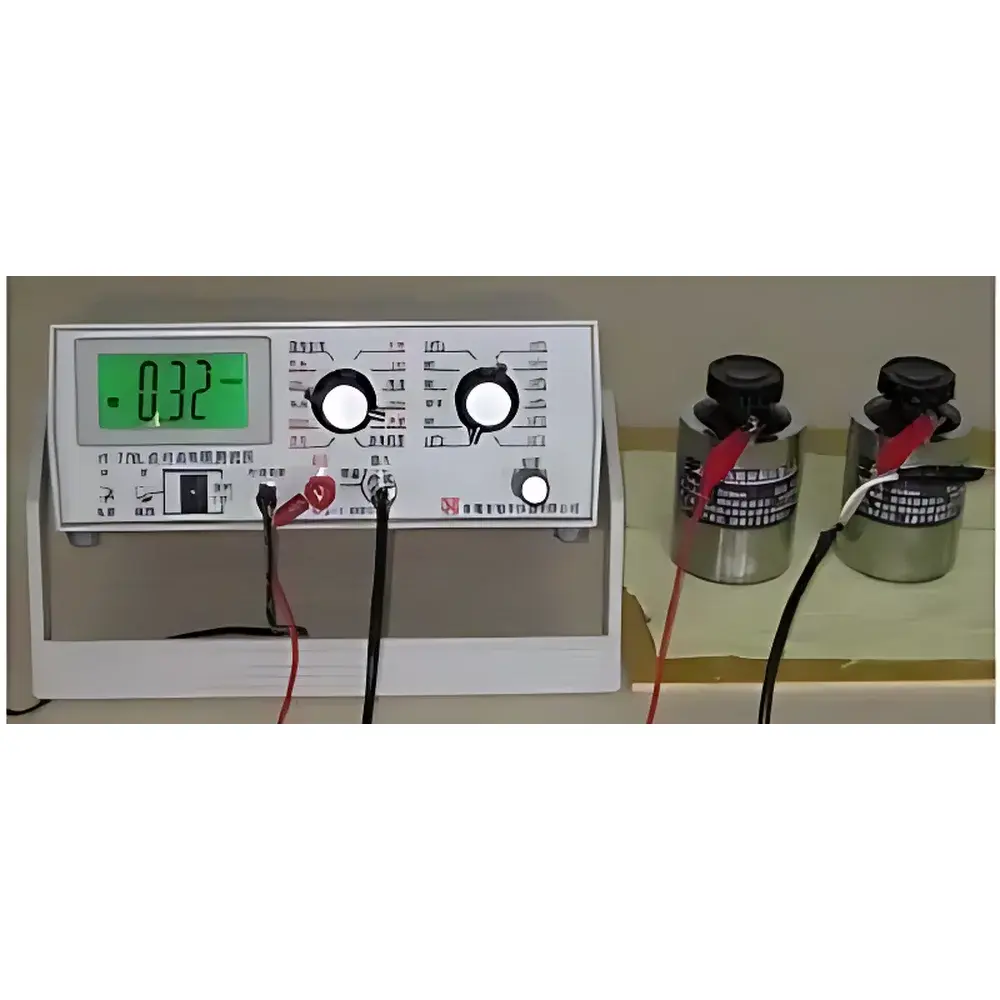
Hanyu HY-779L Point-to-Point Electrical Resistance Tester for Textile Fabrics
| Origin | Tianjin, China |
|---|---|
| Manufacturer Type | Authorized Distributor |
| Origin Category | Domestic (PRC) |
| Model | HY-779L |
| Pricing | Available Upon Request |
| Measurement Range | 0–2×10¹³ Ω |
| Resolution | 100 Ω |
| Accuracy | ≤ ±3% of full scale |
| Test Voltage | 100 V ± 3 V |
| Power Supply | AC 220 V ± 10%, 15 W |
| Compliance | GB/T 12014–2009 Clause 4.1.2 |
| Standard Electrode | Dual-weighted stainless-steel point-to-point electrode set (2.5 kg per electrode) |
| Calibration | NIST-traceable calibration certificate provided |
Overview
The Hanyu HY-779L Point-to-Point Electrical Resistance Tester is a precision instrument engineered for quantitative assessment of surface resistivity in static-dissipative and antistatic textile materials—primarily used in the evaluation of protective workwear, cleanroom garments, and ESD-sensitive manufacturing apparel. It operates on the principle of direct-current (DC) two-terminal resistance measurement between two defined contact points under standardized mechanical loading, as specified in GB/T 12014–2009, “Protective Clothing – Antistatic Performance Requirements and Test Methods.” The device applies a stable 100 V DC test voltage across a pair of calibrated, weight-loaded stainless-steel electrodes placed at fixed separation (typically 300 mm, per standard protocol), enabling reproducible quantification of charge dissipation capability across fabric surfaces. Its measurement architecture is optimized for high-impedance regimes—spanning 0 to 2×10¹³ Ω—with resolution down to 100 Ω, ensuring reliable detection of both conductive (≤10⁵ Ω) and insulative (≥10¹¹ Ω) textile behaviors. Designed for laboratory and QC environments in textile mills, PPE manufacturers, and third-party certification labs, the HY-779L supports objective verification of electrostatic safety compliance without reliance on environmental conditioning chambers—though ambient temperature (23±2°C) and relative humidity (40±5% RH) are recommended per ISO 18562-2 for comparative testing.
Key Features
- Stable 100 V ±3 V DC excitation source with low-noise regulation, minimizing polarization effects during extended measurements
- Dual 2.5 kg stainless-steel point electrodes with precision-machined contact tips (diameter: 16 mm), conforming to GB/T 12014–2009 mechanical interface requirements
- High-input-impedance analog front-end (>10¹⁴ Ω input impedance) and guarded measurement circuitry to suppress leakage current artifacts
- Auto-ranging digital ohmmeter core with 4½-digit resolution and linearized logarithmic scaling for consistent readability across 13 decades of resistance
- Integrated pass/fail threshold indicator supporting user-defined limit values (e.g., ≤1×10⁹ Ω for antistatic classification per EN 1149-1)
- Robust die-cast aluminum chassis with ESD-safe finish and IEC 61000-4-2 compliant transient immunity
Sample Compatibility & Compliance
The HY-779L accommodates flat, flexible textile specimens up to 500 mm × 500 mm, including woven, knitted, nonwoven, and laminated fabrics—provided surface uniformity permits stable electrode contact. It is validated for use with coated, metallized, carbon-loaded, and inherently dissipative fibers (e.g., polyester/carbon blends, nylon/antistat finishes). Compliance is explicitly aligned with GB/T 12014–2009 Section 4.1.2 (point-to-point resistance test method), and its methodology is technically harmonized with ISO 6330 (washing procedures prior to testing), ASTM F1506 (arc-rated clothing), and EN 1149-1 (electrostatic properties of protective clothing). While not certified to IEC 61340-2-3 or ANSI/ESD STM2.1 out-of-the-box, its measurement protocol satisfies the foundational electrical test criteria referenced therein. All instruments ship with a NIST-traceable calibration certificate issued by an ISO/IEC 17025-accredited metrology laboratory, documenting as-found and as-left performance against primary standards.
Software & Data Management
The HY-779L operates as a standalone benchtop instrument with no embedded firmware or digital connectivity. However, it features a RS-232 serial output port (DB9 male) compatible with optional PC-based data logging via ASCII command protocol (e.g., “READ?” returns “R=1.234E+09Ω”). Users may integrate readings into LIMS or QA databases using generic terminal emulators or custom Python/Excel VBA scripts. For regulated environments, manual recording in bound logbooks with operator signature, date/time stamp, and specimen ID meets GLP documentation requirements. The included calibration report contains uncertainty budgets (k=2), traceability chain, and environmental conditions during calibration—satisfying audit readiness for ISO 9001, ISO 13485, and FDA 21 CFR Part 11–aligned quality systems when paired with controlled procedural documentation.
Applications
- Verification of antistatic performance in flame-resistant (FR) coveralls and lab coats for petrochemical and pharmaceutical facilities
- Pre-shipment quality control of cleanroom garments used in semiconductor fabrication and biotech manufacturing
- Material qualification testing for military-specification (MIL-STD-1686) ESD control programs
- Research and development of novel conductive yarns, nanocoated textiles, and hybrid fiber architectures
- Third-party certification testing per CNAS-accredited protocols for CCC mark and CE marking submissions
- Periodic in-house verification of garment aging effects after repeated laundering (per GB/T 3921 or ISO 105-C06)
FAQ
Does the HY-779L comply with international ESD standards such as IEC 61340-2-3 or ANSI/ESD S20.20?
It implements the same physical measurement principle and electrode geometry required by those standards; however, formal conformance requires validation within a certified test lab’s full protocol—including environmental controls and statistical sampling. The instrument itself meets the hardware specifications referenced in Annex B of IEC 61340-2-3.
Can it measure volume resistivity or only surface resistivity?
The HY-779L is configured exclusively for point-to-point surface resistance (Rptp) per GB/T 12014. Volume resistivity requires four-terminal (van der Pauw or collinear probe) setups and is outside its design scope.
Is the calibration certificate valid for ISO/IEC 17025 audits?
Yes—the supplied certificate originates from an ILAC-MRA signatory laboratory and includes measurement uncertainty, traceability statements, and environmental parameters, fulfilling clause 6.5 requirements of ISO/IEC 17025:2017.
What maintenance is required beyond annual recalibration?
Routine cleaning of electrode tips with isopropyl alcohol and inspection for surface pitting or contamination; no internal user-serviceable components exist. Storage in low-humidity environment (<40% RH) is recommended to preserve insulation integrity.





