
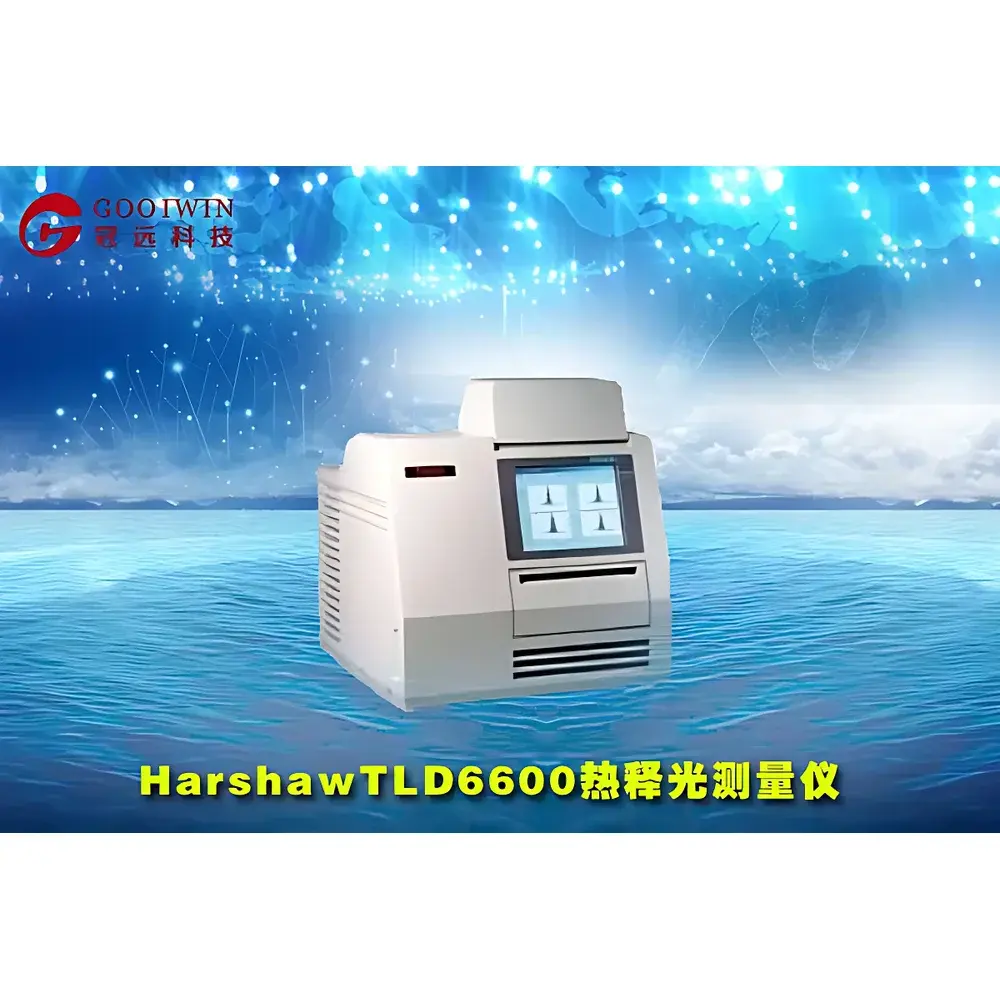
Harshaw TLD 6600 Thermoluminescent Dosimeter Reader with Detector and Housing Options
| Brand | UNION |
|---|---|
| Origin | Denmark |
| Manufacturer Type | Authorized Distributor |
| Origin Category | Imported |
| Model | 6600Y |
| Pricing | Upon Request |
Overview
The Harshaw TLD 6600 is a precision thermoluminescent dosimeter (TLD) reader engineered for high-reproducibility, low-dose radiation monitoring in occupational health, environmental surveillance, and regulatory compliance settings. It operates on the fundamental principle of thermoluminescence: when irradiated crystalline materials—such as LiF:Mg,Cu,P or CaSO₄:Dy,Tm—are subsequently heated, they emit visible photons proportional to the absorbed ionizing radiation dose. The emitted light is detected by a calibrated photomultiplier tube (PMT), digitized, and converted into dose values (in mSv or mGy) using pre-established calibration curves traceable to national standards. While widely deployed across nuclear medicine, radiopharmacy, and industrial radiography, its application in food irradiation facility personnel monitoring and post-irradiation product safety verification aligns with ISO/IEC 17025-accredited QA/QC workflows in food-specialized laboratories.
Key Features
- Modular detector compatibility supporting both formed (chips, rods, discs, glass tubes) and unformed (powdered) TLD materials—including LiF:Mg,Cu,P (tissue-equivalent, optimal for personal dosimetry) and CaSO₄:Dy,Tm (high sensitivity but energy-dependent response)
- Programmable heating profile control (ramp rate, peak temperature, hold time) to optimize glow-curve deconvolution and minimize fading effects
- Integrated background subtraction and real-time noise discrimination to enhance signal-to-noise ratio at sub-mGy dose levels
- Automated annealing station option for standardized thermal reset prior to readout, ensuring measurement consistency across reuse cycles
- Rugged benchtop architecture with electromagnetic shielding and temperature-stabilized PMT housing for long-term operational stability
- Compliance-ready design supporting audit trails, user access control, and data integrity protocols aligned with FDA 21 CFR Part 11 and ISO 14146 requirements
Sample Compatibility & Compliance
The TLD 6600 accommodates detectors ranging from 3.2 mm × 3.2 mm chips to 10 mg aliquots of LiF:Mg,Cu,P powder. For formed detectors, batch-specific sensitivity screening is mandatory: three independent irradiations at ≤1 mGy followed by readout and statistical grouping (±10% coefficient of variation recommended) ensure uniform response across dosimeters. Powdered detectors—when homogenized via vortex mixing—eliminate inter-element variability without requiring individual screening; empirical validation confirms no statistically significant degradation in sensitivity or dispersion after ≥10 readout-anneal cycles. All configurations must meet IEC 61066 and GBZ 128–2019 requirements for minimum detectable dose (MDD), defined experimentally as 3σ of 10 background-exposed dosimeters over one monitoring period (e.g., 30 days). MDD is not a fixed instrument specification but a system-level performance metric dependent on detector type, housing geometry, and ambient background conditions.
Software & Data Management
The proprietary TLD Analysis Suite provides GLP-compliant data handling: automatic glow-curve integration, peak-fitting algorithms (e.g., Grossweiner–Kittel model), and dose calculation using multi-point calibration curves. Audit logs record operator ID, timestamp, calibration file version, and raw PMT output for every readout. Export formats include CSV, XML, and PDF reports compliant with ISO/IEC 17025 clause 7.8.2. Data encryption, role-based permissions, and electronic signature support facilitate alignment with GMP documentation practices in food irradiation facilities subject to EFSA or FDA oversight.
Applications
- Personal dosimetry for staff operating food irradiation accelerators (e.g., electron beam or X-ray systems per ISO/ASTM 51702)
- Environmental dose mapping around irradiation chamber shielding and conveyor interfaces
- Validation of dose uniformity audits during routine process qualification (e.g., ISO/ASTM 51608)
- Retrospective dose assessment following equipment malfunctions or procedural deviations
- Supporting HACCP-based radiation safety plans in USDA-FSIS or EU Regulation (EC) No 1881/2006-compliant facilities
FAQ
What is the practical minimum detectable dose (MDD) for LiF:Mg,Cu,P chips in a 30-day monitoring cycle?
Typical MDD ranges from 0.25–0.35 mSv under controlled laboratory background conditions; site-specific determination per GBZ 128–2019 is required.
Can powdered LiF:Mg,Cu,P be used without sensitivity screening?
Yes—homogeneous mixing mitigates unit-to-unit variation; however, batch certification and annual revalidation per ISO/IEC 17025 are recommended.
How often must annealed detectors be rescreened?
Rescreening is advised after every 10 readout cycles or biannually, whichever occurs first, to verify stability against cumulative thermal stress.
Does the TLD 6600 comply with FDA 21 CFR Part 11 for electronic records?
When configured with validated software, audit trail logging, and electronic signature modules, it meets predicate rule requirements for regulated food irradiation QA programs.
Is CaSO₄:Dy,Tm suitable for food industry personnel monitoring?
Not recommended—its poor tissue equivalence and strong low-energy photon overresponse compromise accuracy in mixed-field environments typical of irradiation facilities.






