Harvard Apparatus CMA Basic Microdialysis System
| Brand | Harvard Apparatus |
|---|---|
| Origin | Sweden |
| Manufacturer Type | Authorized Distributor |
| Origin Category | Imported |
| Model | CMA Basic Microdialysis System |
| Pricing | Available Upon Request |
Overview
The Harvard Apparatus CMA Basic Microdialysis System is a modular, research-grade platform engineered for in vivo and in vitro sampling of low-molecular-weight analytes across neuroscience, pharmacokinetics, endocrinology, and toxicology applications. Built upon the well-established CMA (Carnegie Medicine AB) microdialysis architecture, this system leverages the principle of passive diffusion across a semi-permeable membrane to enable continuous, minimally invasive collection of extracellular fluid from targeted tissue sites—including brain, spinal cord, adipose, muscle, and skin. The system operates under controlled perfusion conditions, where an isotonic, physiologically compatible dialysate is infused at precise, low flow rates (typically 0.1–5.0 µL/min), allowing equilibration of analytes such as neurotransmitters (e.g., dopamine, serotonin), glucose, lactate, cytokines, and small-molecule drugs between the extracellular space and the dialysate stream. Its modular design supports flexible experimental configurations while maintaining compatibility with standard stereotaxic setups, anesthesia systems, and electrophysiological recording equipment.
Key Features
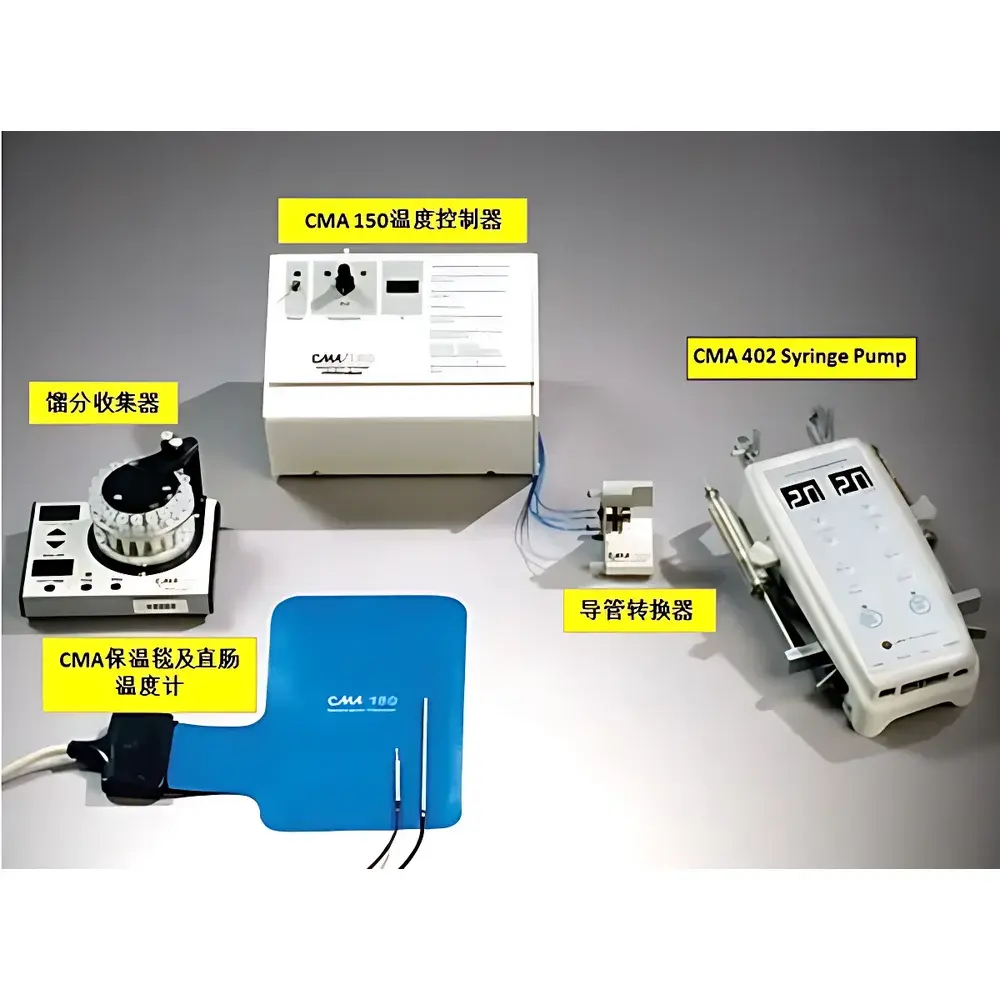
- Modular architecture enabling scalable integration of perfusion, temperature regulation, fraction collection, and fluid switching components
- CMA 402 Syringe Pump delivering stable, pulse-free infusion with programmable flow rates from 0.01 to 10.0 µL/min and high volumetric accuracy (±1.5% of set value)
- CMA 142 Microfraction Collector supporting time-resolved sample acquisition from one or two parallel microdialysis probes; configurable collection intervals (1–60 min) and volumes (0.5–50 µL per fraction)
- CMA 150 Temperature Controller with integrated rectal probe and heating blanket, maintaining normothermia in rodent models (mouse/rat variants available) during prolonged experiments—critical for metabolic stability and data reproducibility
- CMA 110 Liquid Switch enabling seamless, bubble-free switching between multiple syringes or probe lines without manual intervention or system priming
- All components designed for compliance with GLP-aligned workflows and validated for use in preclinical regulatory studies
Sample Compatibility & Compliance
The CMA Basic Microdialysis System accommodates standard microdialysis probes with molecular weight cutoffs ranging from 6–100 kDa (e.g., CMA 7, CMA 12, CMA 71). It supports aqueous-based perfusates including Ringer’s solution, artificial cerebrospinal fluid (aCSF), and custom formulations containing antioxidants or enzyme inhibitors. The system meets essential requirements for biosafety and experimental traceability: all hardware components are CE-marked and RoHS-compliant; software interfaces (when used with optional CMA Software Suite) support audit trails, user access control, and electronic signatures in accordance with FDA 21 CFR Part 11 guidelines. Experimental protocols align with ASTM E2913-21 (Standard Guide for Microdialysis Sampling in Preclinical Research) and ISO/IEC 17025 principles for method validation.
Software & Data Management
While the Basic configuration operates via standalone hardware controls, optional integration with the CMA Software Suite (v5.0+) enables centralized system orchestration, real-time pump monitoring, automated fraction timing, and metadata tagging (e.g., animal ID, probe location, drug administration timestamps). Data export is supported in CSV and XML formats for downstream analysis in MATLAB, GraphPad Prism, or Phoenix WinNonlin. All system logs—including pump run history, temperature deviations, and collector trigger events—are timestamped and stored locally with configurable retention policies, facilitating full experimental traceability and audit readiness.
Applications
- In vivo neurochemical monitoring during behavioral assays, drug challenge paradigms, or disease modeling (e.g., Parkinson’s, depression, epilepsy)
- Pharmacokinetic/pharmacodynamic (PK/PD) profiling of CNS-penetrant compounds with simultaneous plasma and brain dialysate sampling
- Real-time assessment of metabolic flux in peripheral tissues (e.g., skeletal muscle insulin response, adipose lipolysis)
- Validation of biomarker release kinetics in inflammation or ischemia-reperfusion models
- Method development for quantitative microdialysis assay validation per USP and EMA reflection papers on bioanalytical method validation
FAQ
What is the minimum recommended flow rate for stable microdialysis recovery?
For most small-molecule analytes in brain tissue, a flow rate of 0.3–1.0 µL/min is empirically optimized to balance recovery efficiency (>15–30%) and temporal resolution.
Can the CMA 142 collect fractions from two probes simultaneously?
Yes—the CMA 142 supports dual-probe input with independent tubing paths and synchronized fraction timing, preserving inter-probe comparability.
Is the CMA 150 Temperature Controller compatible with non-rodent species?
The controller’s analog output and sensor interface are adaptable to custom thermistor probes; however, normothermic setpoints and heating profiles must be validated per species-specific physiology.
Does the CMA 110 Liquid Switch require calibration or maintenance?
No routine calibration is required; it operates via precision stepper motor actuation and sealed fluid pathways—maintenance is limited to periodic tubing replacement per ICH Q5A recommendations.
How is system sterility ensured during chronic implantation studies?
All wetted components (tubing, connectors, probe interfaces) are autoclavable or single-use sterile; aseptic assembly protocols follow ISO 14644-1 Class 5 cleanroom practices for probe handling and perfusate preparation.