
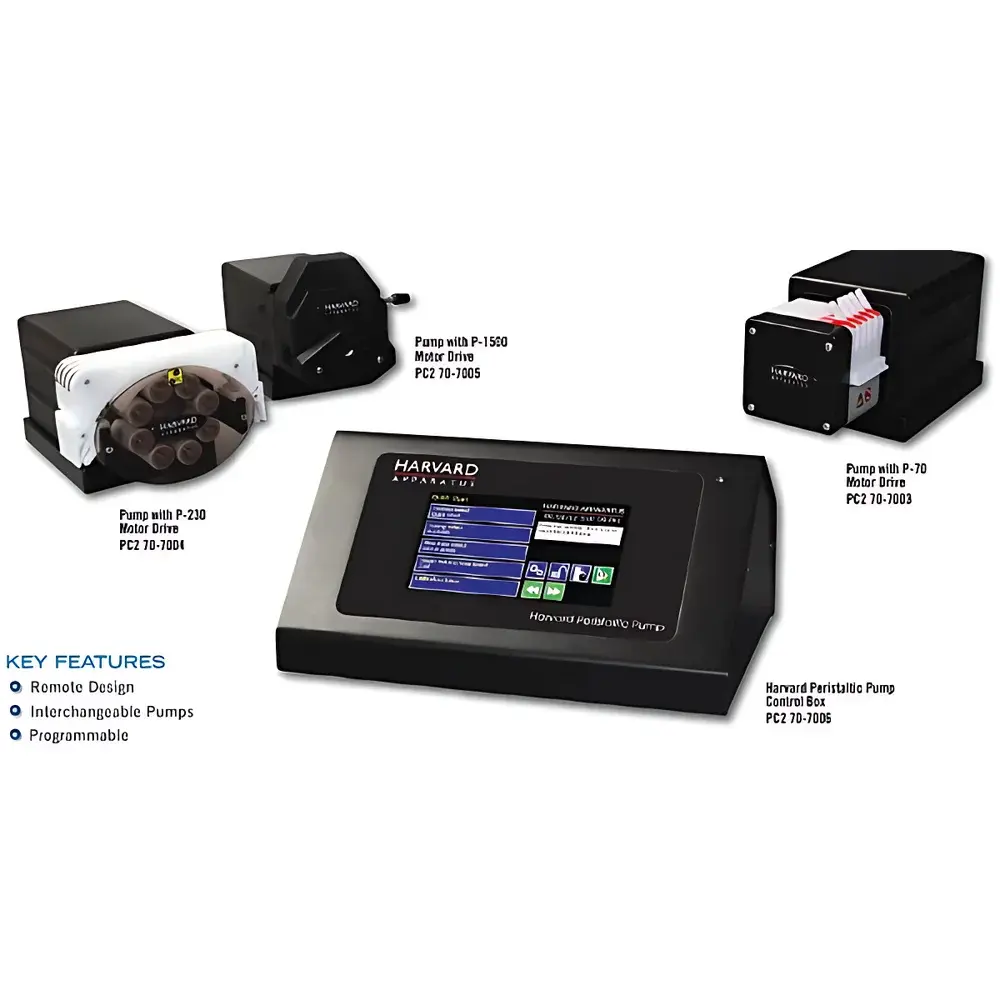
Harvard Apparatus PC2 Series Peristaltic Pumps
| Brand | Harvard Apparatus |
|---|---|
| Origin | USA |
| Manufacturer Type | Authorized Distributor |
| Import Status | Imported |
| Model | PC2 Series (P-70 / P-230 / P-1500 Motor Drives) |
| Flow Rate Range | 0.001–1500 mL/min |
| Speed Range | 50–100 rpm (P-70), 50–100 rpm (P-230), 50–100 rpm (P-1500) |
| Accuracy | ±1.0% |
| Tubing ID Compatibility | 0.13–4.8 mm |
| Rotor Configurations | 8-channel/5-roller, 8-channel/4-roller, 4-channel/1-roller |
| Interface | RS-232 serial, USB |
Overview
The Harvard Apparatus PC2 Series Peristaltic Pumps are precision-engineered fluid transfer systems designed for reproducible, pulse-free, and contamination-free operation in regulated laboratory environments. Based on the fundamental principle of peristalsis—where rollers compress flexible tubing to generate unidirectional flow—the PC2 platform eliminates fluid contact with pump mechanics, ensuring sample integrity and simplifying cleaning and validation protocols. These pumps are widely deployed in applications requiring precise volumetric delivery, including cell culture media perfusion, chromatography mobile phase delivery, dialysis circuit priming, and continuous infusion studies in preclinical research. The modular architecture supports three motor drive options (P-70, P-230, and P-1500), enabling users to select optimal flow capacity and tubing compatibility without compromising control fidelity or mechanical stability.
Key Features
- Three interchangeable motor drives: P-70 (up to 70 mL/min), P-230 (up to 230 mL/min), and P-1500 (up to 1500 mL/min), all operating within a consistent 50–100 rpm speed range for predictable torque response and low-speed resolution.
- High-accuracy flow control with ±1.0% volumetric accuracy across the full operating range, validated using gravimetric calibration methods traceable to NIST standards.
- Multiple rotor configurations: 8-channel/5-roller head for parallel low-flow applications; 8-channel/4-roller head for enhanced tubing life and reduced pulsation; 4-channel/1-roller head for high-flow single-line operation.
- Wide tubing compatibility: accommodates inner diameters from 0.13 mm to 4.8 mm, supporting standard PharMed® BPT, Tygon®, and silicone tubing compliant with USP Class VI and ISO 10993-5 specifications.
- Dual communication interfaces: RS-232 serial port for legacy integration with PLCs or older acquisition systems, and USB 2.0 for plug-and-play connectivity with modern Windows- and macOS-based control software.
- Robust aluminum housing with IP20-rated enclosure, designed for benchtop use in ISO Class 5–8 cleanrooms and GLP-compliant laboratories.
Sample Compatibility & Compliance
The PC2 Series is compatible with aqueous buffers, organic solvents (when paired with chemically resistant tubing), cell suspensions, and viscous media up to 500 cP. No internal valves, seals, or wetted metal components are present—fluid path is restricted exclusively to the selected tubing, enabling rapid changeover between incompatible reagents. The system meets requirements for routine use under Good Laboratory Practice (GLP) and current Good Manufacturing Practice (cGMP) frameworks. While not intrinsically FDA 21 CFR Part 11 compliant, audit-trail-capable software packages (e.g., Harvard’s PumpControl Suite v3.2+) support electronic record generation with user authentication, time-stamped event logging, and exportable CSV/Excel data files suitable for regulatory submissions.
Software & Data Management
Harvard Apparatus provides PumpControl Suite—a native Windows application that enables real-time flow rate adjustment, ramp profiling, multi-pump synchronization, and automated start/stop triggers based on external TTL or analog inputs. All commands and parameter changes are logged with timestamps and operator IDs. Export functions support .csv, .txt, and .xlsx formats for downstream statistical analysis in JMP, MATLAB, or Python-based workflows. For integration into larger automation platforms, ASCII command protocols over RS-232 or USB CDC emulate standard SCPI-like syntax, facilitating interoperability with LabVIEW, Python pySerial, or custom C# applications.
Applications
- Continuous perfusion of 3D bioreactors and organ-on-chip systems requiring stable sub-mL/min flow rates.
- Gradient elution in preparative HPLC and FPLC systems where backpressure tolerance and pulse dampening are critical.
- Automated sampling loops in environmental water analysis and pharmaceutical dissolution testing (USP ).
- In vivo microinfusion in rodent neuroscience models, leveraging low-flow precision and silent operation.
- Calibration of flow sensors and validation of mass flow controllers in metrology labs.
FAQ
What tubing sizes are supported across the three PC2 configurations?
The P-70 drive accepts tubing IDs from 0.13 mm to 2.79 mm; the P-230 supports 0.13–3.17 mm; the P-1500 accommodates 0.8–4.8 mm.
Is the ±1.0% accuracy specified at full scale or across the entire flow range?
Accuracy is maintained across the full calibrated range—from minimum programmable flow (e.g., 0.001 mL/min) to maximum rated output—for each motor/tubing combination, as verified per ASTM D3418.
Can multiple PC2 pumps be synchronized for coordinated flow delivery?
Yes—PumpControl Suite supports master-slave configuration via USB hub or daisy-chained RS-232, enabling phase-aligned start/stop and shared ramp profiles.
Does the PC2 Series include built-in flow sensing or pressure monitoring?
No—flow is controlled open-loop via calibrated roller speed and tubing geometry. Optional external flow meters (e.g., Bronkhorst EL-FLOW Select) may be integrated via analog input triggers.
Are replacement rotors and tubing guides available as consumables?
Yes—Harvard Apparatus supplies OEM-certified rotor assemblies (P/N PC2-ROTOR-5R, PC2-ROTOR-4R, PC2-ROTOR-1R) and alignment jigs for routine maintenance and recalibration verification.



